
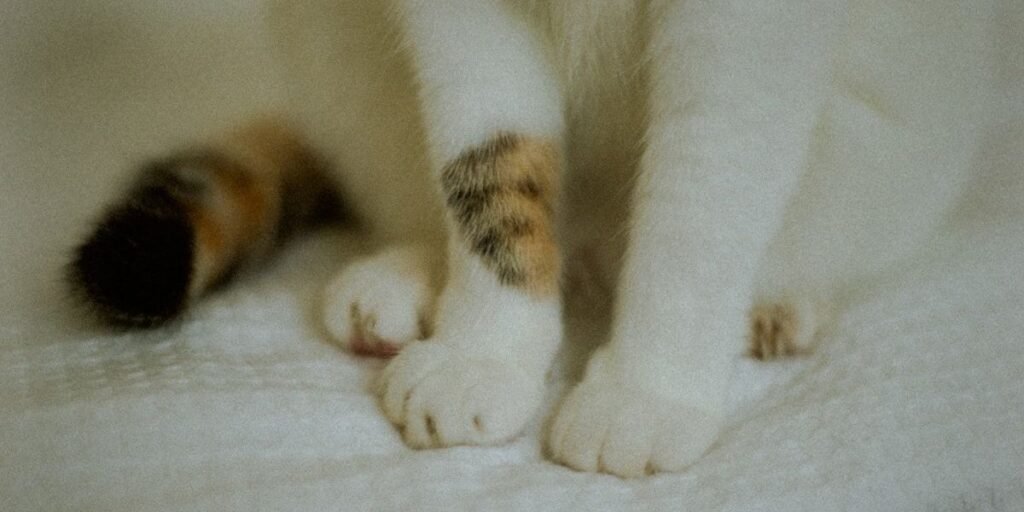

Cats make biscuits because kneading is a nursing instinct. Kittens press their paws against their mother’s belly to get milk flowing, and the motion stays wired to comfort for life. When an adult cat kneads your lap, it is running a program written in its first weeks and aiming it at the person it trusts. Several feline habits work like this, including the pull of a cardboard box.
Take it as the compliment it is, claw pricks included. A kneading cat is a settled cat. There are exactly two versions of this behavior worth a closer look, and both come with other signs attached; the rest is affection you can feel through your jeans.
What Making Biscuits Actually Looks Like
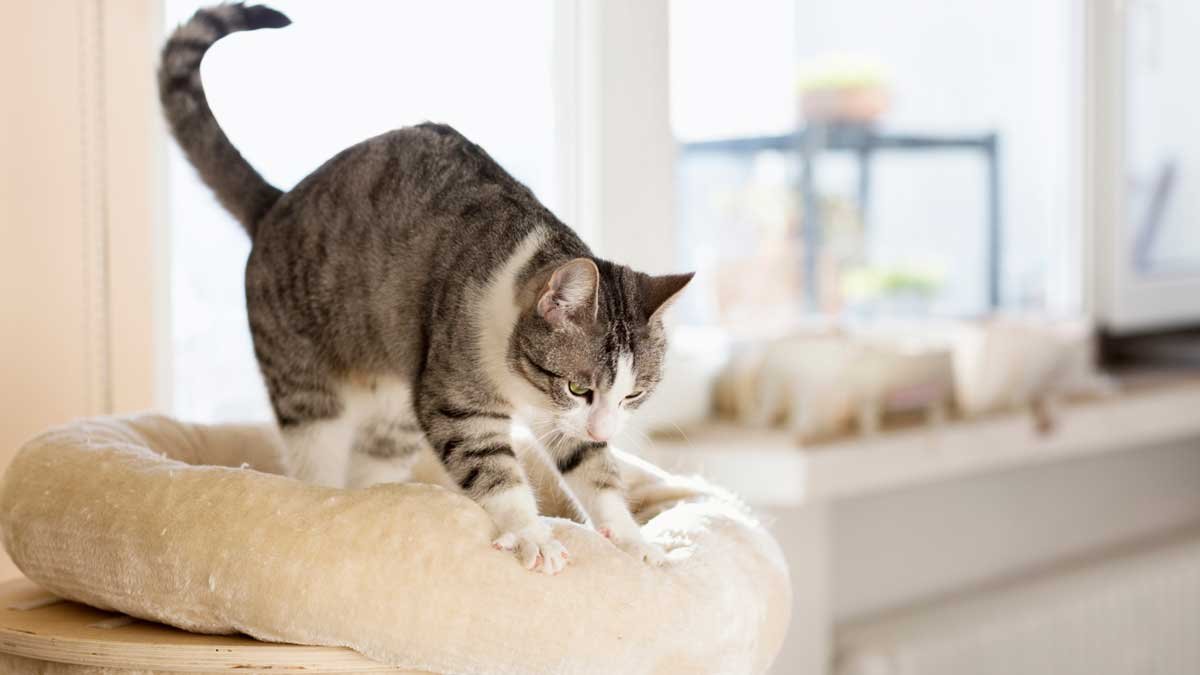
The motion is precise: the cat presses one front paw down, spreads its toes so the claws extend, then closes them as the paw lifts, alternating left and right every second or two. It looks exactly like a baker working dough, which is where the name comes from.
Cats only knead soft, pliant surfaces. On a hard floor the same impulse comes out as a stiff little march in place, with no claw action. The target matters: a wool blanket, a fleece hoodie, your stomach at eleven at night the moment you finally sit down under a throw.
The biscuit metaphor is American, and the rest of the world finds it as funny as we do. A thread asking other countries what they call it drew thousands of answers:
“In your language, what do you call this thing that cats do? As an American, we call it “making biscuits”!”
– r/AskTheWorld, October 2025 (4,706 upvotes)
Brazilians answered “amassar pão”, kneading bread. Portugal has adopted “fazer biscoitos” straight from English. One American baker in the thread pointed out the irony: knead actual biscuit dough that hard and you get tough, flat biscuits.
The Nursing Instinct That Starts It
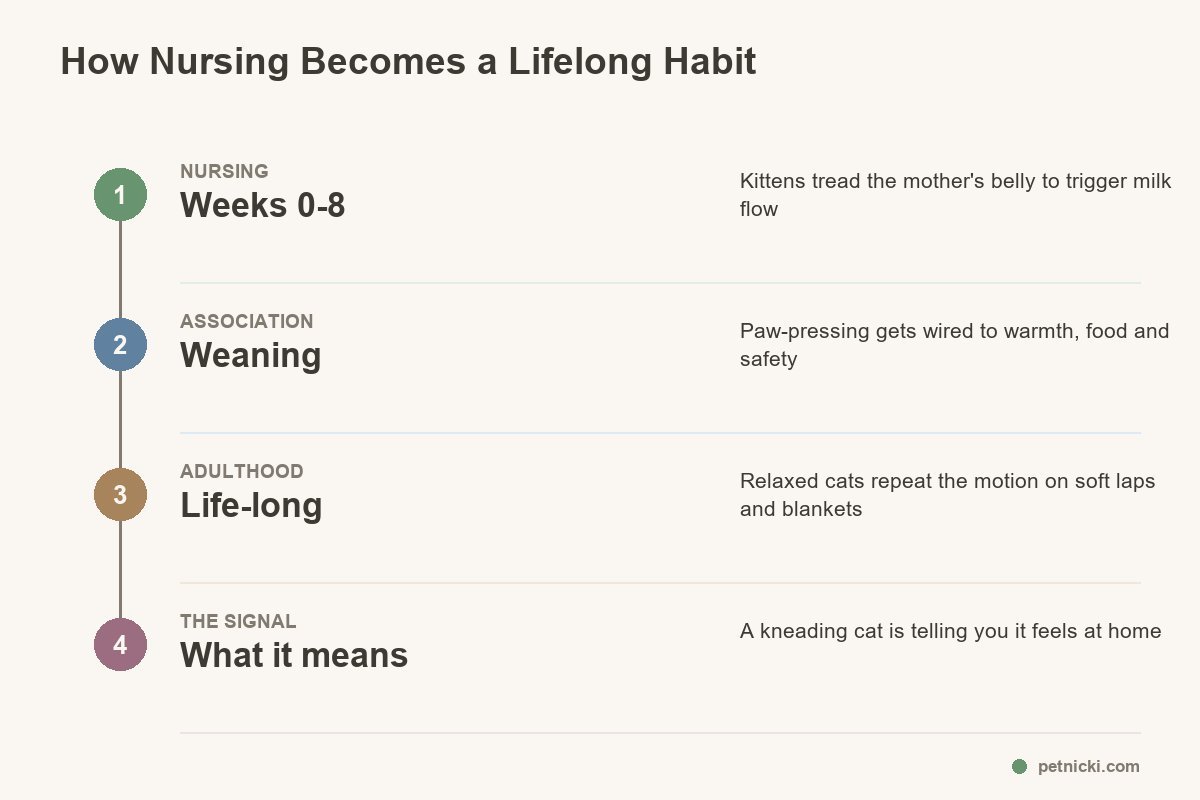
Newborn kittens tread their mother’s belly rhythmically while feeding. The pressure stimulates milk release, so the motion gets paired with food, warmth, and safety during the most dependent weeks of a cat’s life. Most behaviors from that stage fade after weaning. This one sticks, and it resurfaces whenever an adult cat feels the way it felt then.
That link explains a pattern veterinarians have noticed for decades. A review of separation anxiety in the Journal of the American Veterinary Medical Association connects early weaning to persistent suckling and kneading in adult cats: animals taken from their mothers too soon tend to knead more, and some pair it with sucking on blankets, ear lobes, or their own owner’s hands. That is the version owners ask about most, and we cover why cats bite the blanket while making biscuits separately, including how to tell it apart from fabric eating. The behavior fills in for the comfort that got cut short.
Purring runs on the same circuit. Cats purr most as nursing newborns, and most adult cats purr while they knead. The two behaviors grew up together, and they still travel together.
Beyond Comfort: Four More Reasons Cats Knead
The nursing origin is the anchor, but Scientific American’s review of the behavior lists several instincts that feed the same motion.
Trampling a nest
Wild ancestors of the house cat trod down grass and foliage to flatten a sleeping spot. Outdoor cats still leave round, cat-sized nests pressed into long grass. Your duvet gets the same treatment for the same reason: the kneading doubles as bed-making.
Scent marking
Cats carry scent glands between their paw pads. Every press deposits a signature other animals can read. A cat that kneads you is, among other things, labeling you as claimed territory, which is why multi-cat households sometimes see one cat re-knead a spot another cat just left.
A full-body stretch
Kneading works the shoulders, forelegs, and toes through their whole range of motion. Cats sleep up to 16 hours a day; some of the biscuit sessions right after waking are closer to yoga than to nostalgia.
Saying something to you
Behavior researcher John Bradshaw’s work on cat sociality treats kneading directed at humans as communication: the cat is reusing a signal from the mother-kitten bond to address its person. In plain terms, the cat has filed you under family.
Why Does Your Cat Make Biscuits on You?
A cat that kneads your chest, legs, or stomach is choosing warmth, your scent, and your heartbeat over every soft object in the house. It happens most when you are still and relaxed, which is also when the cat is winding down toward sleep, so many owners see biscuits as a bedtime ritual.
The chest is prime territory because it is warm, it rises and falls, and it smells most strongly of you. Legs and stomach win when a blanket is involved. A few cats aim for the face, which is flattering and terrible at the same time.
Intensity varies wildly from cat to cat, and strong kneading alone means nothing bad:
“This is my cat and she makes biscuits very aggressively and for long periods of time”
– r/cats, October 2025 (24,138 upvotes)
Twenty-four thousand people upvoted that clip because they recognized their own cat in it. Long, vigorous, drooling biscuit sessions are a personality trait, not a symptom.
When Kneading Is Not a Happy Signal
Kneading turns into information worth acting on in two situations: when it arrives with heat behavior in an unspayed female, and when a cat’s kneading pattern changes sharply for no visible reason. Everything else on this list is normal variation.
Unspayed females knead more while in heat, as part of nesting instinct, and pair it with yowling and restlessness. Anxious cats also knead to self-soothe after a move, a new pet, or a schedule change; the behavior itself is healthy coping, but the stressor deserves attention. And per PetMD, a sudden spike in kneading can accompany discomfort or illness, especially in older cats.
| Normal kneading | Worth a vet call |
|---|---|
| Happens when the cat is relaxed, before naps or on your lap | Starts or spikes suddenly with no change in routine |
| Comes with purring, slow blinks, loose body | Comes with agitation, yowling, or hiding |
| Includes some blanket sucking in early-weaned cats | Fabric sucking that turns into chewing and swallowing cloth |
| Intense and long in some cats, brief in others | An unspayed female kneading plus heat signs, if kittens are not the plan |
The fabric-swallowing case is the one with real stakes: eaten cloth can block a cat’s intestine. A cat that merely sucks a blanket while kneading is comforting itself; a cat that eats the blanket needs the habit managed and a vet consulted.
Living With the Claws
You do not train kneading away, and punishing it backfires, because the cat is expressing trust. You manage the hardware instead.
- Trim the front claws every couple of weeks; blunt tips turn biscuits from acupuncture into massage.
- Keep a dedicated thick blanket where the cat usually kneads you, and slide it into place when the paws start.
- If the spot hurts, lift the cat gently onto a cushion beside you and pet it there. It keeps the ritual and moves the needles.
A cat interrupted mid-knead will often just relocate and restart, so the blanket beats eviction.
FAQ: Making Biscuits
Are cats happy when they are making biscuits?
Yes, kneading cats are content in nearly every case, and the purring that accompanies it confirms the mood. The exceptions announce themselves with other signs: heat behavior in unspayed females, or agitation after a sudden change at home.
Should I pet my cat while it kneads?
Pet a kneading cat if it leans into your hand; stop if the kneading pauses. Slow strokes along the back extend the calm. Grabbing the paws interrupts a comfort behavior mid-loop, and most cats will simply leave.
Do all cats make biscuits?
No, some cats never knead, and that says nothing about their bond with you. Affection shows up in other channels: following you between rooms, slow blinks, sleeping pressed against your leg. Early-weaned cats tend to knead most; some well-adjusted cats skip it entirely.
What is the 3-3-3 rule for cats?
The 3-3-3 rule is an adoption guideline: a rescued cat needs about 3 days to stop hiding, 3 weeks to learn the routine, and 3 months to feel at home. Kneading often appears near the end of that curve, and a new rescue making its first biscuits is a milestone worth noticing.