


If you’ve ever looked at your dog and wondered how old they’d be if they were a person, you’re not alone. It’s one of the most common questions dog owners ask. The old “multiply by 7” rule you grew up with isn’t accurate, and this dog age chart shows you why.
Below, you’ll find a full dog years to human years breakdown, a size-based chart, and the vet-backed reasoning behind the numbers. We’ll also cover puppy age, senior dog thresholds, and how to estimate age if you don’t know your dog’s birthday. For owners further along that road, we also cover the signs that a dog is nearing the end.
Knowing your dog’s real age in human terms makes it easier to plan food, exercise, and vet visits around the right life stage. It also helps you spot early signs of aging before they become bigger problems.
A dog age chart converts a dog’s actual age into the equivalent human age, based on breed size and life stage. Dogs age faster in their first two years, then slow down. A small dog at 10 years old is roughly 56 in human years, while a large dog the same age is closer to 66.
Why the “1 Year Equals 7 Years” Rule Is Wrong
The old 7-year rule assumes dogs age at a steady pace their whole life. They don’t.
A one year old dog isn’t 7 in human years. Vets estimate a one year old dog is closer to 15, since dogs reach physical and sexual maturity fast.
After that first year, aging slows down. It also splits by size. Small breeds age slower overall and live longer. Large breeds age faster once they pass middle age.
Why Breed Size Changes the Math
It seems backward at first. Bigger dogs should live longer, right? In dogs, it works the opposite way.
Large and giant breeds grow fast, which puts more strain on their bodies over time. Their cells divide faster during growth, and researchers believe this may speed up aging later in life.
Small breeds grow slower and reach full size later relative to their total lifespan. That slower start seems to pay off with a longer, slower aging curve overall.
This is why a single flat “7 years” rule never worked. A Great Dane and a Chihuahua simply don’t age on the same timeline, even if they’re born the same week.
Dog Age Chart by Size
Breed size changes the math a lot. Here’s a general breakdown for adult dogs.
Small dogs (under 20 lbs):
- 1 year = 15 human years
- 5 years = 36 human years
- 10 years = 56 human years
- 15 years = 76 human years
Medium dogs (21 to 50 lbs):
- 1 year = 15 human years
- 5 years = 37 human years
- 10 years = 60 human years
- 15 years = 83 human years
Large dogs (51 to 90 lbs):
- 1 year = 15 human years
- 5 years = 40 human years
- 10 years = 66 human years
- 15 years = 93 human years
These numbers are estimates, not exact science. Genetics, health history, and daily care all play a role in how a dog ages.
If you want a closer look at how age and weight track together in the early months, this puppy growth chart by age and weight breaks it down week by week.
Full Dog Years to Human Years Chart
Here’s a general dog year conversion chart for an average, medium-sized dog:
| Dog’s Age | Human Years |
|---|---|
| 1 year | 15 |
| 2 years | 24 |
| 3 years | 28 |
| 4 years | 32 |
| 5 years | 36 |
| 6 years | 40 |
| 7 years | 44 |
| 8 years | 48 |
| 9 years | 52 |
| 10 years | 56 |
| 12 years | 64 |
| 14 years | 72 |
| 16 years | 80 |
Use the size chart above to adjust these numbers up or down for small and large breeds.
Puppy Age Chart: How Fast Do Puppies Age

Puppies don’t follow the adult formula at all. In their first year, they pack in years of growth in just weeks.
A 6 month old puppy is already close to the human equivalent of a young teenager. By their first birthday, most puppies have hit adult height and are sexually mature.
Growth speed also depends on breed size. Small breed puppies usually finish growing by 9 to 12 months. Large breed puppies can keep growing until 18 to 24 months.
Growth plates in a puppy’s bones stay open until growth is finished. This is part of why large breed puppies need to grow slower and steadier. Rapid weight gain during this window can stress joints that are still developing.
Feeding also shifts fast during puppyhood. Puppies typically eat 3 to 4 small meals a day, then move down to 2 meals once they’re closer to their adult size.
Staying on top of a puppy’s early health checks matters here too. A pet vaccination schedule lines up with these fast early growth stages, so it’s worth reading alongside this chart.
When Is a Dog Considered an Adult, or a Senior?
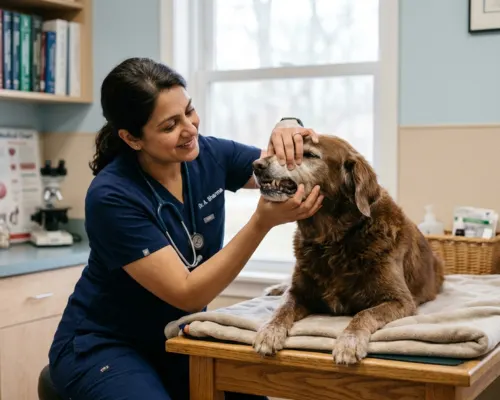
Most dogs are considered adults once they pass one year old, though large breeds may take a bit longer to finish growing.
Senior status depends on size too. Small dogs are often considered senior around 10 to 12 years old. Large breeds can be considered senior as early as 6 to 7 years old, since their lifespans are shorter overall.
Once a dog reaches their senior years, weight and joint health become bigger factors. A pet weight management guide can help you adjust food and activity as your dog ages into these later stages.
[https://www.zoetisus.com/content/_assets/pdf/Understand-Your-Dogs-Age.pdf]
Here’s a simple breakdown of the three main life stages:
- Puppy: Birth to 1 year (small and medium breeds), birth to 18 to 24 months (large and giant breeds)
- Adult: 1 to 6 years for most dogs, later for large breeds
- Senior: 6 to 7 years and up for large breeds, 10 to 12 years and up for small breeds
These ranges shift slightly by breed, but they give you a solid starting point for planning vet checkups and diet changes.
How to Tell Your Dog’s Age If You Don’t Know It
Rescue dogs and strays don’t come with a birth certificate. Vets look at a few physical clues instead.
- Teeth condition. Yellowing, tartar buildup, and wear patterns hint at age ranges.
- Eye clarity. Cloudiness in the lens often shows up in dogs over 8.
- Coat and muzzle color. Gray hairs around the muzzle usually start in the senior years.
- Muscle tone and mobility. Stiffness or muscle loss points toward an older dog.
None of these signs give an exact number. A vet exam is still the most reliable way to get a real estimate.
Shelters and rescues often estimate age using a combination of these signs plus general health and behavior. It’s common for a rescue dog’s listed age to be off by a year or two in either direction, so treat it as a rough guide rather than a fixed fact.
The Bottom Line
A dog age chart gives you a helpful estimate, not an exact science. Size, breed, and health all shape how fast your dog actually ages.
Use the size-based chart above as your starting point, and check in with your vet as your dog moves through each life stage. Understanding where your dog stands helps you plan the right food, exercise, and checkups for whatever stage comes next.
Image Suggestions
- Image: A side-by-side chart graphic showing small, medium, and large dog silhouettes with their age conversions. Alt text: “Dog age chart comparing small, medium, and large breed human years”
- Image: A photo of a puppy next to an adult dog of the same breed. Alt text: “Puppy age chart showing growth difference between puppy and adult dog”
- Image: A vet gently checking a senior dog’s teeth or eyes. Alt text: “Vet checking signs of aging in a senior dog”
- Image: A simple table graphic of the dog years to human years chart from the article. Alt text: “Dog years to human years conversion chart table”
FAQ Section (FAQ Schema Ready)
How old is my dog in human years? It depends on size and age. A 5 year old medium dog is roughly 36 in human years, but small and large breeds shift that number up or down.
Is the “1 dog year equals 7 human years” rule accurate? No. Dogs age much faster in their first two years, then slow down. The 7-year rule doesn’t reflect real aging patterns.
At what age is a dog considered a senior? Small breeds are usually senior around 10 to 12 years old. Large breeds often reach senior status by 6 to 7 years old.
Do small dogs really live longer than large dogs? Yes, generally. Small breeds tend to live longer and age more slowly than large or giant breeds.
How can I estimate my rescue dog’s age? A vet can check teeth wear, eye clarity, coat graying, and muscle tone to estimate an age range, though it won’t be exact.
How fast do puppies age compared to adult dogs? Puppies age much faster early on. Many hit adult height and sexual maturity within their first year, especially small and medium breeds.