
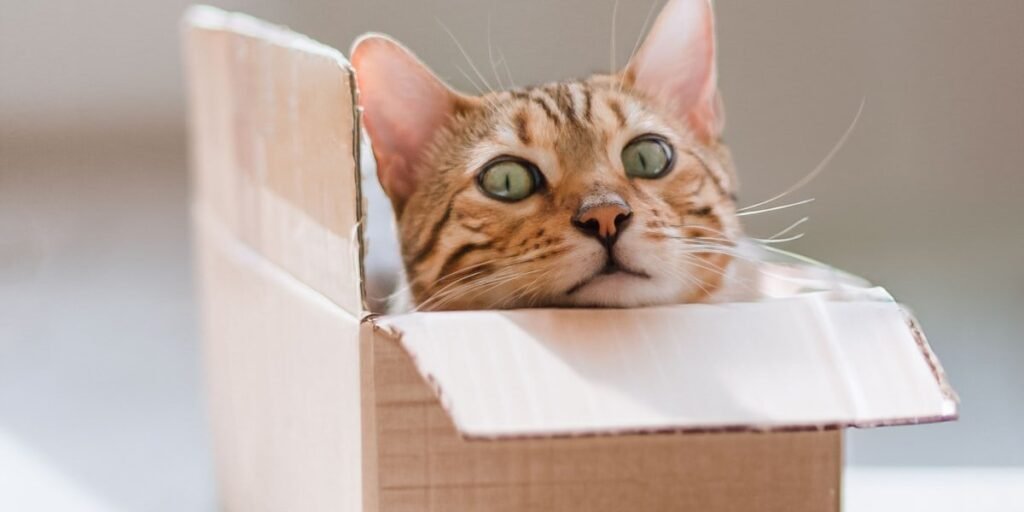

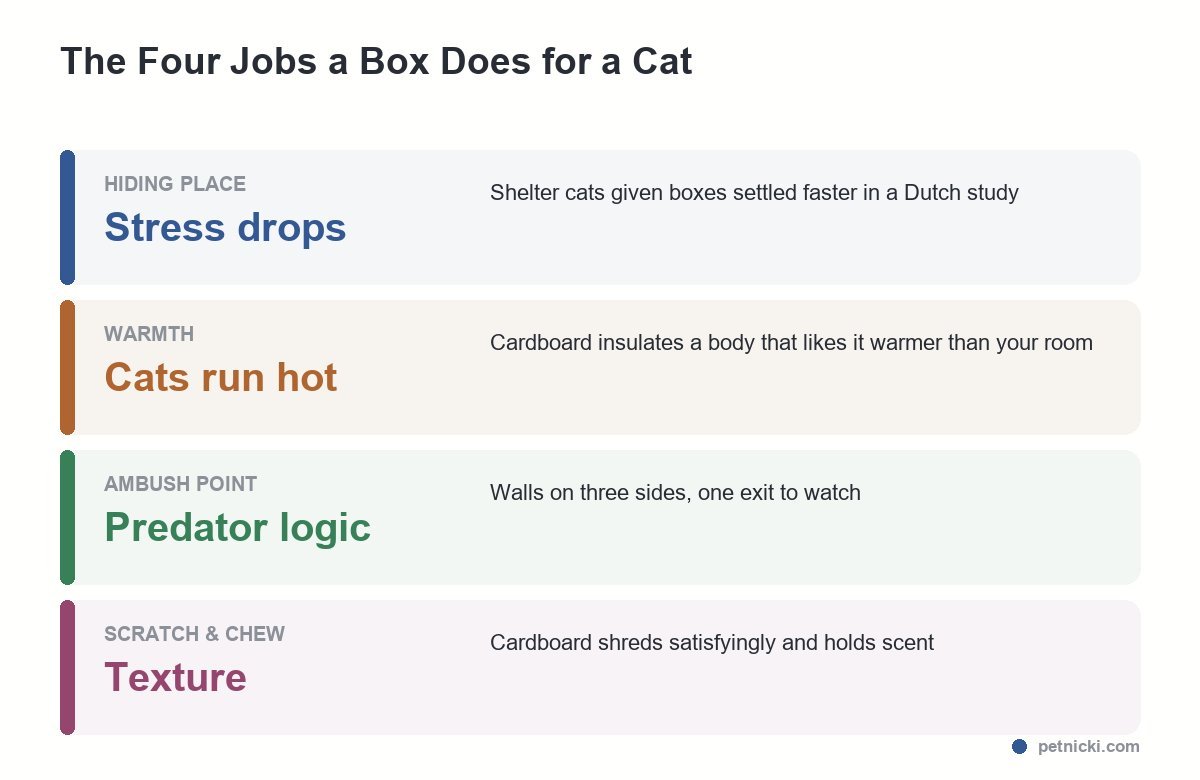
Cats like boxes because a box solves four problems at once: it hides them, warms them, gives them an ambush point, and offers a texture worth scratching. The stress-relief part is measured, not folklore; shelter researchers in the Netherlands found that new cats given a hiding box adapted faster than cats without one. Everything else about the behavior, down to cats sitting inside a square taped on the floor, follows from those four jobs.
The science comes first, because it is better than most cat science; the taped-square experiment and the practical uses follow.
The Box Study That Settled It
The clearest evidence comes from a Dutch animal shelter, in a study published in PLOS ONE. Researchers gave some newly arrived cats a hiding box and left others without; the cats with boxes showed lower stress scores and adjusted to the shelter noticeably faster in their first days. A box, in other words, is not a toy for a stressed cat. It is a coping tool, and it works quickly enough to be measurable.
That is the same principle behind every cat that vanishes into a box the day you move house or bring home a puppy: the box is a place where the new thing cannot reach.
The Four Jobs a Box Does
Hiding
Cats are small predators that are also prey, and their default response to uncertainty is to remove themselves from view. A box offers walls on three sides and one opening to monitor, which is exactly the geometry a cat wants when it does not know what happens next.
Warmth
Per PetMD’s summary of the research, cats are most comfortable at ambient temperatures well above what most homes are kept at, roughly the mid-80s to mid-90s Fahrenheit against a typical 72-degree room. Cardboard insulates and a box traps body heat, so a cat curled in one is running a small personal furnace. This is also why boxes near radiators and in sun patches get the most use.
Ambush
A box is a hunting blind. Cats stalk from cover, and a box at ankle height with a cat inside it is a trap set for whatever walks past, including your feet. The pounce-out-of-the-box move is play, but the instinct being rehearsed is the real one.
Texture
Cardboard scratches well, shreds satisfyingly, and holds scent from cheek-rubbing, which is why cardboard scratchers exist as a product category and why some cats chew boxes as well as sit in them.
The Taped Square on the Floor
The strangest evidence for how deep the box instinct runs is that a cat does not need the box. Tape a square outline on the floor and a fair share of cats will sit inside it; the effect held even when researchers used a Kanizsa square, an optical illusion where the square exists only as an implied shape between four notched circles, in a study published in Applied Animal Behaviour Science. Cats sat in the imaginary square at rates comparable to a real one.
The Kanizsa illusion works on humans because our visual system completes edges that are not there; the study suggests cats’ brains do the same, and that once a boundary is perceived, the urge to be inside it kicks in. A border, real or implied, reads as a place with an inside, and inside is where a cat wants to be.
Why the Box Beats the Bed You Bought
The expensive bed loses to the shipping box for reasons that follow from the four jobs. Most cat beds are open, so they hide nothing. Plush fabric insulates less than a snug cardboard wall. A bed on the floor in the middle of a room has no ambush geometry. And the bed does not smell like anything yet, while a box the cat has been in for an hour smells like the cat.
The fix is not a better bed but a better-placed one: put the bed inside a box, or choose an enclosed cave-style bed, or simply put a box where the cat already likes to sit and stop fighting the market. Some cats also transfer their loyalty to the bathroom sink for the same walled-in reason, which explains a great deal about mornings.
When Box-Sitting Is a Signal
Liking boxes is normal; living in one is information. A cat that suddenly spends most of its day hidden, stops coming out for food or greetings, or retreats to a box after being social for years is telling you something changed, either in the household or in its body. Hiding is one of the first behaviors to shift when a cat is in pain, so a box habit that appears overnight in an older cat earns a vet visit, the same way a sudden change in kneading or a new spate of sneezing would.
FAQ: Cats and Boxes
Is it normal for cats to like boxes?
Yes, box-sitting is one of the most universal cat behaviors, driven by the security, warmth, and ambush cover a box provides. It is normal at any age; only a sudden shift toward constant hiding is worth a closer look.
Can boxes relieve a cat’s stress?
Yes, measurably: shelter cats given a hiding box in the Dutch PLOS ONE study showed lower stress and adapted faster than cats without one. For a cat facing a move, a new pet, or fireworks, a box in a quiet room is one of the cheapest interventions available.
What is a red flag behavior in cats?
Sudden, sustained hiding in a previously social cat is a red flag, along with stopping eating, litter box changes, and new aggression. Any of those appearing abruptly, rather than as long-standing personality, warrants a vet check.
What is the 3-3-3 rule for cats?
The 3-3-3 rule is an adoption guideline: about 3 days to stop hiding, 3 weeks to learn the routine, 3 months to feel at home. A box in the first 3 days is exactly the tool the shelter study endorses; give a new cat one and let it choose when to come out.