
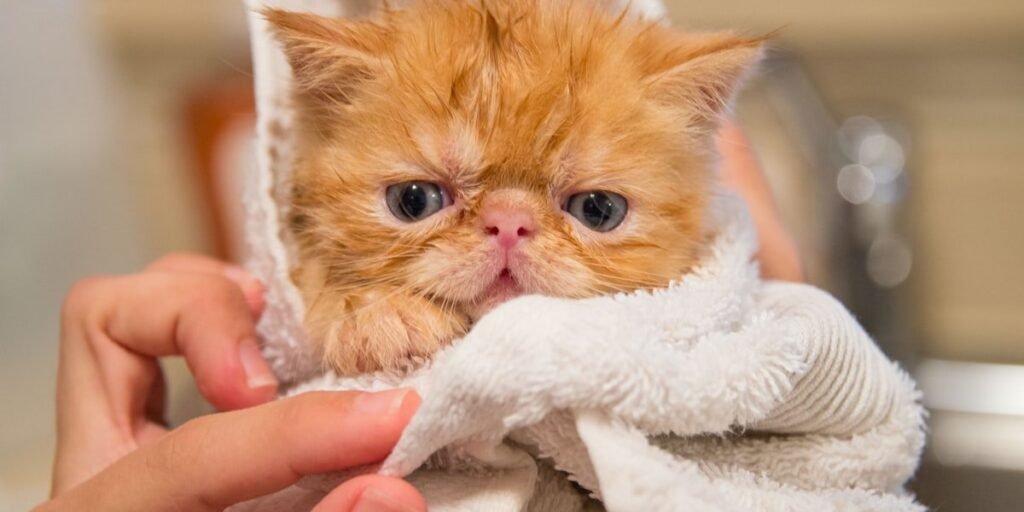

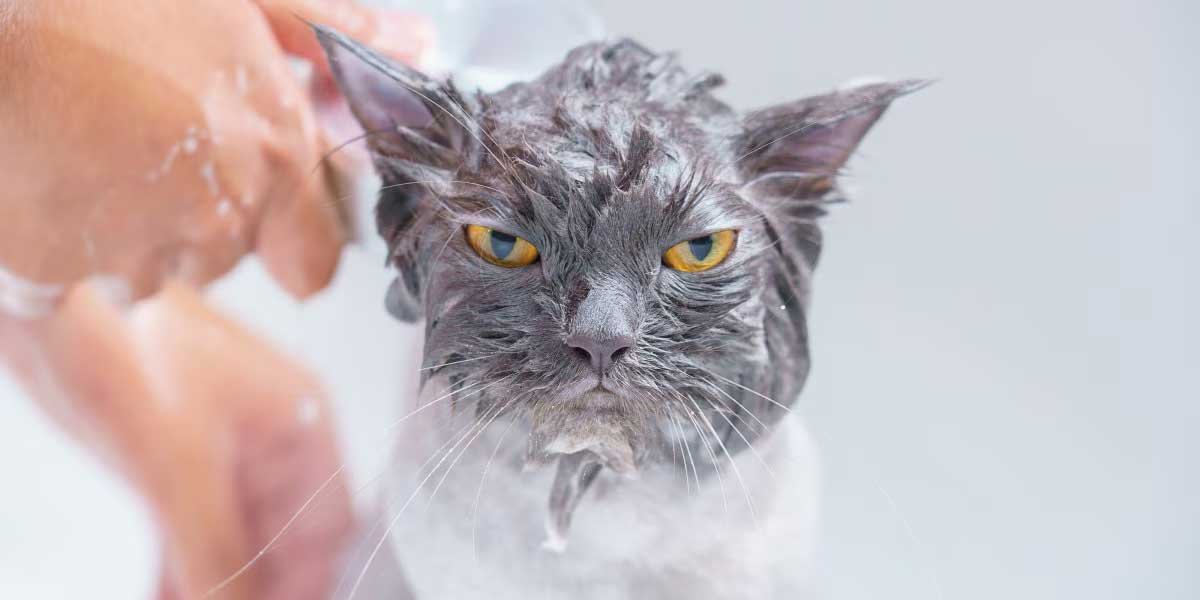
Cats hate water mainly because wet fur is heavy, cold, and slow to dry, which for an animal built on speed and stealth feels like a trap. Add a lineage that evolved in dry country, a coat that soaks instead of sheds water, and a lifetime of never being asked to swim, and the bathroom standoff makes complete sense from the cat’s side.
The hatred is real but not universal: some breeds swim on purpose, most cats will drink from a running tap for hours, and tigers lounge in rivers. The exceptions explain the rule better than the rule does, so both get their space.
The Wet Fur Problem
A cat’s coat is built for insulation, not for water. It absorbs instead of repelling, so a soaked cat carries a heavy, clinging layer that takes hours to dry and, per PetMD’s explanation of the behavior, drains body heat fast enough that a small wet cat can slide toward hypothermia. Weighed down, chilled, and unable to move at full speed, a wet cat is a compromised cat, and cats do not volunteer to be compromised.
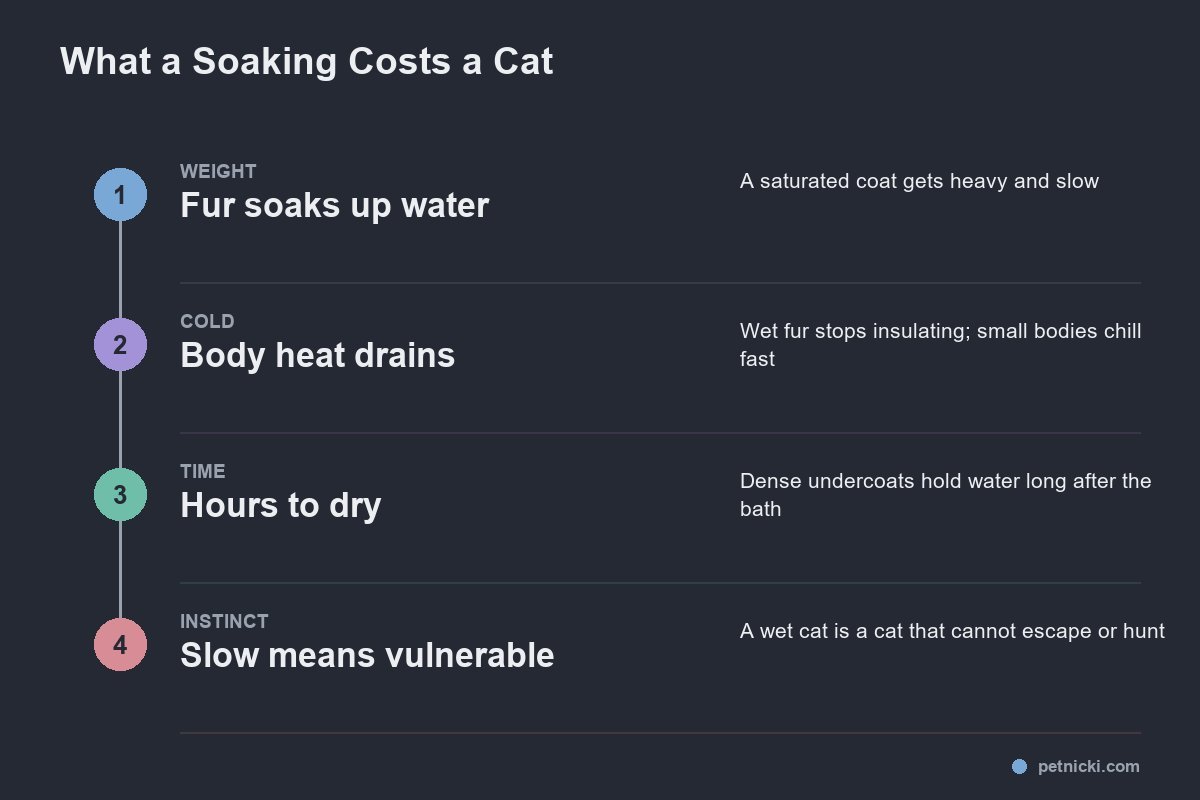
Cat owners land on the same explanation without a textbook:
“I think domestic cats hate it because their fur gets really heavy and then they get cold and because they’ve got thick fur it takes a long time for it to dry. More of a sensory thing I assume.”
– r/biology, June 2026 (75 upvotes)
A Desert Animal at Heart
The house cat descends from the African wildcat, a small predator of arid scrub and semi-desert, and that ancestry left almost no evolutionary reason to swim. Dogs were bred from wolves that hunted along rivers and were then selected for retrieving ducks out of ponds; cats were selected for killing mice in grain stores. One lineage got ten thousand years of practice around water. The other got none, and it shows the first time you fill a tub.
Cats also drink strangely for the same reason. Desert ancestors got most of their water from prey, and modern cats still under-drink from still bowls, which is why so many prefer a running tap or a fountain: moving water reads as fresh, and standing water reads as suspect.
Loss of Control
The physical discomfort is only half of it. A cat in water cannot use its claws, cannot grip, cannot bolt, and cannot groom the wet off fast enough (grooming, like licking a bonded cat, is how a cat resets after stress). Every one of those is a control mechanism, and cats organize their lives around control, the same reason a cat kneads only where it feels safe. Add the noise of a running faucet, the slick tub surface, and a human holding them in place, and the bath is less about water than about being overpowered.
Which is why the “make the water warm” fix so rarely works. Owners who tried it report the same result: the cat still hated it, because the temperature was never the objection.
The Cats That Like Water
Certain breeds break the rule on purpose. The Turkish Van is nicknamed the swimming cat, with a water-resistant coat texture from the lake region it comes from; Maine Coons and Bengals are famous for paw-splashing in bowls and joining showers; and plenty of unremarkable house cats decide on their own that the bath is a fine place to sit:
“Its anecdotal but the three cats I had did not mind water. One used to join me in the bath given half a chance.”
– r/biology, June 2026 (22 upvotes)
Early exposure matters most. Kittens introduced to shallow warm water gently, with an escape route, often grow into cats that tolerate baths; adult cats meeting water for the first time at the vet almost never do. Individual temperament does the rest, the same variance that makes one cat a lap cat and its littermate a ghost.
Why Tigers Don’t Mind
Big cats break the rule for a different reason: they live somewhere hot. Tigers and jaguars evolved in humid forests and wetlands, where a river is cooling relief and a hunting ground, so swimming carries reward instead of risk. Lions, from the dry savanna, are as water-averse as house cats. The pattern is climate, not size; a cat likes water in proportion to how much its ancestors needed it.
Do Cats Even Need Baths?
Rarely. Cats spend a large share of their waking hours grooming and keep themselves cleaner than most dogs, so a healthy shorthair may go its whole life without a bath. The exceptions are real: something toxic or sticky on the coat, a long-haired cat with a hygiene problem, a senior or overweight cat that can no longer reach, or a flea treatment that requires it. Outside those, the standoff is one you can simply decline to have; a damp cloth and a good brush cover most of what a bath would.
FAQ: Cats and Water
Why is a cat so afraid of water?
Wet fur is heavy, cold, and slow to dry, and a wet cat loses the speed and grip it relies on for safety; that sensory and control loss reads as danger. Cats descended from desert ancestors and never evolved a reason to swim, so nothing in the instinct kit offsets the discomfort.
Is it bad for cats to be wet?
Being wet is not harmful by itself, but a soaked cat chills quickly and can slip toward hypothermia if left cold, especially kittens, seniors, and thin cats. Towel-dry immediately and keep a wet cat warm until the coat is dry, which can take hours in longhairs.
What annoys cats the most?
Loss of control tops the list: being held, being wet, loud sudden noises, and being stared at or pointed at directly. Water combines several of those at once, which is why baths rank near the top of a cat’s grievances.
What is the 3-3-3 rule for cats?
The 3-3-3 rule is an adoption guideline: a rescued cat needs about 3 days to stop hiding, 3 weeks to learn the routine, and 3 months to feel at home. It has nothing to do with water, though a cat still in its first 3 days is the worst possible candidate for a bath.