
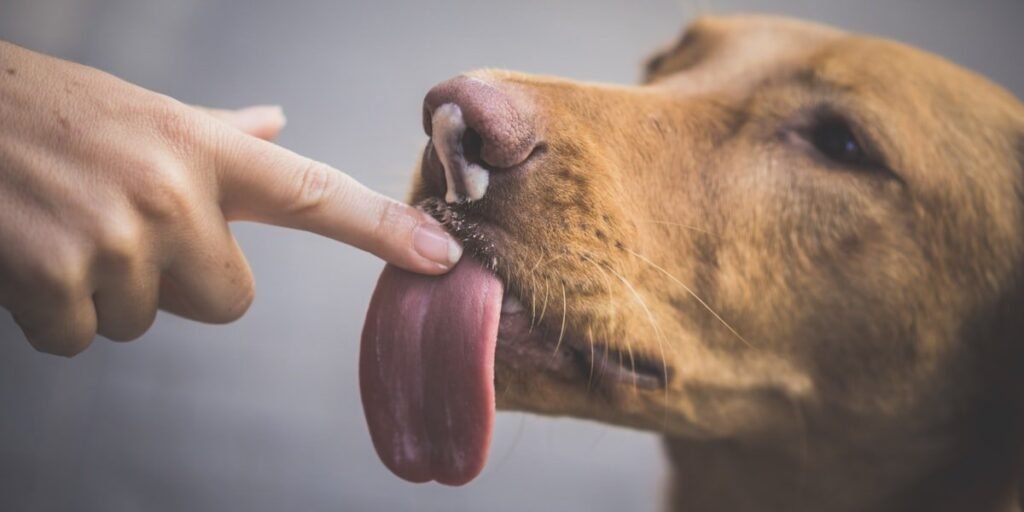

Dogs lick you for affection, taste, attention, and comfort. Most of the time the lick is a compliment: you are the favorite surface in the house, you taste faintly of salt and lunch, and licking you has reliably produced a reaction every single time. The amount matters less than the pattern, the same way grass eating is normal in small doses and a signal in large ones; a dog that has always been licky is a personality, and a dog that suddenly became licky is sending a different message.
The fastest way to read your dog is by when the licking happens, so that decoder comes first. The reasons, the science, and the polite way to reduce it follow.
What the Timing Tells You
The timing of a lick narrows its meaning faster than anything else: petting-time licks are grooming, homecoming licks are greeting, nighttime licks are self-soothing, and a sudden change in the pattern is the only version that points at a problem.
| When the licking happens | Most likely meaning | What to do |
|---|---|---|
| When you pet or stroke her | Reciprocal grooming; she is grooming you back | Nothing, this is social bonding |
| The moment you get home | Greeting plus information gathering: where you went, what you ate | Let it run a minute; it fades with the excitement |
| At night or while you cuddle | Self-soothing wind-down, like a child’s thumb | Fine unless it keeps you awake; redirect to a chew |
| In the morning | You are salty, warm, and finally awake; also breakfast lobbying | Feed on schedule, not in response to licks |
| After you exercise | Sweat is genuinely tasty to a dog | Harmless; wash before applying lotions |
| Suddenly, constantly, or frantically | Stress, nausea, allergies, or pain until proven otherwise | Note other changes and call the vet |
The last row is the only one with stakes, and it gets its own section below.
Reason One: You Taste Genuinely Good
Skin carries salt, traces of everything you touched today, and for a dog’s nose, a full activity log. Per the American Kennel Club, taste and smell exploration is one of the core reasons dogs lick people; your hands after cooking are, from the dog’s side of things, a menu to be read. Post-workout skin and freshly moisturized skin both spike the licking for the same reason, though lotions and sunscreens are worth interrupting since some ingredients are not dog-safe.
Reason Two: Licking Is Baked-In Communication
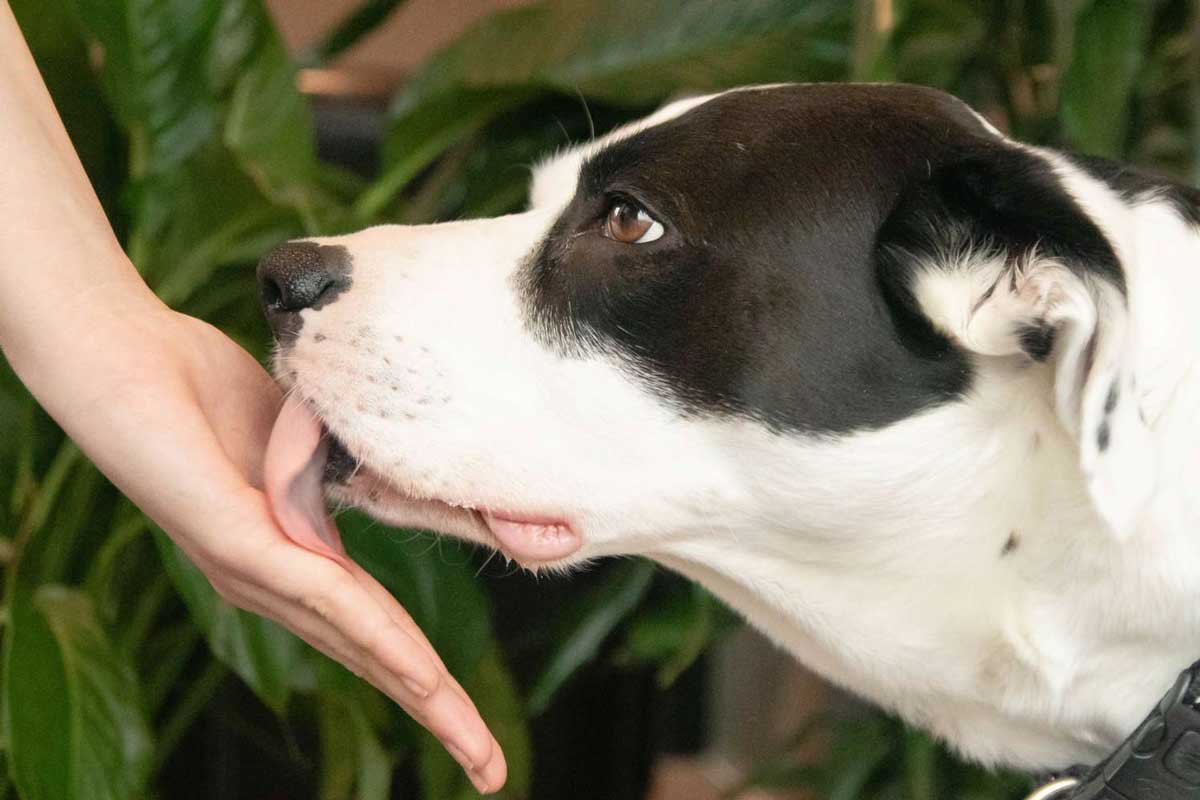
Licking starts at birth. Mother dogs lick puppies to stimulate and clean them; puppies lick their mother’s mouth, a behavior inherited from wild canids where it prompts her to regurgitate food. Out of that history, adult dogs keep licking as a social tool: greeting, deference to someone they consider senior, and plain affection. When your dog aims it at your face and pairs it with a loose, wiggly body, it is the closest thing dogs have to a kiss, and the AKC lists affection as the most common driver.
Deference licking looks slightly different: lower body posture, ears back, softer eyes. Nothing is wrong; your dog is being polite in fluent dog.
Reason Three: It Works on You Every Time
Think about what happens in the two seconds after a lick. You laugh, you talk to the dog, you pet the dog, or you push the dog away while saying its name. Every one of those is attention, and attention is the paycheck.
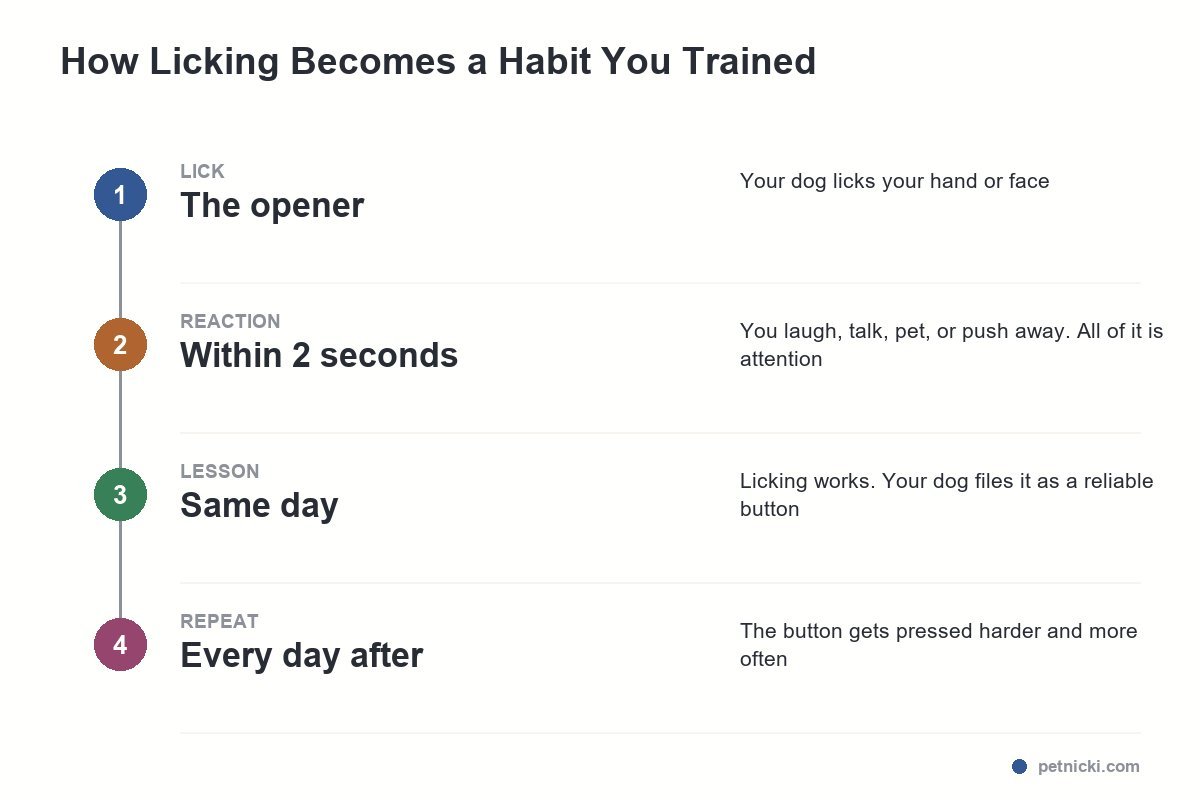
This is why licky dogs get lickier over the years. It is also the honest answer to why your dog licks you more than anyone else in the house: you react the most, and you smell the most like the person who feeds them.
When Licking Is a Symptom
A sharp change in licking is information. PetMD’s guide to excessive licking puts allergies, skin problems, pain, and nausea on the medical side of the list, and anxiety on the behavioral side; the Merck Veterinary Manual classifies truly relentless licking among compulsive behaviors that deserve a workup rather than scolding.
Worth a vet call: licking that starts suddenly in a dog that never did it, licking paired with lip-smacking or drooling (a nausea tell, especially if appetite drops too), frantic licking of you plus the air or the floor, and licking that your dog cannot be interrupted out of. If the target is their own paws instead of you, that is a different problem with its own causes, covered in our guide to constant paw licking.
Senior dogs earn one extra note: new, repetitive licking in an older dog can accompany cognitive decline, and it is worth mentioning at the next checkup even if everything else seems normal.
How to Dial It Down Without Punishing
You are allowed to dislike being licked by a healthy, happy dog. The fix is management, not correction, because punishing a bonding behavior confuses the dog without removing the motivation.
- Go still and neutral when the licking starts; the loop starves without a reaction.
- Stand up and walk away for ten seconds if it continues. Return calmly. Dogs read this fast.
- Give the tongue a better job: a licking mat with a smear of dog-safe peanut butter redirects the exact urge.
- Reward the sit or the chin-rest that replaces the lick, so the dog has a new button that pays.
Consistency beats intensity here. One family member who giggles and allows face licks will out-train three who do not.
FAQ: Dogs That Lick a Lot
Should I let my dog obsessively lick me?
No, obsessive licking is worth interrupting, both because it can signal anxiety or nausea and because it reinforces itself. Redirect to a chew or licking mat, and book a vet visit if the intensity is new or your dog cannot stop when asked.
How do I say “I love you” in dog language?
Slow blinks, a soft voice, calm side-by-side time, and scratching the spots your dog offers you are the clearest signals dogs read as affection. Long eye contact with a relaxed face works with bonded dogs; forced hugs mostly do not, however much we like giving them.
Do dogs pick a favorite person?
Yes, most dogs have a clear favorite, built from early socialization, daily care, and who responds to them most. The favorite typically gets the most licking, the most following, and the doorway greeting; it can shift if routines change.
What breed of dog licks the most?
No study ranks breeds by licking, so any list you see is reputation, not measurement. Anecdotally, people-oriented breeds like Labradors, Golden Retrievers, and spaniels get named most often, and individual temperament outweighs breed every time.