
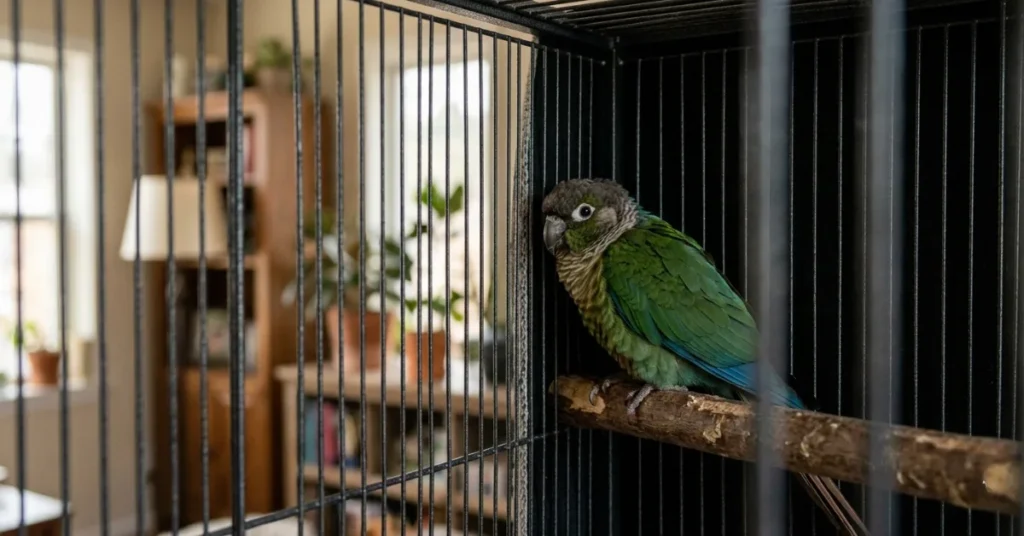

When I first brought my green cheek conure home, getting him to sit on my finger felt impossible. The moment my hand went near the cage, he’d bolt to the farthest corner and start screaming. I made every mistake you can imagine, and it took me weeks to figure out what was actually going wrong.
If your parrot tucks its feathers, backs into the corner, or lunges every time a hand comes near, this article is for you. I’ll walk you through why this happens, what your bird is actually communicating, and the exact approach I used to turn things around, without force and without shortcuts.
Quick Answer: Why Is My Parrot Afraid of Hands?
Parrots fear hands because hands have either hurt them before, scared them, or simply feel like an unknown threat. Since parrots are prey animals by nature, anything large moving toward them triggers an automatic alarm response. This fear is learned, not permanent. With the right approach, most parrots, even badly traumatized ones, can learn to trust hands again over time.
The Real Reason Your Parrot Panics Around Hands
A lot of people assume their bird is just “mean” or “stubborn.” That’s not it.
Think about it from the parrot’s point of view. In the wild, a bird that doesn’t run from large fast-moving objects doesn’t survive long. That reflex is baked into them. Your hand, no matter how kind your intentions are, looks exactly like a threat to a bird that hasn’t learned otherwise.
Here’s what usually causes this fear in pet parrots:
- The bird came from an aviary or a breeder with minimal human handling. It simply never learned that hands are harmless.
- Someone grabbed it, restrained it, or forced it to be held. Even once is enough to create a lasting fear response.
- The bird was rehomed and the previous owner had a different energy, scent, or way of moving. New hands feel like strangers.
- Handling has been inconsistent. Some days you try, some days you don’t. The bird never knows what to expect, so it stays on edge constantly.
One thing that surprises a lot of new owners: a “hand-tamed” label from a breeder or pet store doesn’t guarantee anything. Hand-fed as a baby doesn’t mean hand-comfortable forever. If the environment changes, the owner changes, or the bird had a single bad experience, that trust resets. You’re basically starting from zero.
What Your Bird Is Telling You with Its Body
Before you ever try to work with a scared parrot, you need to get good at reading what it’s telling you. This is the skill most people skip, and it’s the reason most taming attempts fail.
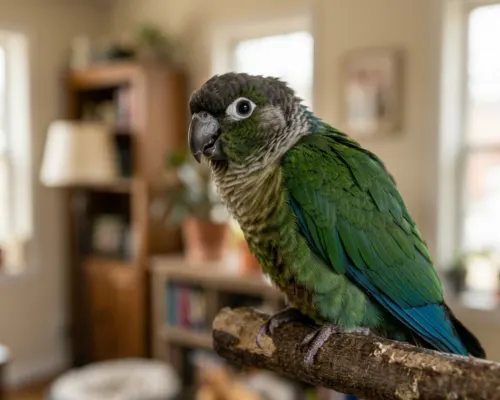
Fear signals to watch for:
- Feathers pressed flat and tight against the body
- Crouching low on the perch, weight shifted back, like it’s about to bolt
- Eyes rapidly changing between small and large pupils (called “pinning”)
- Beak slightly open as a warning
- Tail fanning or flicking sharply
- Moving sideways along the perch, away from you
Signs your bird is actually relaxed:
- One foot tucked up, standing casually on the other
- Feathers slightly puffed, loose posture
- Beak grinding quietly (a happy, sleepy sound)
- Slowly blinking or half-closing eyes
- Leaning toward you out of curiosity
The Association of Avian Veterinarians has long noted that missing these subtle signals is the biggest mistake owners make during bird handling. When you ignore the early warning signs, the bird escalates to biting because that’s the only thing left it can try.
Once you can read these signs reliably, the whole process gets easier.
Why Forcing It Never Works
This part is important, so stay with me.
When a bird is scared and you keep approaching anyway, it triggers what’s called a flooding response. The bird’s brain is flooded with stress hormones. It can’t think, can’t learn, can’t associate your presence with anything good.
Some people keep pushing because eventually the bird stops reacting. They think that means it’s working. It usually doesn’t. The bird has just hit a state called learned helplessness. It’s not calm, it’s given up. That’s a very different thing, and it makes real trust much harder to build afterward.
What actually works is the opposite: you give the bird control over the interaction. When it learns that staying calm makes the scary thing (your hand, your presence) go away, it starts to understand it’s safe. The fear shrinks because the bird chose to face it, not because you pushed it through.
For a broader look at how parrot psychology connects to daily care and training, the Petnicki Parrot Care Guide covers this really well alongside practical setup advice.
How to Actually Help a Parrot That Fears Hands
This process works. I’ve used it personally and I’ve seen it work for birds far more fearful than mine was. The only non-negotiable rule is patience.
Start Before You Even Touch the Cage
Walk toward the cage slowly, keeping your arms at your sides. The moment the bird shifts, leans back, or shows any tension at all, stop walking. Don’t wait for it to fly away. That reaction is too late.
Stand still. Breathe normally. Look slightly to the side rather than directly at the bird. Staring straight at a parrot looks predatory to them.
Wait until the bird visibly relaxes. Its posture will soften, maybe it’ll look away, maybe it’ll go back to eating. Once it does, turn around and walk away calmly.
That’s it for that session.
What you just did is teach the bird that your presence does not lead to anything bad. Over several repetitions, the distance at which it starts to tense up will slowly shrink. You’ll be able to stand closer each time before you see any tension.
When You Can Stand at the Cage
Once you’re standing right next to the cage without your bird reacting, start lifting your hand slowly into its field of view, outside the bars. Not inside yet. Just visible. Stop when you see tension. Wait for calm. Lower the hand. Walk away.
Drop a treat into its food bowl while you’re standing there. Walk away. Every time your hand near the cage results in something good, the bird files that away.
Introducing Your Hand Inside the Cage
This is where most people rush. Don’t.
Open the door just slightly and let your hand rest near the opening. Not reaching in. Not moving toward the bird. Just present. Let the bird look at it, smell it, approach it if it wants to. If it tenses, hold still. If it stays calm, you’re making progress.
Over days, let your hand come a little further in. Still not reaching for the bird. Just there.
Letting the Bird Come to You
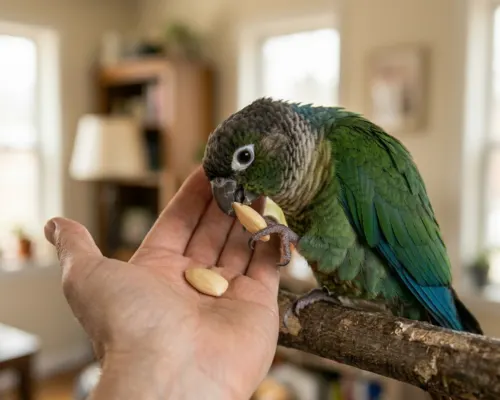
Hold a piece of almond, a bit of mango, or whatever your bird goes wild for between your fingers. Don’t move your hand toward the bird. Just hold it steady and wait.
The first time a scared bird leans toward your hand to sniff a treat, that’s a massive moment. Let it happen at its own pace.
PetMD notes that treat-based positive reinforcement is one of the most well-documented methods for reducing fear-based avoidance in parrots, specifically because it lets the bird make an active choice rather than having an experience forced on it.
Things That Will Set You Back
Avoid these, even when you’re frustrated:
- Going faster than the bird’s comfort level just because you had a good session yesterday
- Using gloves. The bird can’t read your hand properly through them and they look strange.
- Training when the room is noisy, when other pets are around, or late at night when birds are naturally more alert to threats
- Multiple people all trying at once. Pick one person to lead, especially in early stages
- Looking directly into the bird’s eyes during approach
Realistic Timelines
A young bird with no prior bad experiences might start stepping up within a week or two. A rehomed bird or one that was handled roughly could take two to three months. I’ve heard of cases taking longer.
The timeline doesn’t matter much. What matters is whether you had a session today. A calm ten minutes every day beats an hour-long session once a week every single time.
FAQ
Why does my parrot bite every time I reach into the cage? Reaching into the cage without building trust first feels like an ambush to the bird. It bites because that’s the most effective thing it can do to make the scary thing stop. Go back to basics, build comfort outside the cage first, and work your way in slowly.
My bird was fine before and suddenly became scared of hands. What happened? Something probably spooked it, even something small. A dropped object, a sudden grab, someone new handling it. Parrots have excellent memories for negative experiences. Treat it like a fresh start and rebuild from step one.
Can I use a perch stick instead of my bare hand to start? Yes, and it’s often a smart bridge. A neutral object is less threatening than a hand. Once the bird steps up on a stick comfortably, transitioning to a hand becomes much easier.
My parrot only trusts my partner and not me. Is that fixable? Completely fixable. Start the whole process from scratch as if the bird has never met you. Some birds respond to lower or higher voices more easily, so try speaking softly and moving a bit slower than you normally would.
Is fear of hands different in different parrot species? Yes, somewhat. Cockatiels and budgies tend to tame down faster. African greys and amazons can hold onto fear or past trauma for longer. But the approach is the same regardless of species. Respect the bird’s pace.
Should I let my parrot out of the cage before we’ve worked through the hand fear? It’s better to wait. Free flight before the bird trusts your hand makes it harder to manage interactions and can create more unpredictable stress. Get comfortable with in-cage trust first.
Wrapping Up
A parrot that’s scared of hands isn’t a lost cause. It’s a bird that needs someone patient enough to let it figure out that hands are safe.
The whole process comes down to one thing: stop deciding for the bird and start letting it decide. Move slow. Read the signals. Reward the right moments. Let it come to you.
When a bird that used to bolt at the sight of your hand eventually walks up your arm on its own, it’ll be one of the most rewarding things you’ve experienced as a bird owner. That trust is real because the bird chose it.