
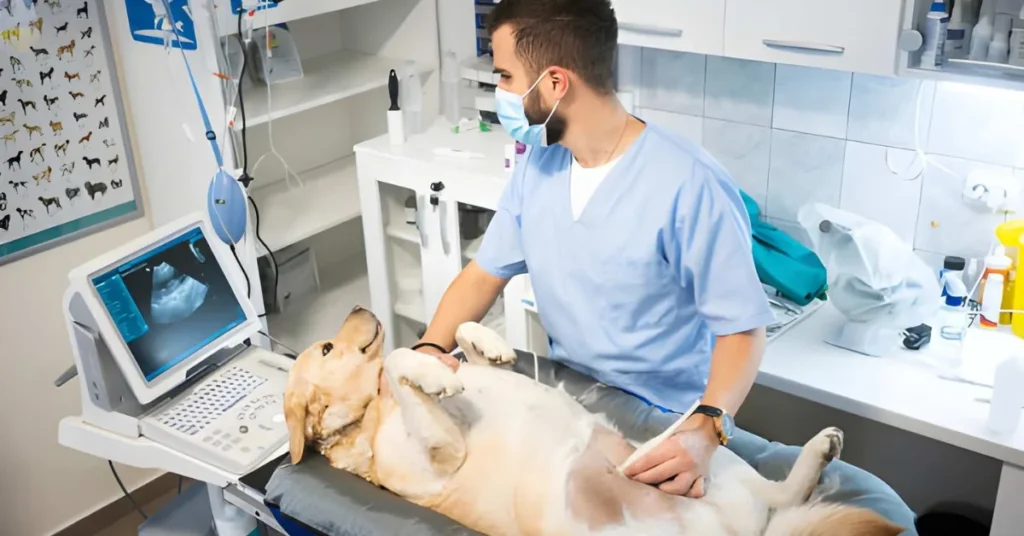

If you think your dog might be pregnant, or you are planning to breed her, you probably have a lot of questions. It is normal to feel uncertain. Dog pregnancy moves fast, and knowing what to expect at each stage makes a real difference. As her body changes, providing a comfortable place to rest, such as an orthopedic dog bed, can help support her comfort throughout pregnancy.
This guide covers how long dogs are pregnant, what signs to watch for week by week, how vets confirm pregnancy, and how to prepare for the birth of a new litter.
Quick Answer: How Long Are Dogs Pregnant?
Normal gestation in dogs is about two months, but the number depends on which date you count from. The Merck Veterinary Manual gives 56 to 58 days from the first day of diestrus, 64 to 66 days from the LH surge or the rise of progesterone above baseline, and 58 to 72 days from the day the female first accepted breeding. VCA Animal Hospitals gives 57 to 65 days, with an average of 63. Merck adds that breeding dates and conception dates do not line up closely enough to predict the whelping date exactly.
Why Pinpointing the Due Date Can Be Tricky
You might assume you can count 63 days from the date of mating and land on an accurate due date. In practice, it is not that simple.
A male dog’s sperm can survive inside the female reproductive tract for several days. When the female ovulates, the egg still needs two to three more days before it can be fertilized. This means a dog can mate days before or after ovulation and still become pregnant, making the breeding date alone an unreliable predictor.
The most precise dating comes from hormone testing. Merck counts 64 to 66 days from the LH surge or the progesterone rise, a much narrower window than counting from breeding. Without hormone dates, count from the last known mating and ask your vet; VCA says that if there were two matings, birth is expected 63 to 65 days after the later one.
| Date you know | Count | Source |
|---|---|---|
| First day of diestrus | 56 to 58 days | Merck |
| LH surge or progesterone rise | 64 to 66 days | Merck |
| First day she accepted breeding | 58 to 72 days | Merck |
| Last of two matings | 63 to 65 days after it | VCA |
Dog Pregnancy Week by Week
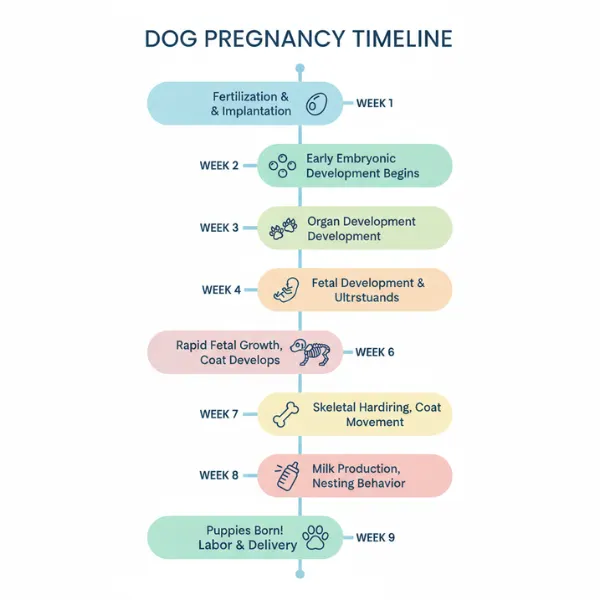
Dog pregnancy is divided into three trimesters, each lasting roughly three weeks. Changes in the first trimester are mostly internal and easy to miss.
Weeks 1 and 2: Fertilization
After mating, sperm fertilizes the eggs and embryos begin to form. Your dog will show no outward signs of pregnancy yet. Her energy and appetite should stay normal.
Week 3: Early Embryo Development
The embryos travel to the uterus and begin to implant in the uterine lining. Some dogs experience mild nausea around this time. Like humans, some dogs suffer from morning sickness and will vomit in the early stages of pregnancy.
Other subtle signs at this stage include:
- A slight decrease in appetite
- Increased tiredness or restlessness
- More affectionate behavior toward their owner
Week 4: Confirmed Pregnancy Window
This is when a vet can start to confirm pregnancy. Merck says the uterine swellings become palpable at about day 21, and that ultrasound is best done at 25 to 35 days, with false negatives possible before day 21. VCA says most scans after day 28 are reliable. An early answer usually comes from ultrasound, not from how she looks or acts.
This is a good time to schedule your first prenatal vet visit if you have not already.
Weeks 5 and 6: Rapid Fetal Growth
The fetuses grow quickly during this phase. After around 40 days, once your dog enters her final trimester, fetal growth accelerates significantly. You will start to notice more obvious physical changes:
- An enlarged and rounded abdomen
- Darker and more prominent nipples
- Clear or slightly milky vaginal discharge
- A noticeably increased appetite
VCA Animal Hospitals says her food intake should stay the same for the first two-thirds of pregnancy, then rise gradually after week six, in small frequent meals. The nutrition section below has the numbers.
Weeks 7 and 8: X-Ray and Litter Count
Merck says the skeleton is not detectable on routine X-rays until about day 42 to 45, and that X-rays taken after day 55 are the best way to count the litter. Knowing how many puppies to expect matters so you know when labor is complete and do not miss a retained puppy.
At this point your dog may also start nesting behavior, circling, pawing at blankets, and seeking out a quiet and private space.
Weeks 8 and 9: Final Days Before Labor
Labor is approaching. Your dog may:
- Lose her appetite in the final 24 to 48 hours
- Become restless or pace around the house
- Pant more than usual even without exercise
- Have a drop in rectal temperature (Merck gives a mean of 37.1 °C, about 98.8 °F, with a range of 36.7 to 37.8 °C)
Merck places this temperature drop 8 to 24 hours before whelping. Set up a whelping box in a warm and quiet area well before this point so she has time to get comfortable with it.
How Vets Confirm Dog Pregnancy
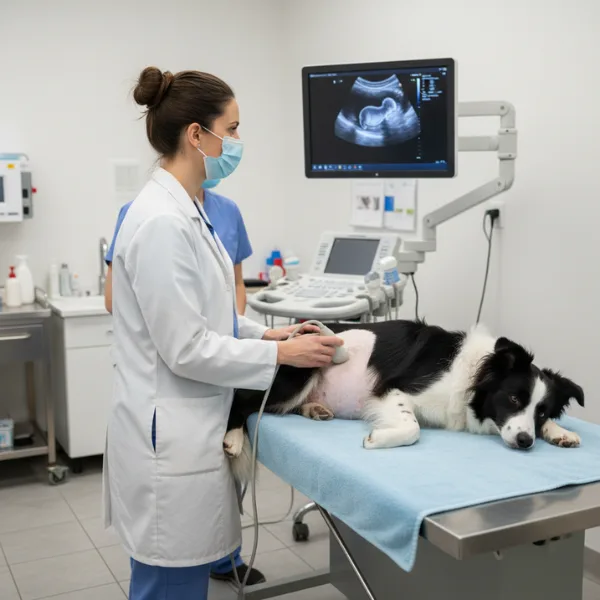
There are four main methods vets use, each suited to a different stage of pregnancy.
Relaxin hormone blood test: Detects relaxin from the placentas. Merck says the commercial test works after about day 22 to 27 of gestation, and VCA warns that false negatives can occur if it is done too early.
Abdominal palpation: The vet gently feels the abdomen for the uterine swellings. Merck says they are palpable at about day 21 and become harder to tell apart after days 35 to 38; VCA calls the results variable.
Ultrasound: The preferred method. Merck says it is best done at 25 to 35 days and may give a false negative before day 21; VCA says most scans after day 28 are reliable.
X-ray: Merck says skeletons show on routine X-rays from about day 42 to 45, and that X-rays after day 55 are the best way to count puppies before birth.
For a detailed breakdown of what to expect after the puppies arrive, the Petnicki puppy growth chart is a helpful reference to bookmark now.
The Three Stages of Dog Labor

Labor in dogs happens in three distinct stages. Each stage has its own signs and timeline. Knowing what is normal at each point helps you stay calm.
Stage 1: Cervix Dilation (12 to 24 Hours)
Contractions begin internally. Your dog may seem restless, pant heavily, refuse food, and seek solitude. This stage ends when the cervix is fully dilated. You may not realize it has started because there are no visible contractions yet.
Stage 2: Delivery of Puppies
Visible abdominal straining comes with each birth. Merck gives about 30 to 60 minutes between puppies as typical, says delivery is ideally finished in about 7 to 9 hours, and says efforts should not go on for more than 1 to 2 hours between puppies.
Puppies can be born head-first or tail-first, and both are normal presentations. If she strains for more than one to two hours without producing a puppy, contact your vet or an emergency clinic.
Stage 3: Delivery of the Placentas
Each puppy has its own placenta. Count them carefully because one placenta per puppy should be delivered. A retained placenta can lead to serious uterine infection.
Merck lists stage 1 lasting more than 24 hours without moving on to delivery, and straining that does not produce a puppy within 1 to 2 hours, as reasons for veterinary help. Placentas may be eaten, passed unnoticed, or pass within 24 hours.
Pregnancy Nutrition: What to Feed a Pregnant Dog
Diet matters more during pregnancy than at almost any other time in a dog’s life.
Weeks 1 to 6: VCA says intake should stay the same for the first two-thirds of pregnancy. Feed a premium diet approved by your vet; VCA suggests a food whose label says it suits gestation and lactation, or all life stages.
Weeks 6 to 9: VCA says intake should rise gradually after week six, in small frequent meals, reaching up to 1.5 times the normal level in the last three weeks. The AAHA 2021 guidelines use a different yardstick: 3.0 times the resting energy requirement for the last 21 days, against 1.4 to 1.6 for a neutered adult. Our dog calorie calculator has a “Pregnant, last 21 days” option. The two sources do not agree, so ask your vet which number fits your dog and her litter.
After birth: Her energy needs are highest while she is nursing. Ask your vet how long to keep the larger portions.
Always check with your vet before adding supplements. Some vitamins and minerals can cause harm during early gestation, particularly in the first 30 days when organ development is happening.
Signs of a Problem During Labor: When to Call the Vet
Most dogs give birth without complications. But some situations require urgent veterinary attention:
- No puppies after 24 hours of stage one labor beginning
- More than one to two hours of active straining without a puppy being born
- Green discharge, which Merck lists as abnormal
- Visible signs of severe pain or extreme distress
- A puppy visibly stuck in the birth canal
Save your vet’s emergency contact number before your dog reaches week 8. Do not wait until labor begins to look it up.
What Owners Ask About Dog Pregnancy
These quotes are copied word for word from public Reddit threads. They are single people’s accounts, not evidence, and we use them only to show the questions behind the numbers above.
If this happened less than 3-4 weeks ago there isn’t a reliable way to determine pregnancy. Not by behaviour, not by clinical assessment, not by bloods, not by ultrasound.
r/AskVetAnimals, Feb 2026, an owner whose dog may have mated at a family barbecue · Reddit thread
Our take. This matches the sources above. Merck puts the first palpable swellings at about day 21 and says ultrasound before day 21 can give a false negative, so a check at three to four weeks is the first one that tells you something.
At that time the X-rays only showed 4 spines. On Monday, they counted 6
r/DOG, Oct 2026, an owner expecting a litter from a rescued dog · Reddit thread
Our take. We do not know how far along that dog was, but the pattern is a known one. Merck says skeletons are not detectable on routine X-rays until about day 42 to 45, and that X-rays after day 55 are the best way to count the litter, so an early film can undercount. If you want a count to plan for, ask your vet when to schedule the X-ray.
FAQ: Dog Pregnancy Questions Answered
How do I know if my dog is pregnant without visiting a vet? Early signs include subtle nipple changes, mild nausea, increased tiredness, and slight appetite shifts. However, these signs are easy to miss or misread. A vet visit around day 25 to 30 is the only reliable way to confirm pregnancy.
Can a dog’s gestation period be shorter than 58 days? Delivery before day 58 is considered premature. Puppies born this early may not survive without intensive veterinary care. If your dog goes into labor very early, contact your vet immediately rather than waiting to see how things develop.
Do larger dog breeds have longer pregnancies than smaller ones? Neither Merck nor VCA gives a separate gestation length by breed size. Merck’s wide 58 to 72 day range comes from breeding dates and conception dates not lining up closely, not from the size of the dog. If your vet has a hormone-based date, trust that over a count from the mating.
Can a dog get pregnant during her very first heat cycle? Yes. Dogs can become pregnant during their first heat, which usually starts between six and eighteen months of age. Most responsible breeders wait until the dog is physically and mentally mature before breeding, typically after the second or third heat. Our guide to how long dogs stay in heat covers the stages and the fertile window.
How many puppies can a dog have in one litter? Litter size varies widely by breed and individual. Small breeds commonly have one to four puppies. Large breeds can have eight or more. Merck says X-rays taken after day 55 are the best way to count the litter before whelping.
Is it normal for a dog to eat the placentas after giving birth? Yes. This is instinctive behavior. One or two placentas are generally harmless for the mother. Eating all of them can cause digestive upset. You do not need to intervene unless she is consuming every single one.
Conclusion
Dogs are pregnant for about two months. Counted from the LH surge or progesterone rise the figure is 64 to 66 days, and counted from the first accepted mating it can fall anywhere from 58 to 72 days, so use our dog pregnancy calculator once you have a date. The pregnancy moves through clear stages, with most visible signs appearing in the second half of the gestation period. Early vet involvement, good nutrition, and a prepared whelping space are the three most important things you can do to support a healthy outcome for both mother and puppies.
Once the litter arrives, the weeks ahead are just as important to track. For a clear guide on what to expect as your puppies grow, explore Petnicki’s puppy growth chart and age-weight guide, which breaks down development week by week so you always know what is normal.
When the puppies are ready to leave for their new homes, a small going-away gift makes the goodbye easier. Many breeders send each puppy off with a first leather collar with the puppy’s name on it, a keepsake the new family can use from the very first walk.