


How long are dogs in heat? PetMD says most dogs stay in heat for 14 to 21 days, while Banfield Pet Hospital says a typical cycle lasts two to four weeks. She is fertile for only part of that, and the infection risk called pyometra arrives in the weeks afterwards.
The numbers you’ll see online disagree, and they aren’t all wrong. PetMD gives 7 to 10 days for proestrus, the stage when bleeding starts, whereas the Cornell Riney Canine Health Center says the bloody discharge usually lasts 14 to 21 days. AKC averages nine days for proestrus and nine for estrus, and says each can run anywhere from 3 to 21.
How Long Are Dogs in Heat? Stage by Stage
The heat itself is two stages, and bleeding can start in the first and carry into the second, which is why you’ll find a separate row for it in the table.
| What | PetMD | AKC | Cornell |
|---|---|---|---|
| Proestrus (swelling, bleeding, not yet receptive) | 7-10 days on average, a few days to 4 weeks | 9 days on average, 3-21 | About 6-11 days on average |
| Estrus (receptive, fertile) | 9 days on average, 3-21 | 9 days on average, 3-21 | Usually 5-9 days, range 1-20 |
| Bloody discharge | No length given | No length given; thins and turns watery and pinkish in estrus | Usually 14-21 days |
| Whole heat | Most dogs 14-21 days | Not given | Not given |
| Between heats | About every 6 months, up to 11 | About every 6 months | 5-11 months on average |
Banfield’s page lists the same stages with proestrus at about 7 to 10 days and estrus at about 5 to 10 days, then diestrus at about two months and anestrus at four to five months.
Why Bleeding Can Outlast the Average
Bleeding can run past the stage averages without anything being wrong, because the averages describe the middle of a wide spread. Cornell’s 14 to 21 days is roughly double PetMD’s 7 to 10 days for proestrus, and AKC explains part of the difference: the discharge carries on into estrus, only thinner and pinker.
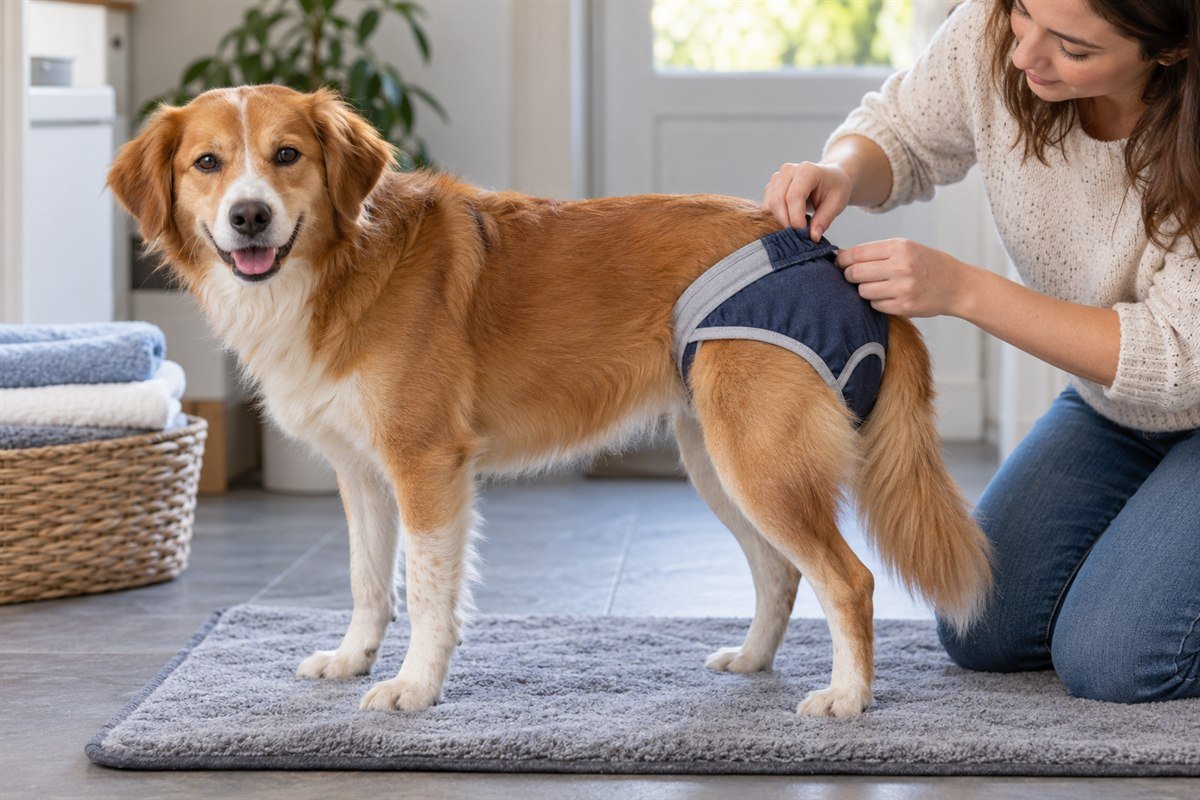
An r/labrador owner, writing in December 2025 about an eight-month-old puppy, put the gap in words, in a post that drew 74 upvotes:
“It’s been 15 days, and we’re still in the diaper stage (proestrus, bleeding). I read the average was 9 days,”
– r/labrador, December 2025 (74 upvotes)
Fifteen days is inside Cornell’s range, so that owner was not looking at a problem. Another reply in the same thread, with 20 upvotes, went further:
“Mine had active bleeding for 21 days. The Vet said that was pretty unusual to go that long.”
– r/labrador, December 2025 (20 upvotes)
That is one owner’s account of what a vet said. Twenty-one days sits at the top edge of Cornell’s range, so it’s long but not outside it. The line to act on comes from Banfield: call the vet if bleeding is heavy, lasts more than three to four weeks, or soaks through diapers quickly. Banfield also notes that some dogs have a silent heat with little or no visible bleeding, so a dog that shows nothing may still be in season.
When She Can Get Pregnant
She can become pregnant during estrus, not during the first bleeding days. AKC puts the fertile period at a couple of days before ovulation to five days after, and Cornell says a vet can pin down the stage with vaginal cytology or hormone testing when breeding is planned.
Owners can’t see ovulation, which is why many plan around the whole stretch, a few weeks at a time. One r/DogHealth reply from March 2026 said:
“About 3 weeks, give or take some days. They also start smelling to males before the actual bleeding starts and after the bleeding ends…so you should stay away from any dog parks for about a month, to be safe.”
– r/DogHealth, March 2026 (4 upvotes)
It’s a cautious rule of thumb from one owner, not a veterinary figure. If a pregnancy is possible, our dog pregnancy calculator and the dog pregnancy week-by-week guide take it from the mating date onwards.
The Weeks After Heat and Pyometra
Pyometra, a uterine infection, tends to show up after the heat has ended, not during it. Cornell says a dog will often develop it one to two months after her previous heat, and AKC puts it typically at four weeks to four months afterwards.
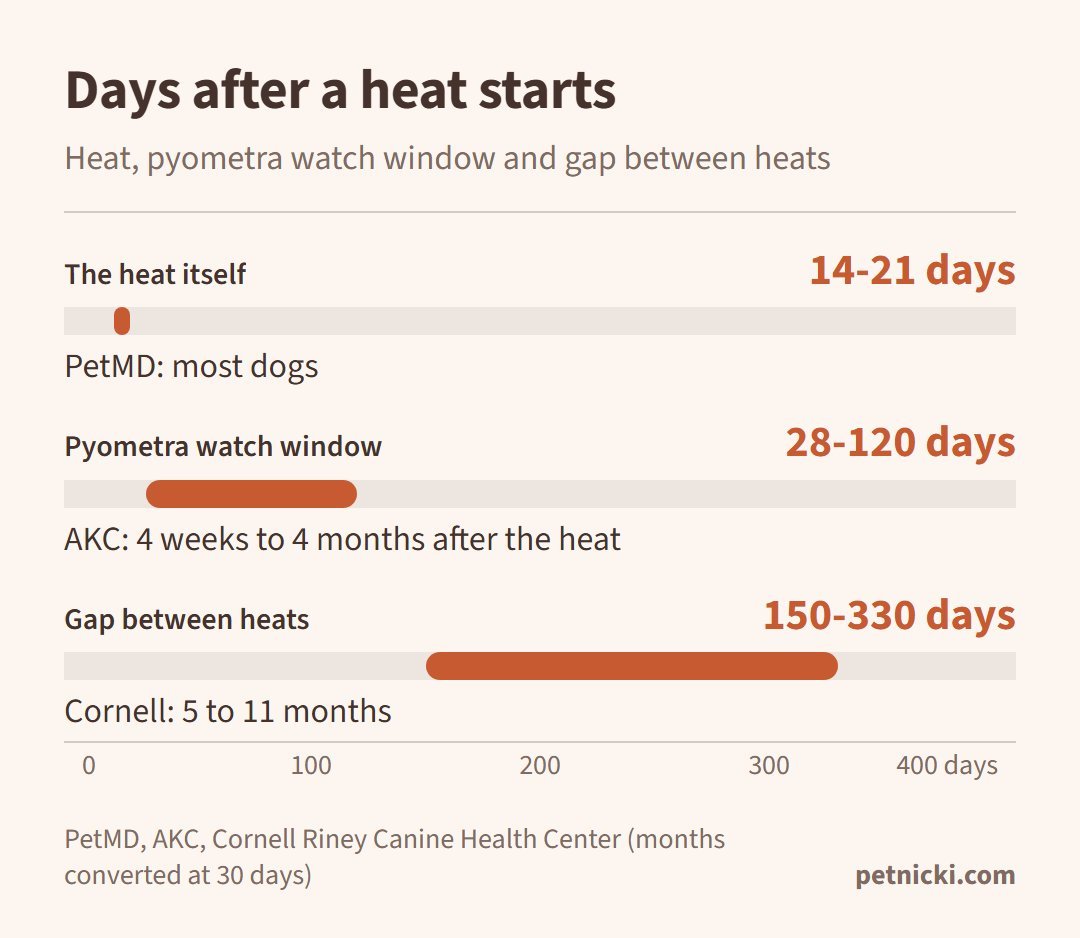
Cornell calls it a medical emergency and describes cream-coloured or bloody discharge as the main sign when the cervix is open, with increased thirst or urination, lethargy, poor appetite and vomiting also possible. Signs of illness are more severe when the cervix is closed, and in that case there may be no discharge to see. If you haven’t had her spayed, note that middle-aged and older dogs are most at risk — especially after several heats — and PetMD flags dogs older than eight. Our guide to early signs of pyometra covers what to look for.
First Heat, How Often and Spaying
Most puppies have a first heat between 6 and 12 months, says Banfield, though small breeds can start at 5 months and large and giant breeds may wait until 18 to 24 months. AKC puts the range from toy breeds at 4 or 5 months to about two years for giants, and Cornell gives 6 to 24 months overall. After that, most dogs cycle roughly twice a year.
Spay timing is a judgement for your vet. Banfield says spaying before the first heat removes the risk of pyometra and lowers the risk of mammary cancer, that some vets wait for physical maturity in large and giant breeds to protect bone and joint development, and that there is no one-size-fits-all answer. Whatever you decide, the heat is not the end of the story: keep watching her for the next two months.