

You’ve probably heard that one cat year equals seven human years. It’s the first math lesson most new cat owners learn, and it sticks because it’s simple.
But it’s not accurate. Cats don’t age on a flat 1:7 scale at all.
This guide breaks down the real cat years to human years formula, the life stages behind it, and what your cat actually needs at each age.
Quick answer: Cat years to human years don’t follow a fixed 1:7 ratio. A 1-year-old cat is close to 15 human years old, and a 2-year-old is around 24. After that, each extra cat year adds about 4 human years, so a 10-year-old cat is closer to 56 than 70.
Why the “1 Cat Year = 7 Human Years” Rule Is Wrong
The 7-year rule assumes cats age at the same steady pace every year. They don’t.
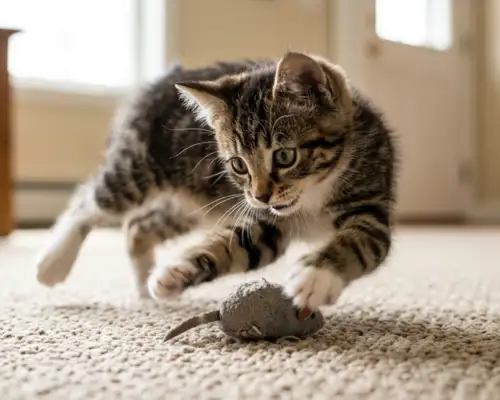
Kittens grow up fast. A cat reaches physical maturity by around 1 year old, something that takes a human over a decade.
After that first sprint, aging slows down. Each extra cat year stops counting for nearly as much as the ones before it.
The Cornell Feline Health Center notes that the popular seven-year belief isn’t entirely accurate, since cats age individually. A proper chart tells you more than a fixed multiplier.
The Real Cat Years to Human Years Chart
Here’s a more reliable cat years to human years chart, based on the formula most veterinary sources use.
| Cat’s Age | Human Years Equivalent |
|---|---|
| 1 year | 15 |
| 2 years | 24 |
| 3 years | 28 |
| 4 years | 32 |
| 5 years | 36 |
| 6 years | 40 |
| 7 years | 44 |
| 8 years | 48 |
| 9 years | 52 |
| 10 years | 56 |
| 12 years | 64 |
| 14 years | 72 |
| 16 years | 80 |
| 18 years | 88 |
| 20 years | 96 |
Notice the big jump between year 1 and year 2. After that, the climb levels off. That curve is the real difference between this chart and the old 7-year math.
How to Calculate Your Cat’s Age in Human Years
You can work this out yourself with a simple rule:
- Year 1 equals about 15 human years
- Year 2 equals about 24 human years total
- Every year after that adds roughly 4 more human years
So for a 7-year-old cat: 24 for the first two years, plus 5 more years at 4 each, equals 44 human years.
If you’d rather skip the math, an online cat age calculator can work it out for you in seconds.
Cat Life Stages, Explained
Vets don’t just think in raw numbers. The AVMA groups feline aging into four life stages, each with its own behavior patterns and care needs.
Kitten (Birth to 1 Year)
This is the fastest-changing stage of a cat’s life. Kittens grow, wean, and learn social skills in just a few months.
Play is how kittens learn. Pouncing, chasing, and biting are hunting practice, not bad behavior.
Kittens are also exploring taste and texture for the first time as they move from milk to solid food. It’s worth knowing what flavors cats can actually detect, since food preferences start forming early and can stick for life.
Young Adult (1 to 6 Years)
This is a cat’s prime. Energy, muscle tone, and curiosity are usually at their peak.
Young adult cats tend to be territorial, especially around other cats. Routine matters a lot to them, and they settle into habits around feeding, play, and sleep.
Mature Adult (7 to 10 Years)
Cats in this stage still look and act like younger adults, but subtle shifts start happening. Metabolism slows, and weight gain becomes easier than before.
This is a good age to start watching for early dental issues and to ask your vet about slightly more attentive yearly checkups.
Senior (10 Years and Older)
Senior cats slow down. Sleep increases, play decreases, and joints can get stiff.
Many cats this age also groom themselves less, which can lead to a duller or matted coat. Some care guides split this stage further into senior and geriatric for cats 15 and older, since the aging process keeps progressing well past 10.
What Affects How Fast a Cat Ages
No two cats age at exactly the same pace. A few factors make a real difference:
- Genetics and breed: Some breeds live longer, or develop age-related issues earlier, than others. Large breeds also finish growing later; a Maine Coon is not fully grown until three or four years old, so a two-year-old is still filling out.
- Indoor vs. outdoor lifestyle: Indoor cats are shielded from traffic, predators, and disease, which tends to support a longer life.
- Spay or neuter status: Spayed and neutered cats often live longer, partly by avoiding certain reproduction-related health risks.
- Weight and diet: Overweight cats are more likely to develop joint and metabolic problems earlier.
Behavior Changes You’ll Notice With Age
Cat behavior shifts gradually, not overnight. Knowing what’s normal for each stage helps you tell the difference between aging and an actual problem.
- Kittens are bold, clumsy, and constantly testing limits.
- Young adults are confident, playful, and routine-driven.
- Mature adults are calmer but still alert and social.
- Senior cats often sleep more, vocalize more at night, and prefer warm, quiet spots.
A senior cat that suddenly goes from social to withdrawn, or starts crying at night, is worth a vet visit. That kind of change usually isn’t just “getting old.” It can point to pain, vision loss, or cognitive decline. Age changes the travel maths too: a cat past this stage is one of the cats that should not be left alone overnight without someone checking in.
Caring for an Aging Cat
Care needs shift right along with the life stages.
For kittens: Focus on safe play, early socialization, and a kitten-specific diet that supports rapid growth.
For young and mature adults: Keep up with annual checkups, dental care, and steady weight management.
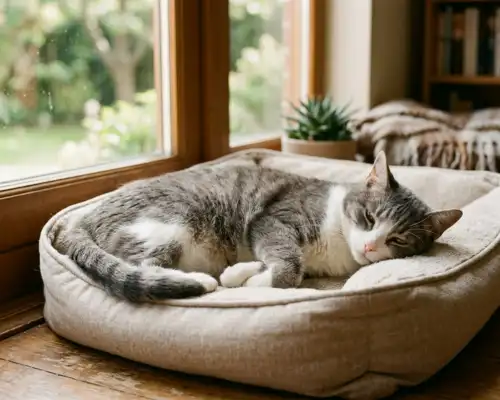
For seniors: Add softer bedding, low-sided litter boxes, and easy access to food and water. Joint stiffness is common at this stage, and a gentle at-home massage routine can help senior cats relax and rest more comfortably.
Senior cats also sometimes lose interest in food. A weaker sense of smell plays a bigger role in this than most owners expect, and it helps to understand how a cat’s sense of taste changes over time if your older cat has gotten noticeably pickier.
If your cat’s eating, mobility, or litter box habits change suddenly, talk to your vet rather than assuming it’s just age.
Frequently Asked Questions
Is one cat year really equal to seven human years? No. That ratio is too simple. Cats age fast in their first two years, then much more slowly after that.
How old is a 10-year-old cat in human years? Around 56, based on the formula most vets use. That puts a 10-year-old cat right at the line between mature adult and senior.
What age is considered senior for a cat? Most vets mark 10 years old as the start of the senior stage, though some cats show no real signs of slowing down until later.
Do indoor cats age differently than outdoor cats? Indoor cats tend to live longer overall, mainly because they avoid many risks outdoor cats face. The underlying aging process is the same either way.
Does breed affect how a cat ages? Yes, to some degree. Genetics can influence lifespan and how early health issues show up, though individual care matters just as much.
How can I tell if my cat is entering their senior years? Watch for slower movement, less self-grooming, weight changes, and shifts in sleep or appetite. A vet visit can confirm what’s age-related and what isn’t.
The Bottom Line
The old seven-year rule is easy to remember, but it doesn’t match how cats actually age. Cats mature fast early on, then settle into a much slower pace.
Use the cat years to human years chart above as a guide, not a strict rule. Every cat ages a little differently. If you’re ever unsure what’s normal for your cat’s age, your vet is the best place to start.