
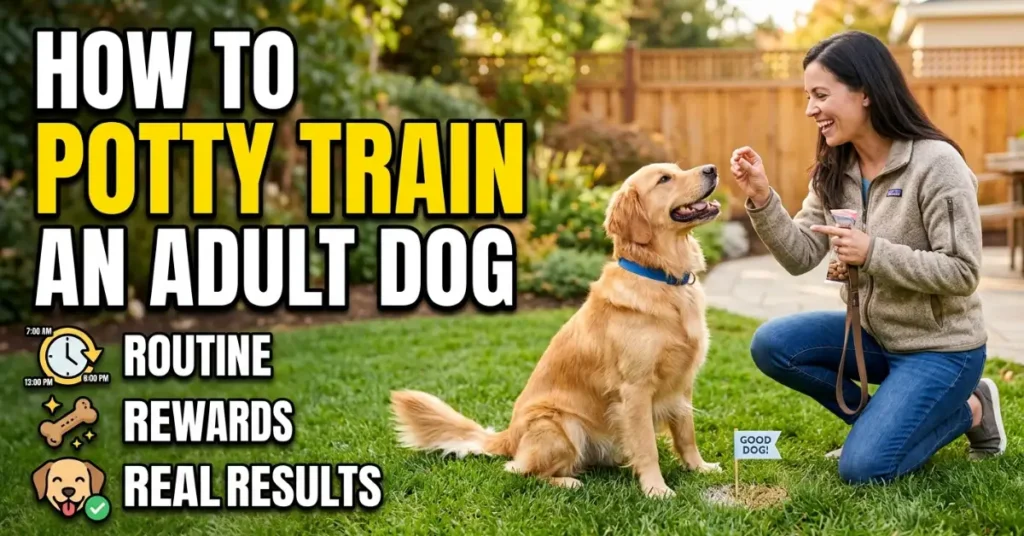

You brought home an adult dog expecting them to already know the rules. But accidents keep happening, and you are not sure what went wrong.
You are not alone. Potty training an adult dog is one of the most common challenges new dog owners face, whether with a rescue, a rehomed pet, or a dog that simply never got proper housetraining. The good news is that adult dogs can absolutely learn. Their bladder control is stronger than a puppy’s, and they pick up routines quickly with the right approach.
This guide covers everything you need to housetrain your adult dog. You will find a daily schedule, reward strategies, accident handling tips, and answers to the most common questions.
What Does It Mean to Potty Train an Adult Dog?
Potty training an adult dog means teaching them that the only appropriate place to eliminate is outdoors or in a designated area. Unlike puppies, adult dogs can hold their bladder for several hours. The challenge is not physical ability. It is establishing a new habit in a new environment. Most adult dogs, including rescues, need to be retrained from scratch whenever they move to a new home.
Why Adult Dogs Need Retraining
Many owners assume a dog that was housetrained in a previous home will automatically carry that behavior to a new one. That assumption leads to accidents.
A new house means new smells, a new layout, and a new routine. Your dog does not know which door leads outside. They do not know where their bathroom spot is. From their perspective, everything is unfamiliar.
Even if your dog was housetrained before, treat them like they are starting from scratch. Start fresh, stay consistent, and the retraining process will move quickly.
Common Reasons Adult Dogs Are Not Housetrained
- They lived outdoors their entire life
- They spent time in a shelter kennel where elimination habits were inconsistent
- They were trained to use pads indoors and never transitioned outside
- A medical issue like a urinary tract infection is causing accidents
If your dog has sudden accidents after being reliably trained, a vet visit is the right first step. If a dog who is already potty trained starts having accidents, there might be a medical cause worth checking with your veterinarian.
Build a Consistent Outdoor Schedule First
The foundation of housetraining is a predictable routine. Dogs thrive on consistency. A set schedule teaches your dog when and where to eliminate.
When to Take Your Dog Outside Every Day
- First thing in the morning
- After every meal
- After naps or rest periods
- After playtime
- Before bed
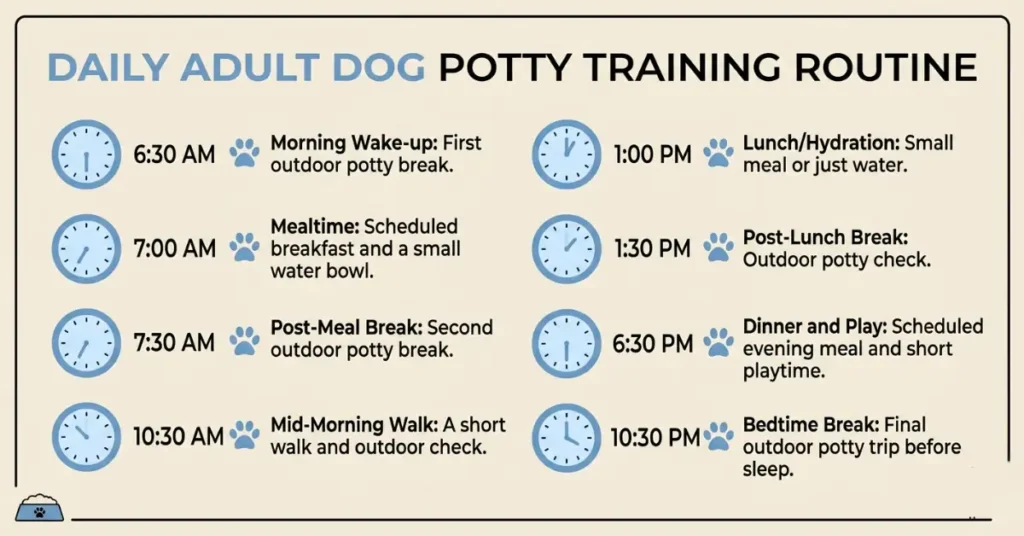
Feeding your dog on a set schedule twice a day makes elimination more regular and easier to predict. Pick up the food bowl 10 to 15 minutes after placing it down. This keeps digestion on a predictable cycle.
Always take your dog to the same outdoor spot. The familiar scent of previous eliminations signals to your dog that this is the right place. Use a calm, consistent cue word like “go potty” right before they begin. Over time, that phrase becomes a reliable trigger.
Daily Potty Training Schedule
| Time | Action |
|---|---|
| 6:30 AM | First trip outside, reward success |
| 7:00 AM | Breakfast, take outside 15 min after |
| 10:00 AM | Mid-morning outdoor trip |
| 12:30 PM | After lunch outdoor trip |
| 3:00 PM | Afternoon outdoor trip |
| 5:30 PM | After dinner outdoor trip |
| 8:00 PM | Evening outdoor trip |
| 10:30 PM | Final trip before bed |
Adjust times to your own schedule. The key is consistency, not the exact hours.
Reward Timing Makes or Breaks the Training
Timing is everything in dog training. A reward given more than two seconds after the behavior loses its connection entirely.
The moment your dog finishes eliminating outdoors, give them an immediate reward, which could be a treat, praise, or a toy. Waiting until they come back inside teaches them the wrong thing entirely.
What Treats Work Best
Use a high-value treat your dog does not get at any other time. Deli turkey, small pieces of cooked chicken, or soft training treats work well. The reward needs to feel special.
Do not rush your dog back inside right after they finish. Let them enjoy a few minutes outdoors. If going outside always means the fun immediately ends, some dogs will hold it just to stay out longer.
Indoor Freedom Has to Be Earned, Not Given
During the housetraining period, your dog should not have unsupervised access to the full house. Freedom comes after consistent success, not before.
Limit your dog’s run of the house to the one or two rooms where you can see them at all times. Dogs usually show pre-elimination behavior such as sniffing, circling, and walking with stiff back legs. These are signs to get them outside immediately.
Tools That Help You Supervise Indoors
- A leash attached to you indoors
- Baby gates to block off rooms
- A crate when you cannot supervise
The crate is not a punishment. Dogs naturally avoid eliminating where they sleep. A properly sized crate, just big enough to stand, turn, and lie down, becomes a clean holding space when you are unavailable. If your dog also struggles with anxiety at night, learning about helping a puppy through nighttime stress can give you useful context on how stress affects new dogs in a home setting.
How You React to Accidents Matters More Than You Think
Accidents will happen. How you respond to them directly affects how fast your dog learns.
Do not yell. Do not rub their nose in it. Punishment will only teach your dog to use the bathroom inside when you are not present. They will not understand that indoor elimination is wrong. They will only learn that it is dangerous to go in front of you.
What to Do When You Catch an Accident
If you catch your dog in the act, calmly interrupt with a neutral sound, say “outside,” and take them to their spot immediately. If they finish outdoors, reward right away.
If you find the mess after the fact, clean it up and say nothing. The connection between the act and your reaction is gone.
Why Enzymatic Cleaner Matters
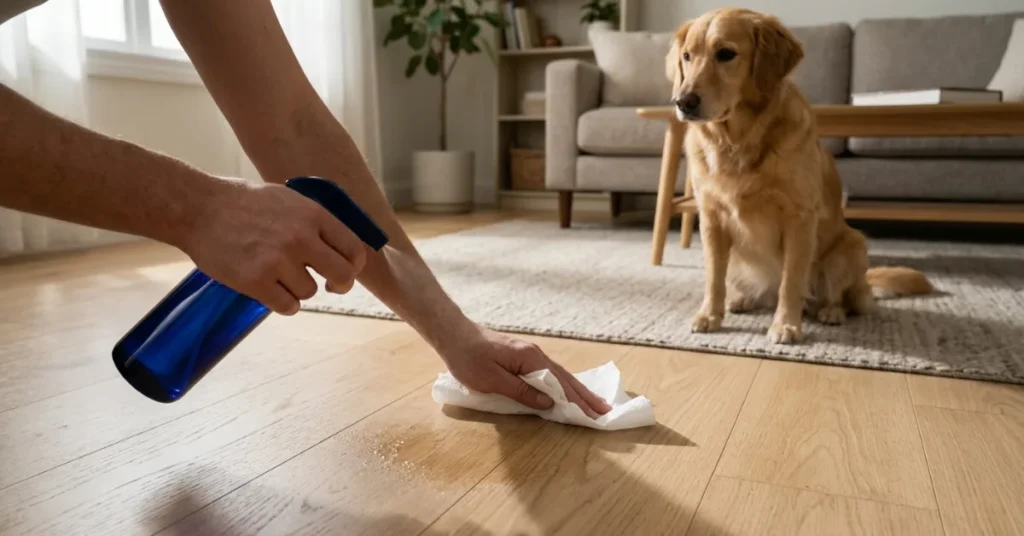
Always clean soiled areas with an enzymatic cleaner. Regular household cleaners do not break down the urine pheromones that signal to your dog that a spot is an acceptable bathroom. Products like Nature’s Miracle remove the scent markers that attract repeat accidents.
Watch for Patterns and Common Mistakes
Keep a simple log for the first two weeks. Write down when your dog eliminated outside successfully, when and where accidents happened indoors, and what your dog was doing before each accident.
Patterns appear quickly. If accidents happen every evening around 7 PM, that signals you need an extra outdoor trip at 6:30 PM. If a specific room keeps getting targeted, block access to it entirely until training is solid.
Mistakes That Slow Down Housetraining
- Giving full house access too early
- Skipping the outdoor trip after meals
- Using punishment after accidents
- Forgetting to reward outdoor success every single time
- Using the wrong cleaner on accident spots
- Expecting too much too fast
When to See a Vet
If your dog continues having accidents despite consistent training for more than four weeks, a medical evaluation is needed. Urinary tract infections, bladder stones, spinal issues, and hormonal problems can all cause loss of bladder control.
According to the ASPCA, house soiling is often linked to underlying medical conditions. A vet checkup rules out physical causes before you continue behavioral training.
Frequently Asked Questions
How long does it take to potty train an adult dog?
Most adult dogs show clear improvement within two to four weeks of consistent training. Some reach full reliability in as little as one week. Dogs with no prior training or significant anxiety may take six to eight weeks.
Can an older dog really learn to be housetrained?
Yes. Adult dogs have strong bladder control and adapt well to routines. Age is not a barrier to housetraining. Consistency and positive reinforcement work at any age.
Should I use puppy pads when training an adult dog?
Pads can create confusion about where elimination is acceptable. Unless you live in an apartment with no outdoor access, skip the pads and go straight to outdoor training. Mixed signals slow the process down.
Why does my dog go outside but still has accidents indoors?
Your dog may not be getting rewarded strongly enough for going outdoors. Also check if you are coming back inside too quickly. Some dogs need extra time to sniff and settle before they can eliminate.
Is crate training necessary for adult dog house training?
It is not mandatory, but it helps significantly. A crate limits unsupervised indoor access and uses your dog’s natural instinct to keep their sleeping area clean. Most dogs adjust to a crate within a few days.
What if my rescue dog marks indoors instead of having accidents?
Marking is territorial behavior, not a housetraining failure. Neutering or spaying reduces marking significantly. Supervise closely, interrupt marking immediately, and take the dog outside. Enzymatic cleaner on all marked spots is essential.
Conclusion
Potty training an adult dog is built on routine, reward, and patience. Your dog is not being stubborn or difficult. They simply do not know the rules yet. With a consistent outdoor schedule, immediate rewards, proper supervision, and calm responses to accidents, most adult dogs make fast and reliable progress.
The most important thing is to start fresh. Do not assume your dog knows anything yet. Treat every outdoor success as worth celebrating and every indoor accident as a neutral learning moment.
For more helpful guidance on your dog’s behavior and daily care, explore Petnicki’s pet resources and keep building the habits that help your dog thrive at home.