

No single gram figure fits a 3 month old kitten. The right daily amount depends on how many calories are packed into the food in front of her, and two kitten foods sitting side by side on the same shelf can carry very different calorie densities.
That is why the feeding chart on the back of the packet is the only starting number that means anything. It is calibrated to that specific product. A number lifted from a blog post is calibrated to nothing.
What follows is how to turn that starting number into the amount your kitten actually needs, how many times a day to hand it over, and how to check whether you got it right.
Why no chart can hand you a gram number
Dry food is energy-dense, so a correct portion often looks alarmingly small in the bowl. International Cat Care makes the point directly, telling owners to weigh dry food because the correct amount looks like too little while still carrying every calorie the cat needs.
Owners who eyeball it tend to correct upward, and a kitten fed by eye is usually a kitten fed generously. The error compounds quietly, because a slightly heavy scoop does not show up the next morning; it shows up weeks later as a body condition that has drifted, by which point you are undoing a habit instead of setting one. International Cat Care puts the cost of weighing at under a couple of minutes added to the feeding routine, which is a small price for taking the guesswork out.
Find your kitten’s weight on the packet chart and feed that row. That is the whole starting procedure, and it beats every gram number on the internet because it is tied to the food you own.
Two things narrow it further. Feed a food labelled for kittens or for all life stages, never adult food, because a growing kitten has higher nutritional demands than a grown cat and adult formulas are not built for them. And weigh the portion rather than scooping it, at least at first, until you can recognize the correct amount on sight.
By three months the transition is long finished. Weaning normally starts at three to four weeks and wraps up around eight weeks, so a twelve-week-old kitten is on solid food full time and no longer needs anything softened or soaked. If you want the broader arc of how portions shift from weaning through adulthood, our cat feeding guide by age lays out the stages.
How many meals a day a 3 month old kitten needs
More than two, and more than most owners expect. International Cat Care recommends dividing the daily ration into at least five portions spread across the full 24 hours, which is closer to how cats eat when nobody is managing them.
Wild and feral cats hunt small prey repeatedly and can spend upwards of twelve hours out of every twenty-four working at it. Domestic feeding schedules collapsed that into two bowls because two bowls fit human routines, not because cats do better on them.
Five feedings sounds impossible on a workday, and it would be if every one of them needed you standing there. It does not. Timed feeders cover the middle of the day, and puzzle feeders stretch a single portion into something that takes real effort, which also handles the boredom problem that comes with a bowl that is always in the same spot and always easy.
One caution on the obvious shortcut. Leaving food out permanently so she can graze looks like the natural version of little-and-often, but unrestricted access is exactly what tips cats into overeating and obesity. Portioned little-and-often is the goal; a permanently full bowl is a different thing wearing the same clothes.
Her body reports back before the scales do
Stop watching the bowl and start handling the kitten.
The packet number is a manufacturer’s average, and your kitten’s real requirement moves with her activity level, so the only reliable feedback comes off her body. Vets score this on the WSAVA nine-point body condition chart, and you can run the same check with your hands in seconds.
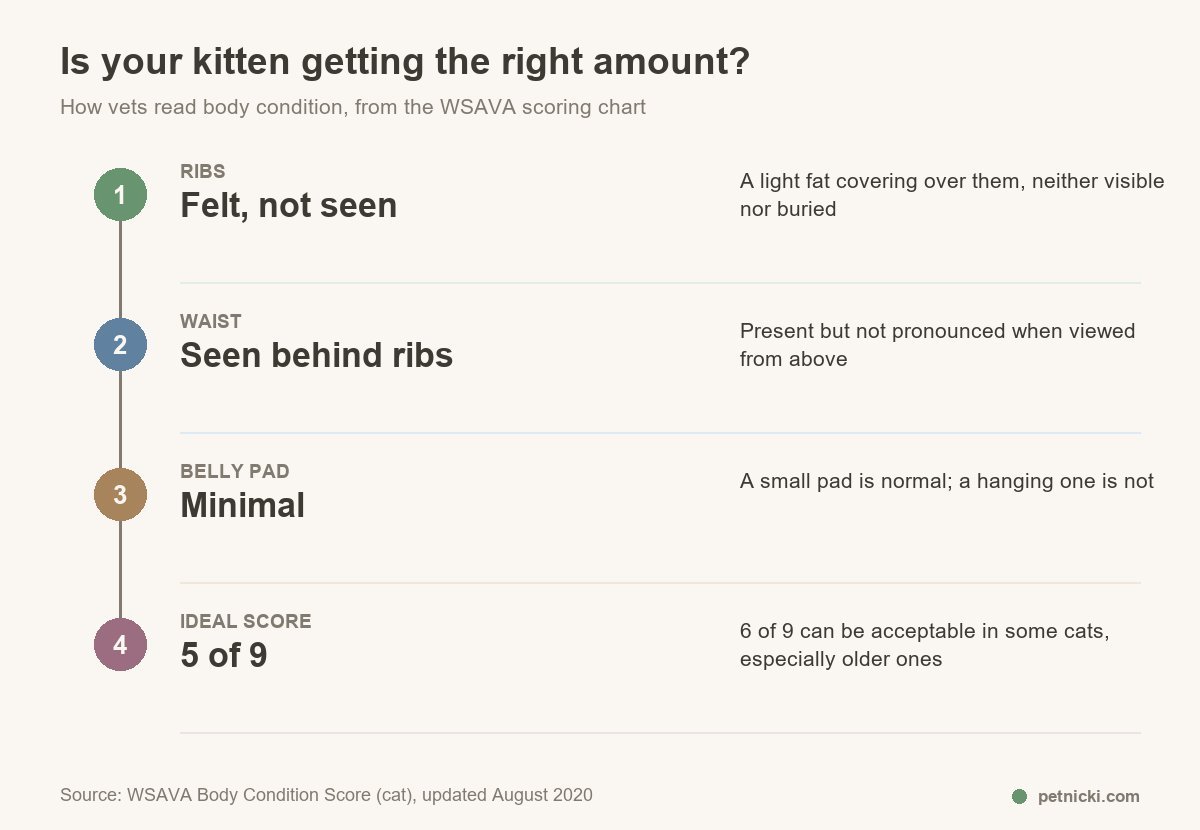
A score of five out of nine is the target on the WSAVA chart: ribs you can feel under a light fat covering, a waist visible behind the ribs without being pronounced, and a minimal abdominal fat pad. Ribs you can see on a short-haired kitten mean the portion is too small. Ribs you cannot find under the covering mean it is too large.
Weigh her regularly on kitchen or baby scales and write it down; International Cat Care recommends the same habit for adult cats, and the same logic drives pet weight management at every life stage. A growing kitten should be gaining, and a flat or falling reading is information you want early.
Adjust in small steps and let each change settle before judging it. Body condition shifts slowly, and owners who re-cut the portion every few days end up chasing noise.
Frequently asked questions
Can I leave a 3 month old kitten alone for 8 hours?
A twelve-week-old kitten should not go eight hours without food, water, or a check. If your workday is that long, a timed feeder covering the middle of the day solves the feeding half, but a kitten this young also needs someone looking in on her.
Will kittens stop eating when full?
Not reliably. Cats given unrestricted access to food often overeat, which is the route to obesity that International Cat Care warns about. Self-regulation is not a safe assumption to build a feeding plan on, especially with a kitten who is growing and hungry.
Is 2 meals enough for a kitten?
Two meals will keep a kitten alive but sits well below the recommended pattern. International Cat Care advises splitting the daily ration into at least five portions across 24 hours. Timed and puzzle feeders make that practical without five separate trips to the bowl.
How do I know if my kitten is overfed?
Run your hands over her ribs. If a layer of fat makes them hard to find, and her waist has disappeared when viewed from above, she is over the ideal five out of nine on the WSAVA body condition chart. A rounding belly with an obvious fat pad points the same way.
My kitten acts hungry after every meal. Should I feed more?
Begging is not a measurement. Check her body condition first, and if she scores at or above five out of nine, the amount is adequate and the behavior is about the routine instead of the calories. Puzzle feeders and more frequent smaller portions usually settle it.
The packet chart gets you a starting number; her ribs tell you whether it was correct. Give any change time to show on her body before you decide it failed.
General information only, not veterinary advice. If your kitten is losing weight, refusing food, or gaining nothing over consecutive weeks, contact your veterinary team.