
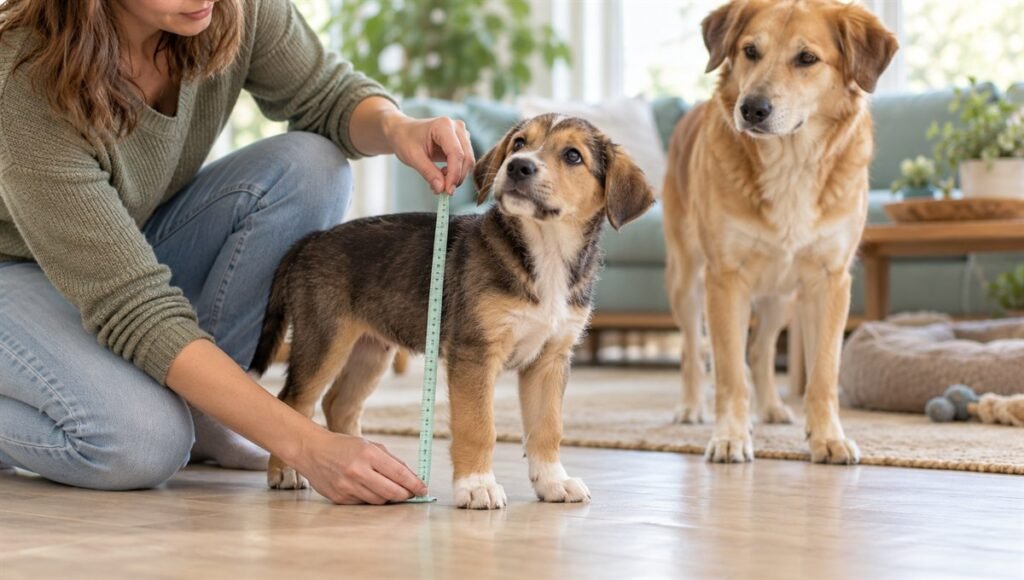

The standard estimate is to double a medium, large or giant puppy’s weight at 16 weeks, and to triple a small or toy puppy’s weight at 8 weeks, according to Sarah J. Wooten, DVM, writing for Great Pet Care. Treat either figure as a ballpark, because breed, sex and neutering all shift the result.
How big will my puppy get also depends on what you know about the parents, and the answer loosens the less you know. A shelter mix of unknown parentage is the hardest case, which is why the places where the rules fail matter as much as the rules themselves.
How Big Will My Puppy Get? The Two Multipliers
Weigh the puppy at 16 weeks and double it for a medium to giant dog, or weigh at 8 weeks and triple it for a small or toy one. Wisdom Panel’s vets use the same doubling at four months: a puppy at 15 lb suggests roughly 30 lb, give or take a few pounds.
For a small dog the arithmetic starts earlier. As an example, a puppy that weighs 3 lb at 8 weeks comes out at about 9 lb. The multiplier changes with size because small dogs finish growing sooner: Wisdom Panel says toy breeds often reach adult size by as early as eight months, whereas giant breeds may keep growing for up to two years. A small puppy is simply further along its growth at a given age, which is the likely reason one multiplier cannot serve every size.
Both rules assume you know the age. The WALTHAM Petcare Science Institute points out that in a young puppy a week or two can change how growth is read, and that a shelter puppy’s birth date is usually an estimate, so any curve built on it should be followed with caution.
Why the Multiplier Misses
Breed, sex, neutering and early health all move the adult weight, and a multiplier ignores every one of them. Wisdom Panel names breed as the greatest source of variance in adult height and weight.
Males tend to be a little larger than females, and Waltham adds that they grow more quickly — so a female may reach her size sooner and finish lighter. Neutering matters too, although the sources frame it differently: Wisdom Panel cites a study in which neutering before about nine months slightly increased adult size and later neutering slightly decreased it, while Great Pet Care says dogs neutered earlier tend to be taller and heavier. Puppies that were malnourished early, or that have orthopaedic, metabolic or organ disease, tend to be smaller, Great Pet Care adds. The formulas themselves, it notes, make no allowance for neutering, nutrition or health problems.
Mixed breeds show the gap most clearly, as one r/mutt commenter found after adopting a puppy from a shelter:
“It’s kind of hard to tell. We adopted a mixed breed puppy at 10 weeks old from the shelter and when we took her to the vet they said she would probably be around 20 lbs as an adult. She is 38 lbs at nearly 11 years old. It’s so hard to tell with mixed breeds.”
– r/mutt (8 upvotes)
That was a vet’s estimate at 10 weeks, and the dog finished at nearly double it. One dog says nothing about how often estimates miss, but it shows how wide “around 20 lb” can be when the parents are unknown.
Paws, Parents and Breed Ranges
Breed ranges and the parents’ sizes are the sturdier clues, and paws are the one the sources disagree on. Great Pet Care’s breed categories put toy breeds at up to 10 lb, small at 10 to 25, medium at 25 to 50, large at 50 to 100 and giant above 100, and it warns that they work less well for mixed breeds, or for mixes whose parents come from different size groups.
Paws split the sources. Great Pet Care calls paw size a fairly reliable predictor but a subjective one, and suggests a second opinion from your vet. Wisdom Panel warns that some dogs simply have large or small feet for their body. On r/mutt, replies with 41 and 19 upvotes said big paws mean a big dog, and a third reply, with 8 upvotes, said that paws in proportion to the body suggest a dog that is full grown or close to it. If you’re choosing between two size bands, paws can break the tie. They don’t give you a weight.

Track the Curve Instead of Guessing Once
Weigh your puppy three times, two weeks apart, from 12 weeks old. The Waltham Petcare Science Institute says the curve those weights draw may then serve as a rough guide to adult weight, provided the puppy keeps growing at a healthy rate.
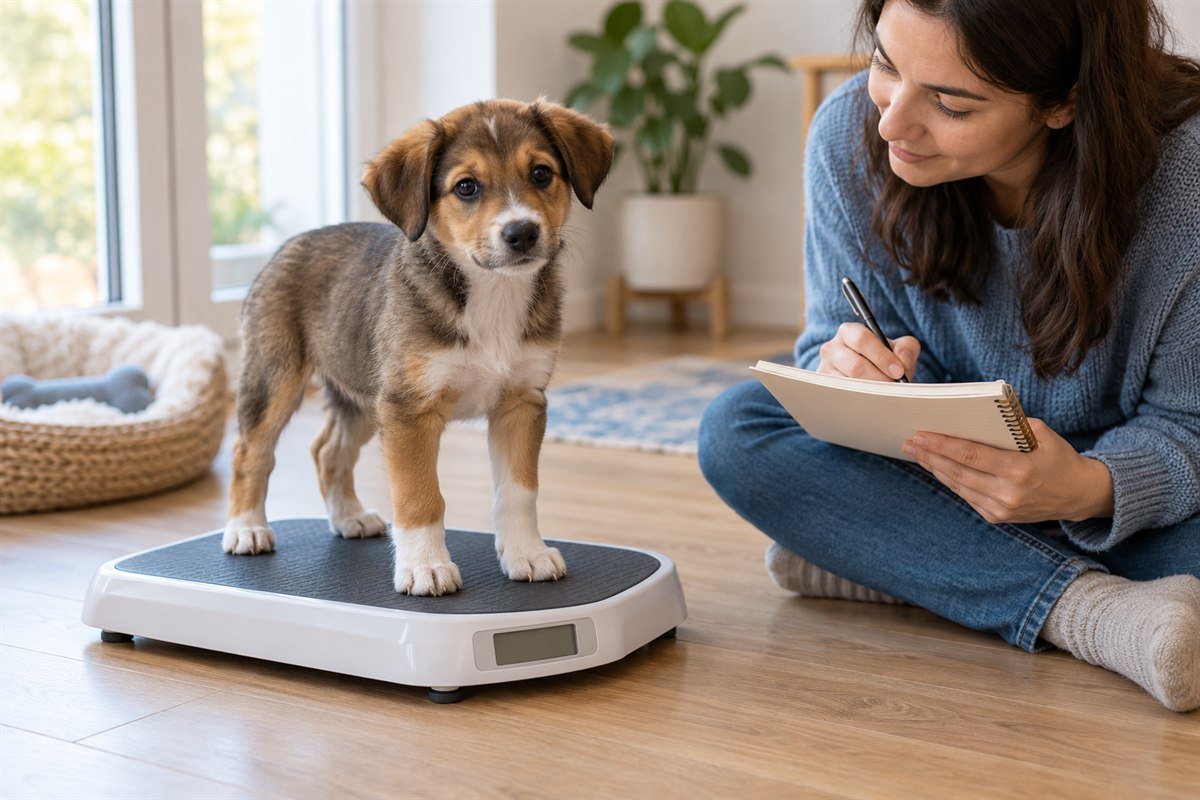
- Fix the birth date. Use the breeder’s date. For a shelter puppy, ask the vet for an estimate and remember that the curve built on it is only as good as the guess.
- Start weighing at 12 weeks. Waltham’s charts are validated from 12 weeks, and the colour zones appear once two weights have been entered two weeks apart, so the earliest you will see them is at 14 weeks.
- Keep weighing. Waltham suggests every 2 to 4 weeks up to 6 months, then every 1 to 3 months until the dog is fully grown.
- Compare with a size group. The charts come from 50,000 healthy young dogs weighed at Banfield Pet Hospitals in the USA, with 14 charts across seven size groups for males and females. A weight in the green zone is on the expected track, orange means growing a little faster or slower than expected, and red means check the scale and the date, then weigh again two weeks later.
Growth isn’t smooth, which is why three weights beat one, as one r/MiniSchnauzer owner described:
“Mine seemed to plateau around the 8-9 lbs mark at 5 months but then added another 6 lbs pretty soon thereafter (he’s fully grown at 15 lbs)”
– r/MiniSchnauzer (2 upvotes)
Anyone who had read the plateau as the answer would have been about 6 lb short. A run of weights shows a stall for what it is, and a single weighing cannot. The same run would also have caught the jump that followed.
When to Stop Guessing
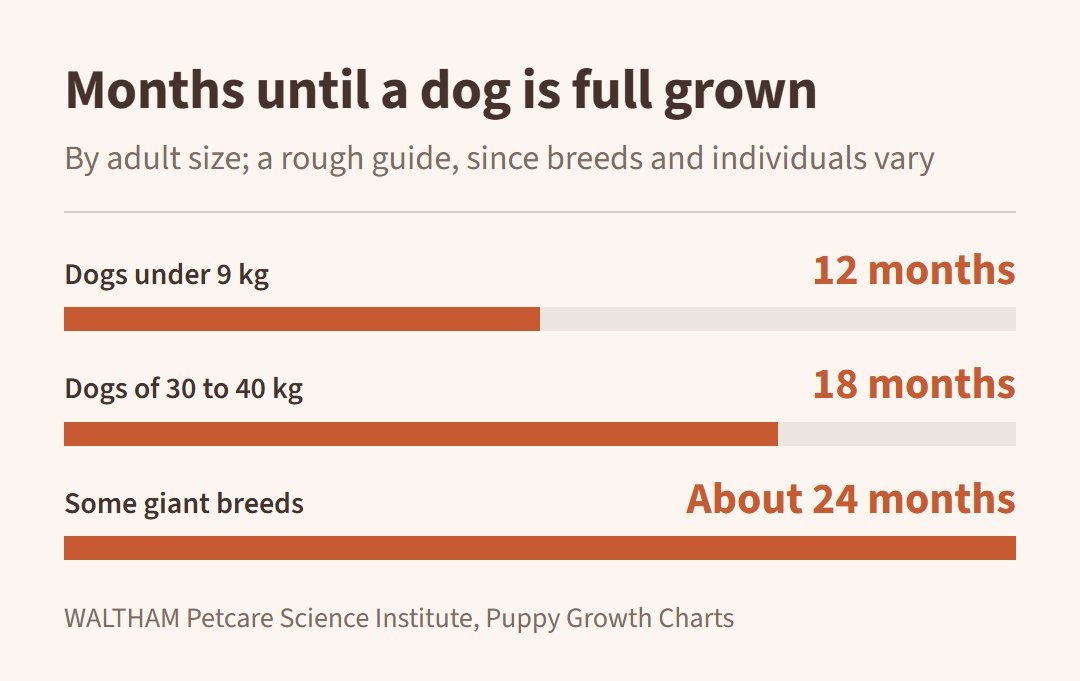
Once a dog is close to full grown, its current weight is the answer. Waltham says dogs under 9 kg (about 20 lb) finish growing in 12 months, a 30 to 40 kg dog (roughly 66 to 88 lb) in 18 months, and some giant breeds in almost two years, or about 24 months.
Before then, a DNA test is the most precise route on offer. Wisdom Panel ranks formulas as low accuracy, breed averages and parentage as medium and its own DNA tests as high, and since it sells those tests the ranking deserves a pinch of salt. Your vet can also give an estimate and, as Great Pet Care points out, already knows the puppy’s history.
For a quick number from one weight and an age, our puppy weight calculator gives a likely adult weight with a range, and the puppy growth chart sets out typical weight by age so you can see where your puppy sits. Great Pet Care describes calculator results as general estimates that ignore neutering, nutrition and health, so when a calculator and your own measured curve disagree, trust the curve.