
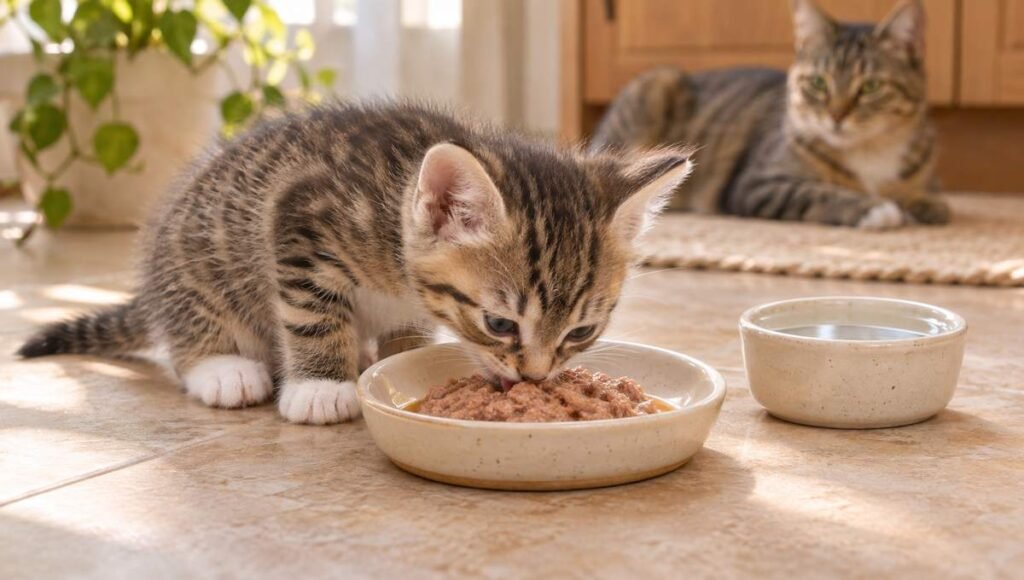

Kittens can usually start on dry food at about 5 to 6 weeks old, softened with water or kitten formula and added to wet food they are already eating. PetMD and Cats.com both give that age, and Cats.com has them mostly on dry kitten food by 7 to 8 weeks. Before about 3 to 4 weeks the answer is milk, not kibble.
When Can Kittens Eat Dry Food? What Four Sources Say
Dry food is the last step of weaning, so every source starts the clock with milk. International Cat Care says weaning should begin at around three to four weeks, and it is the most generous on dry food, saying you can offer wet or dry kitten food from then if the dry is moistened with water or kitten milk.
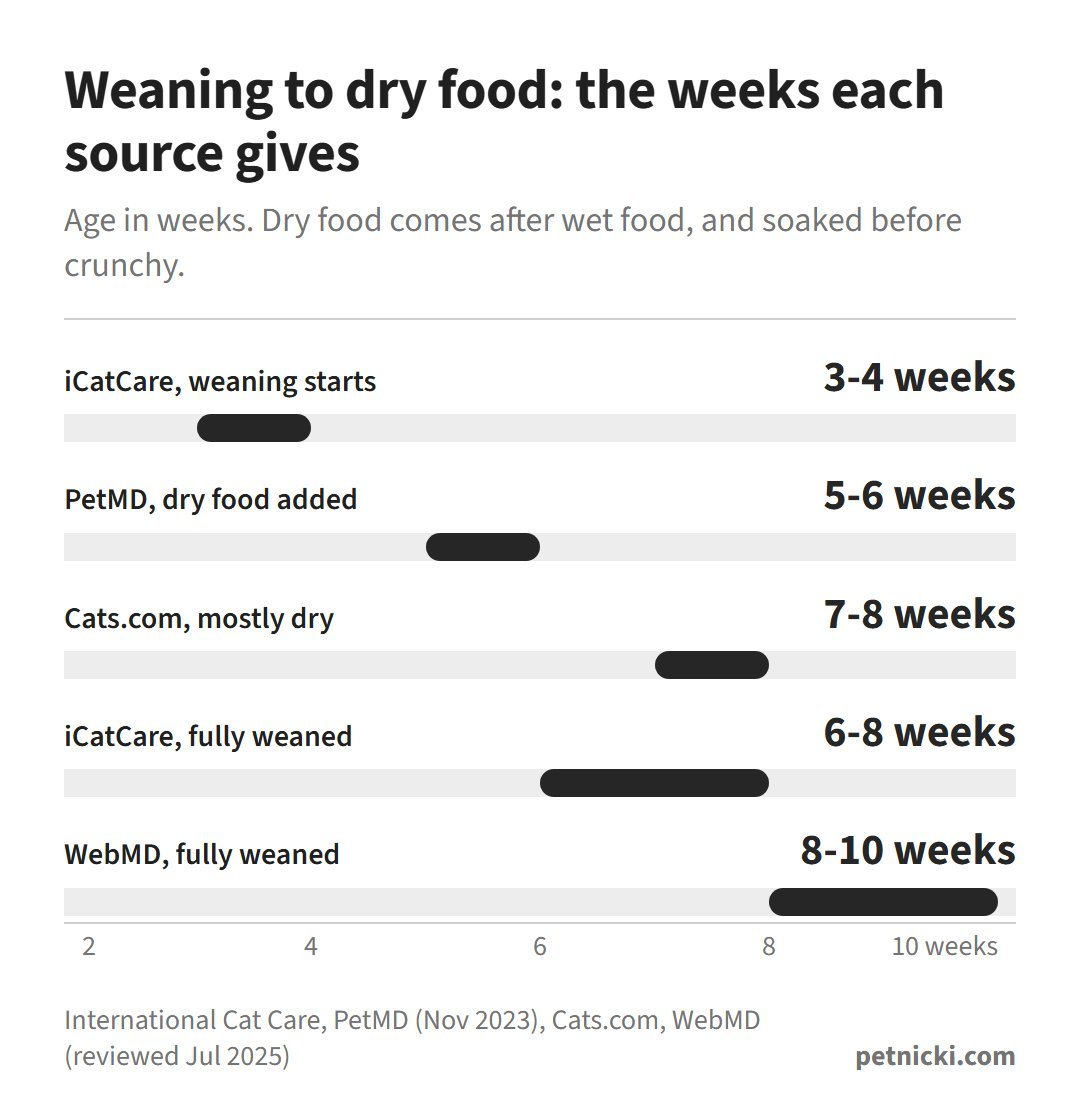
PetMD, in a November 2023 article by Dr Krista Seraydar, puts readiness for solid food at about 4 weeks, with some kittens ready at 3. It starts with canned kitten food and adds a dry-food mixture at 5 to 6 weeks, about a week later. Cats.com follows the same order: wet food mixed with water or formula at 4 weeks, dry added at 5 to 6, wet reduced at 6 to 7 weeks and mainly dry by 7 to 8 weeks. WebMD, medically reviewed by a vet in July 2025, begins at around four weeks and has a typical kitten entirely weaned between eight and ten weeks.
The sources agree on the order and differ on the speed. PetMD has the switch complete by 8 weeks, while International Cat Care says fully weaned by around six to eight weeks and WebMD allows up to ten. The one condition none of them drops is that early dry food is softened. You aren’t asking a 5-week-old kitten to crunch.
Signs Your Kitten Is Ready for Solid Food
Age is a guide — the kitten has the final word. PetMD lists four signs: the kitten is more mobile, has its baby canines and incisors, is becoming curious and playful, and is showing interest in its mother’s solid food. WebMD adds that a kitten ready to wean can stand with its tail held up, and that one unable to stand, play or focus its eyes is too young. If you’re unsure whether the eyes are ready, they should normally be fully open at around two weeks (when kittens open their eyes covers the timeline), well before weaning starts.
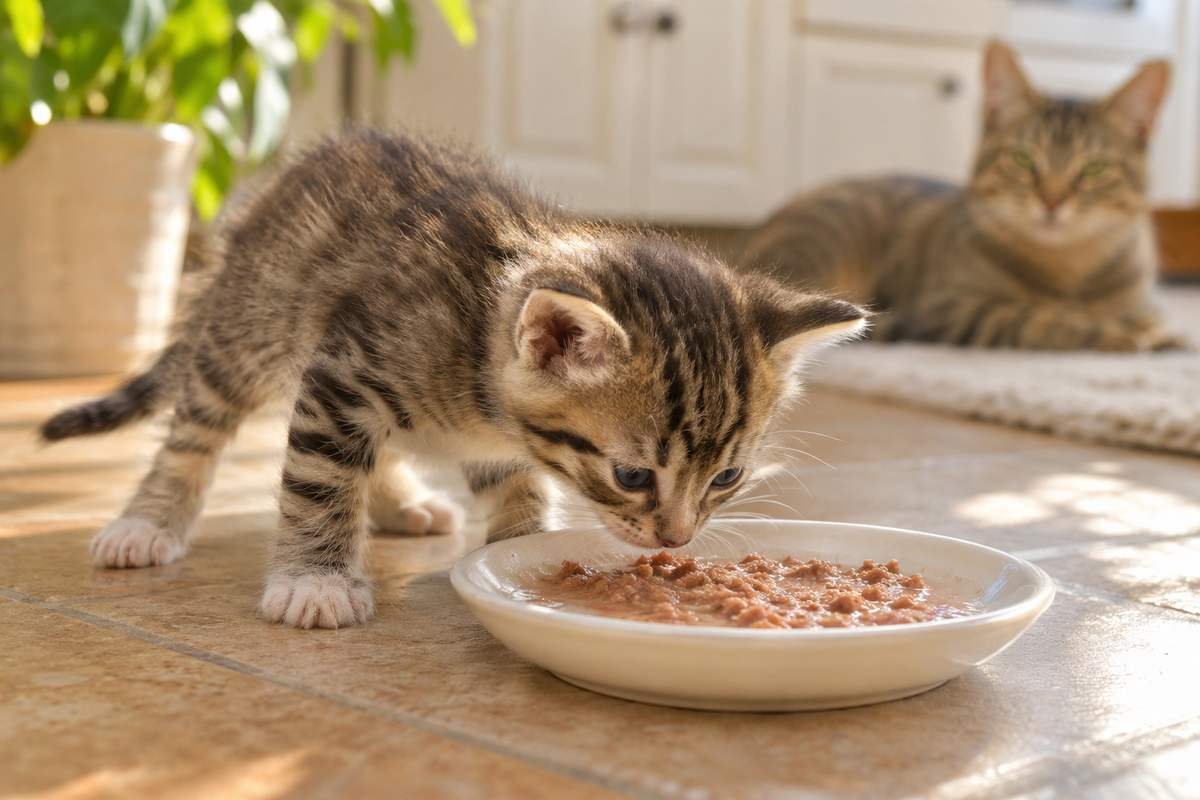
Going too early has a cost. PetMD says that weaning too soon can lead to behavioural problems such as anxiety and aggression, and that it is always better to wean later. International Cat Care says that weaning too early or too suddenly stresses the mother, at a time that is already stressful for the kittens.
One reply in an r/CatAdvice thread on the same question put the readiness point bluntly:
“If they *are* eating it then they *can* eat it no problem. Age isn’t a set rule, as they develop and mature at different rates. You’re fine to cut down wet food as long as they’re drinking plenty of water and act satisfied with the kibble”
– r/CatAdvice (3 upvotes)
That’s one owner’s view, with few upvotes. It fits the readiness signs above, though you’ll notice it leaves out the softening step that the vet-written sources all include.
Wet Food First, Then Soaked Dry, Then Dry
PetMD’s weaning steps are the most detailed of the four sources, and Cats.com and International Cat Care agree with them on the main points. Put together, the sequence looks like this.
- Pick a complete kitten food. PetMD asks for a statement from the Association of American Feed Control Officials (AAFCO) confirming that the food meets the nutritional needs of a growing kitten. International Cat Care adds that adult food lacks nutrients for growth.
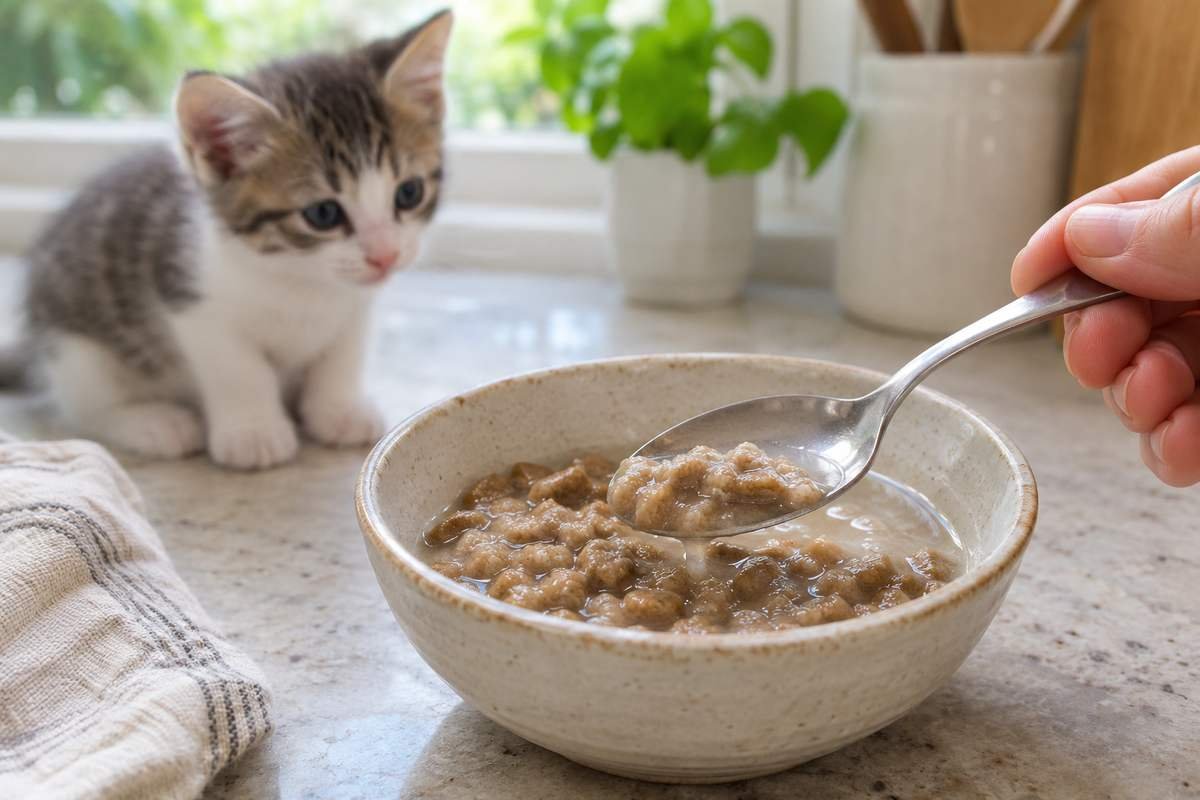
- Start with wet. Mix a little canned kitten food with kitten formula or warm water and offer it on a spoon, a shallow dish or your fingertip. PetMD says the move to wet food can take a few days to a week.
- Add soaked dry food. About a week later, repeat the process with dry kitten food mixed with formula or warm water, at 5 to 6 weeks. Cats.com says you can also soak the kibble before offering it.
- Cut back the liquid. Reduce the water or formula a little at a time until the kibble goes in dry. PetMD says this should be done by 8 weeks, though it varies by kitten.
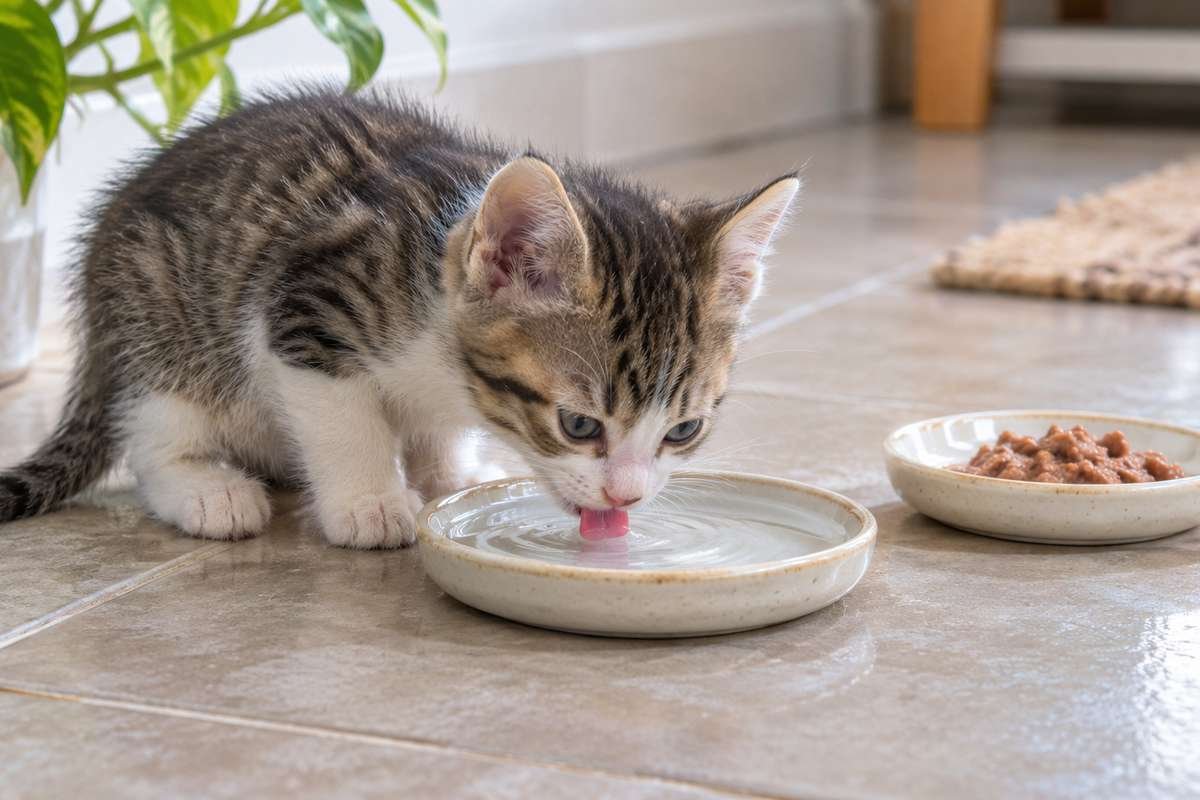
- Keep water down. Kittens can show interest in water from about 4 weeks, and PetMD asks for a shallow dish no more than 2 inches deep.
Do not use cow’s milk to soften anything. PetMD says to use warm water or kitten formula, and both PetMD and WebMD warn that cow’s milk can upset a kitten’s stomach. If a kitten is not eating the recommended amount and is not gaining weight steadily, PetMD says it should still get formula until it is.
Do Kittens Still Need Wet Food?
Cats.com says very young kittens need at least some wet food, because their immature teeth can’t chew dry well. Once a kitten chews kibble properly, it says, dry kitten food alone is fine.
The same page says cats develop texture preferences early, so offering both is a way of raising a kitten that will eat either later. That is the site’s claim, not a measured finding.
Not everyone on Reddit accepts that dry is fine. In the r/FosterAnimals thread where an owner asked when 7 and 8-week-old kittens could eat mostly kibble, one reply took the opposite line:
“They should mostly eat wet food throughout their lives if you want to avoid expensive kidney issues later on.”
– r/FosterAnimals (4 upvotes)
None of the four sources I read makes that kidney claim, and the comment offers no source of its own, so treat it as an opinion. The point they do share is the practical one: whichever mix you choose, the food must be a kitten diet, and PetMD says kittens should stay on a commercial kitten diet until they are at least 12 months old.
How Much and How Often
The sources give meal counts rather than portions. International Cat Care suggests at least four feeds a day, or ideally food available all the time.
Cats.com says wet food should be offered at least four times daily and dry can be left out for grazing. PetMD asks you to replace food every three to four hours and to follow the amounts on the packet.
For the amounts themselves, the packet chart is your starting point, and the page on feeding a 3-month-old kitten explains how to adjust it, while the pet food calculator turns a calorie target into grams or cups. For later stages, see the cat feeding guide by age.
Kitten Dry Food Questions
When can kittens start drinking water?
PetMD says kittens can show interest in water as early as 4 weeks. Because formula and canned food contain a fair amount of water, you may not see much drinking until they move to dry kibble, so keep a shallow dish of fresh water down regardless.
Can kittens eat adult cat food?
Not as a staple. International Cat Care says adult food lacks nutrients for growth, and PetMD asks for a commercial kitten diet until at least 12 months.
What about an orphaned kitten?
WebMD says an orphan can begin weaning at about three weeks if it shows signs of readiness, using kitten formula in a shallow saucer. PetMD agrees that some kittens are ready at 3 weeks. WebMD wants an orphan confident about eating on its own as early as possible, since there is no mother to finish the job.
How do I know weaning is going well?
PetMD asks that the kitten eats consistently at every meal and gains weight daily. Vomiting, diarrhoea, lethargy or loss of appetite means a vet should examine the kitten as soon as possible.