
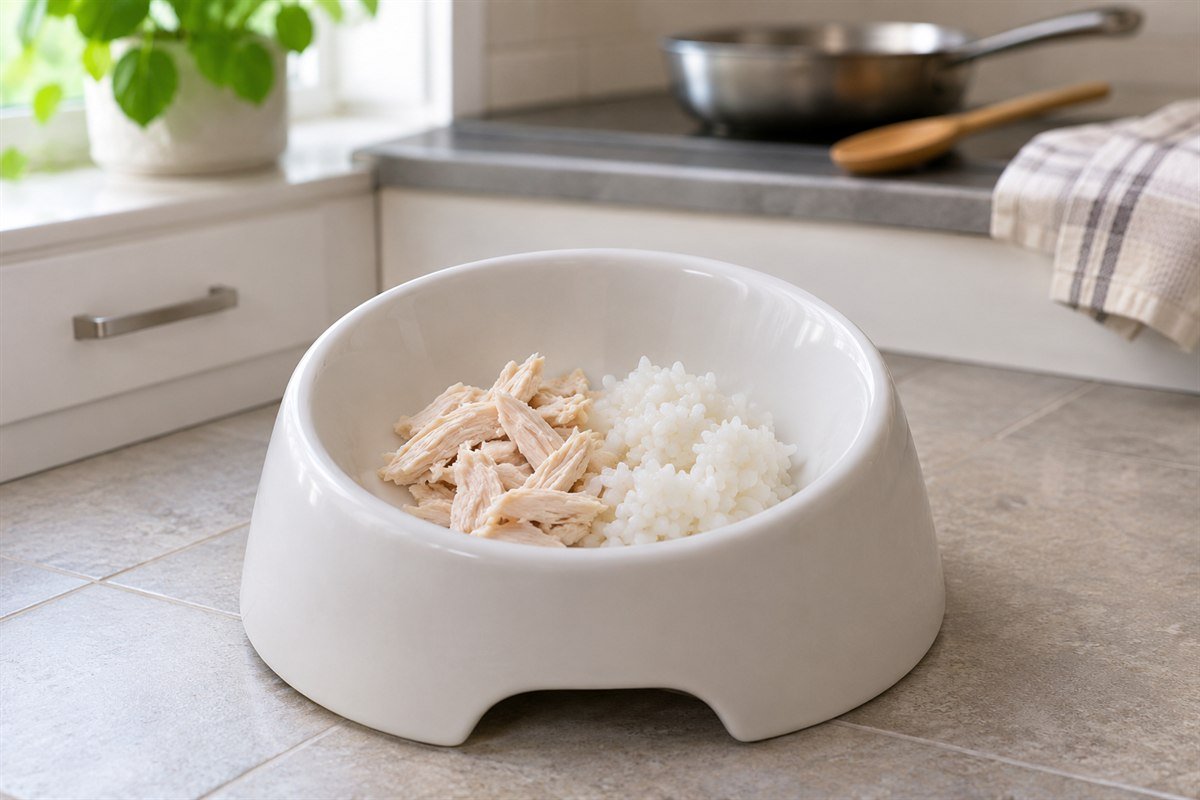
What can I give my dog for an upset stomach? PetMD says that if the problem has lasted under 48 hours and your dog is still eating and drinking, not lethargic and passing no blood, you can try small amounts of plain boiled white-meat chicken and white rice with no salt, fat or seasoning. Four veterinary and pet-care pages agree on that meal and split on much of what surrounds it.
Below, those pages sit side by side: where they agree, where they differ on fasting, pumpkin and timing, and the signs that make home care the wrong plan. It’s general information, not a diagnosis, so ring your vet if you’re unsure.
What Can I Give My Dog for an Upset Stomach? The Common Ground
PetMD, Petco, Thrive Pet Healthcare and Ruby Vet all point to a plain, boiled bland meal in small portions, and Petco and Thrive add no treats or table scraps and no human medicines. Petco, updated on 28 October 2026, says to mix protein and carbohydrate at your vet’s ratio, typically 1:2.
Petco also suggests feeding every four to six hours instead of in big meals, and choosing white rice over brown because white rice is lower in fibre. Its list of foods to leave out is long: fatty and fried food, dairy, commercial treats, raw food, table scraps, bones and chews.
Water matters too. Petco lists dry or tacky gums, lethargy, skin that stays tented when pinched, sunken eyes and reduced urination as signs of dehydration, and says to offer water in shallow bowls or add water to the food. On broth the pages part company: Petco says to avoid flavoured broths unless a vet approves, while Thrive suggests ice cubes, low-sodium broth or Pedialyte for a dog that won’t drink.
“Introductions of treats during the transition can make pinpointing the cause of tummy issues difficult. One thing at a time. Good luck!”
– r/DogFood, a reply on a short-term feeding thread, 2026 (7 upvotes)
Where the Vet Advice Differs
The four pages differ on whether to fast first, whether pumpkin helps, how long to keep the bland diet going and when to stop waiting at home. Each row below reflects what that page says, and a dash means it doesn’t cover the point.
| Question | PetMD | Petco | Thrive | Ruby Vet |
|---|---|---|---|---|
| Fast first? | Not mentioned; small bland meals if under 48 hours | Not mentioned; small portions every 4 to 6 hours | Hold food for a few hours if vomiting | 12 hours without food and water, adults only |
| Pumpkin? | Canned 100% pumpkin adds fibre for diarrhoea | Listed, but extra fibre could worsen diarrhoea | Too little fibre to work in most cases | — |
| How long on bland food? | — | 2 to 3 days | Diarrhoea typically takes 3 to 5 days | 3 to 5 days, then 3 to 5 days back to normal food |
| Call the vet when? | Over 48 hours, or any extra symptoms | Diarrhoea over two days, or any red flag | Vomiting or not eating beyond 24 hours | Most mild cases settle in 24 to 48 hours |
Some of the split is about the dog. Ruby Vet says withholding food and water is for healthy adults only, and that puppies, small or miniature breeds and dogs with underlying conditions need a vet’s guidance first. Pumpkin is plainer disagreement: Thrive’s objection is volume, since it says the amount of canned pumpkin needed for even a small dog would be excessive.
The honest summary: these pages don’t agree on a single schedule. Pick the cautious end of each row — and let the call to your vet settle the rest.
Getting Back to Normal Food
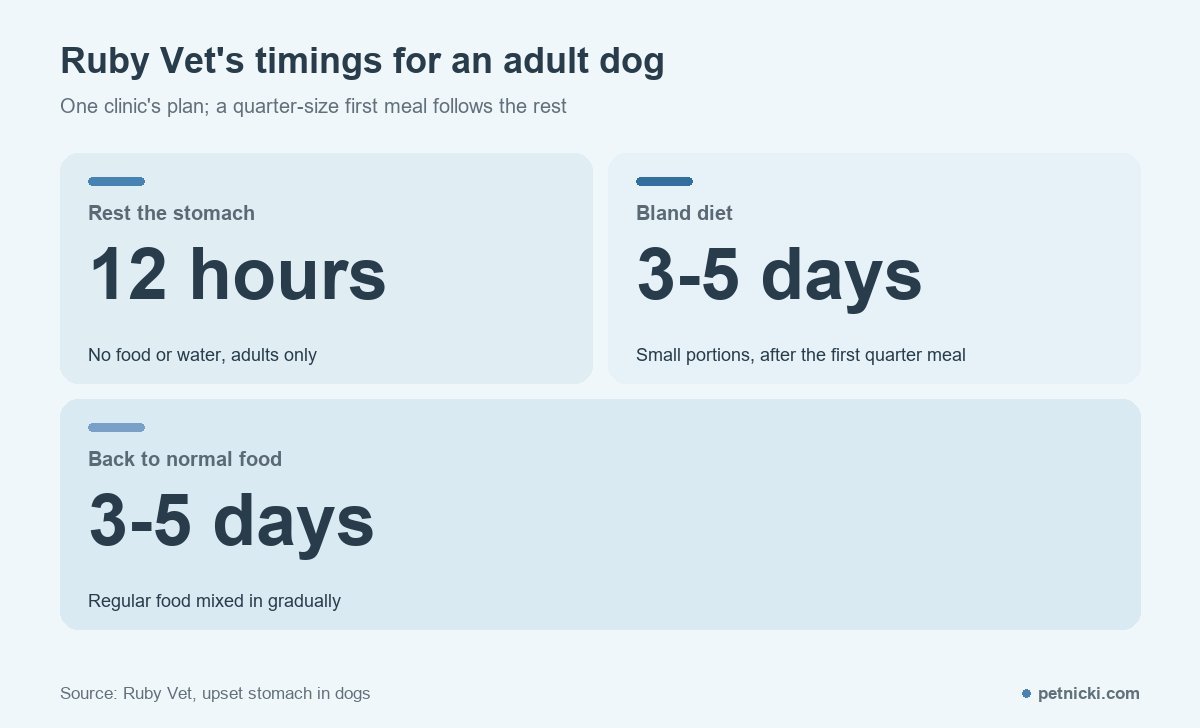
Ruby Vet gives the most detailed recovery sequence of the four, written by an emergency and urgent care vet, and it is one clinic’s plan rather than a standard. It starts with small sips of room-temperature water, since cold water can shock the stomach, and moves on to about a quarter of a normal meal.
Petco is a little quicker. After 24 to 48 hours without symptoms its page has the vet mixing regular food into the bland diet over several meals or several days, depending on how bad the upset was. Ruby Vet says vomiting or diarrhoea that returns once the regular food is back means the dog needs a vet, while Petco says the vet will generally pause feeding if symptoms return.
What Not to Give: Human Medicines
Petco and Thrive both say not to give over-the-counter antacids, anti-diarrhoeals or pain relievers made for people without a vet’s instruction. Thrive’s reason is that some have drastically different dosages from the veterinary versions and some are very toxic to dogs.
Ruby Vet spells out two examples. Pepto-Bismol can turn stools greenish-black, which makes them harder for a vet to assess, and its tablets show up on X-rays and can be mistaken for a foreign body. Imodium slows the gut, so Ruby Vet doesn’t recommend it where bacteria, viruses or parasites are behind the diarrhoea, and dogs with the MDR1 gene mutation, including Collies, Shelties and Australian Shepherds, shouldn’t take it.
Vets do use drugs in these classes. PetMD lists anti-nausea medication and antacids such as omeprazole or famotidine among its treatments, but those come with a diagnosis and a dose that your vet chooses.
When Home Care Is the Wrong Plan
PetMD says an upset stomach lasting longer than 48 hours, or with any symptom beyond vomiting and diarrhoea, needs a vet, and that blood in vomit or stool can mean an emergency such as haemorrhagic gastroenteritis. Petco adds repeated vomiting, severe lethargy, belly pain or bloating, and refusing food or water to the list.
Ruby Vet says an immediate reaction of vomiting, a refusal to eat, lethargy, vomiting that returns within 24 hours or diarrhoea that reappears after the first bland meal means an appointment. It also says pets with bloody stools or vomit must be evaluated, and it names stools that look like raspberry jam as a significant sign.
One post in r/DogHealth shows how a visit can go. The owner’s dog had three bouts of vomiting in 24 hours, and the vet found a normal blood panel and a little inflammation on ultrasound:
“Blood work was pristine, ultrasound showed some inflammation on the stomach lining. Vet recommended bland diet and gave her anti-nausea meds and antacids.”
– r/DogHealth, 2026 (2 upvotes)
Before you phone, write down what your dog ate and when, how often it vomited or had diarrhoea, and whether the stomach contents came up undigested, which counts as regurgitation, not vomiting. Petco’s page lists these questions for the call. If the main sign is yellow foam or a dog that won’t eat, the pages on dog vomiting yellow foam and a dog that is not eating on this site cover those cases.