


People searching for pit bull breeds online find scattered, conflicting information. Some pages list three breeds, others stretch the list to twenty. The reason this happens is simple: “pit bull” is not an official breed name. It is a loose label applied to many dogs that share a blocky head, short coat, and muscular build.
This guide gives you the full picture. You will learn exactly which breeds are officially recognized, what makes each one different from the others, which dogs get mistaken for pit bulls, and how temperament actually works with these dogs.
What “Pit Bull” Actually Means
The term has no formal definition in any breed registry. It started as a description for dogs used in bull-baiting in 19th century England, where bulls and dogs were put together in enclosed pits as a spectator sport. Dogs of many different breeds were involved, not just one type.
Today the label is applied based on appearance. Any dog with a wide jaw, thick neck, and short coat can end up called a pit bull by shelters, media, and even some vets. This matters because those labels follow dogs throughout their lives and often affect their chances of being adopted.
The American Kennel Club and the United Kennel Club use the term “pit bull type” to describe four specific recognized breeds. These four are the only ones with any formal standing as pit bull type dogs.
The 4 Official Pit Bull Type Breeds
According to the AKC and UKC, four breeds fall under the pit bull type category. Each has its own distinct history, build, and registered breed standard.
American Pit Bull Terrier
The American Pit Bull Terrier is the breed most people picture when they hear “pit bull.” It is recognized by the United Kennel Club and the American Dog Breeders Association. The AKC does not recognize it, a decision that goes back to the 1930s when the AKC created a separate registration to distance the breed from its fighting past.
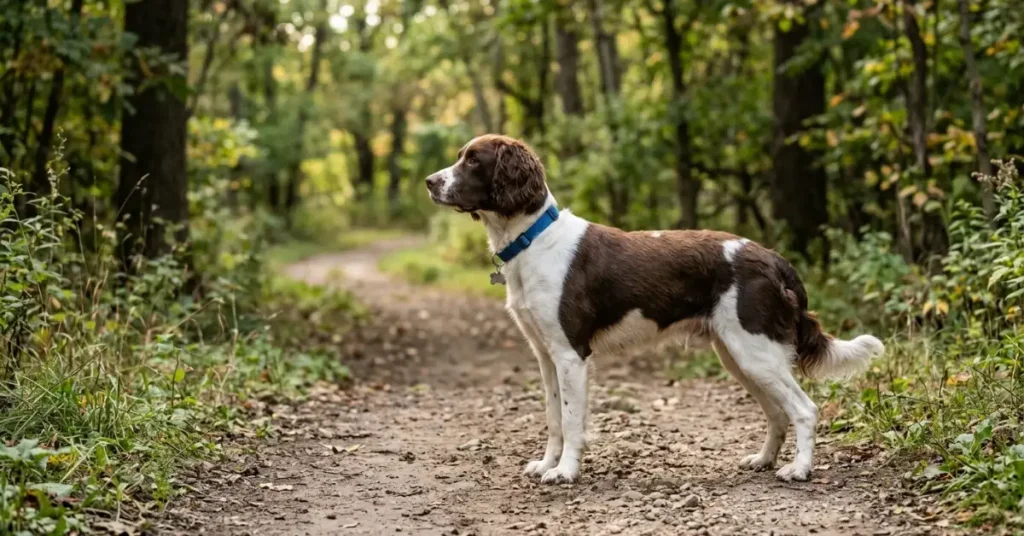
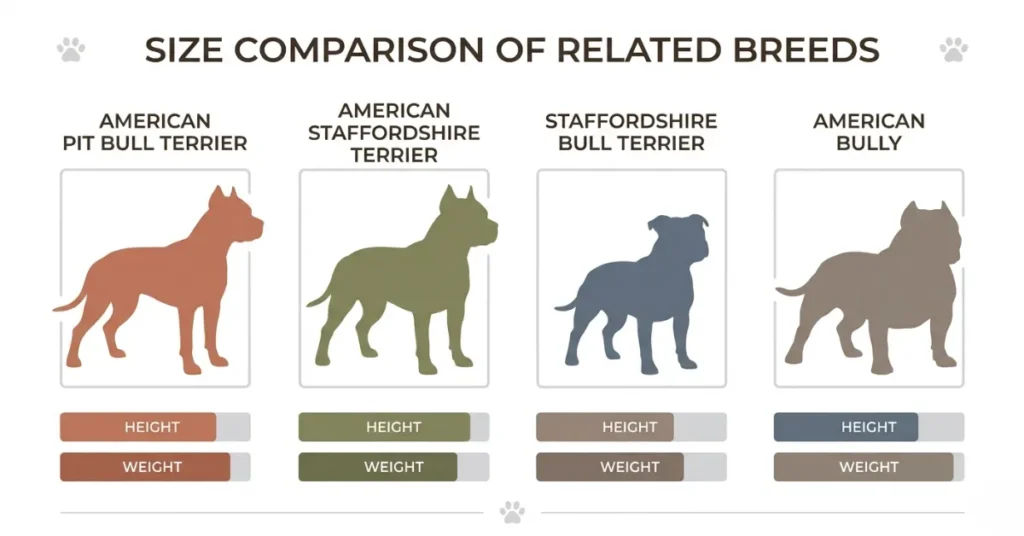
Males weigh between 35 and 60 pounds and stand 18 to 21 inches tall. Females are slightly smaller. The body is lean and athletic, built for movement rather than bulk.
In terms of personality, the APBT is confident, energetic, and deeply attached to its owners. It responds well to training because it genuinely wants to work alongside people. Many APBTs work today as therapy dogs, search and rescue dogs, and in K9 detection roles. The working drive that made this breed useful in the past is now channeled into legitimate, helpful work.
American Staffordshire Terrier
The American Staffordshire Terrier, often called the AmStaff, shares its ancestry directly with the APBT. In 1936, the AKC opened its registration to a group of American Pit Bull Terriers under the name Staffordshire Terrier. The name was changed to American Staffordshire Terrier in 1972 to prevent confusion with the newly registered British breed.
AmStaffs weigh between 40 and 70 pounds and stand 17 to 19 inches tall. The build is heavier and more compact than the APBT, shaped by decades of AKC conformation breeding rather than working performance.
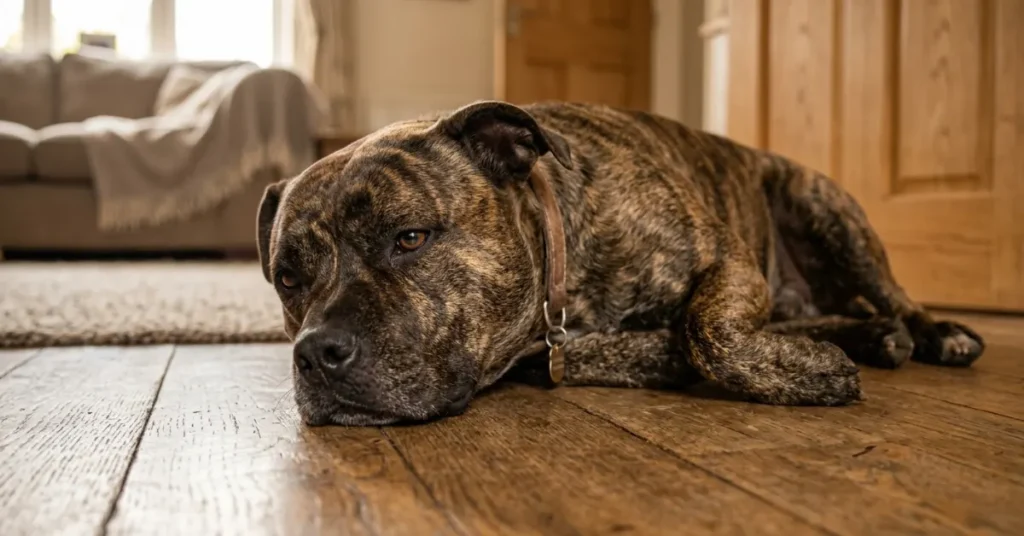
The AmStaff is known for being calm and steady around families. Because this breed has been selected for temperament and appearance in show settings for nearly 90 years, it tends to be slightly more uniform in behavior than its APBT cousins. Some dogs carry dual registration, listed as both an AmStaff with the AKC and an APBT with the UKC.
Staffordshire Bull Terrier
The Staffordshire Bull Terrier is the oldest and smallest of the four recognized breeds. It comes from England and was formally recognized by the AKC in 1974.
Weight runs between 24 and 38 pounds, with height between 14 and 16 inches. The Staffy is compact and low to the ground, carrying significant muscle on a short frame. Standing next to an APBT, a Staffy looks almost like a smaller, rounder version of the same type.
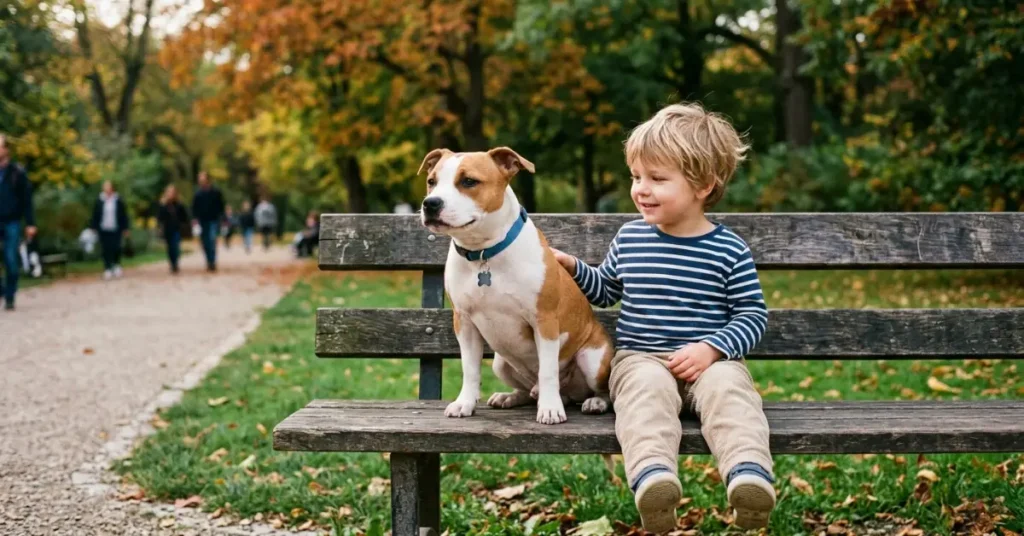
This breed is widely known for its patience and affection with children, which earned it an informal nickname in England as the “nanny dog.” That reputation reflects genuine breed behavior. Staffies are intensely people-focused and do best in households where they can spend time with their owners rather than being left alone for long periods.
The Staffordshire Bull Terrier is one of the most popular dogs in the United Kingdom and is considered far less controversial there than the term “pit bull” tends to be in the United States.
American Bully
The American Bully is the newest of the four recognized breeds. It was developed in the United States during the 1990s through selective breeding of American Pit Bull Terriers and other bully-type breeds. The goal was to create a companion-focused dog with reduced working drive and a naturally calm temperament. The UKC formally recognized it as its own breed in 2013.
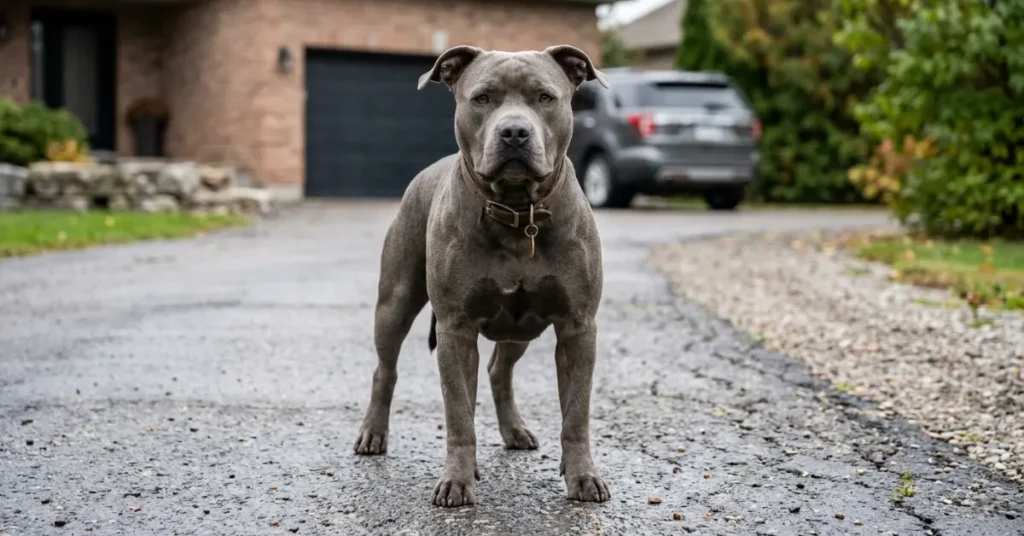
The American Bully comes in four size classes: Pocket, Standard, Classic, and XL. A Pocket Bully can weigh as little as 30 pounds, while an XL can exceed 100 pounds. Despite the size range, all four classes share the same characteristic wide chest, heavy bone structure, and short, smooth coat.
This breed is often confused with the American Bulldog, but these are two separate dogs with different ancestry, different physical standards, and different registries. The American Bully was specifically designed as a family companion, and responsible breeders worked to remove the dog-aggression and high drive traits found in older bully lines.
Dogs That Get Mislabeled as Pit Bulls
More than 20 breeds share the broad head and muscular build that people associate with pit bulls. The most common ones that get misidentified include the American Bulldog, Bullmastiff, Cane Corso, Dogo Argentino, Boxer, and Bull Terrier.
These are all separate breeds with their own histories and registries. None of them are classified as pit bull type dogs by any major canine organization.
The mislabeling problem has real consequences. Dogs in shelters are often labeled as pit bulls based on looks alone, which can limit their chances of adoption in areas with breed restrictions. Research has shown that even trained shelter workers and veterinarians frequently get breed identification wrong when working from appearance. DNA testing almost always produces results that differ from the visual guess.
If you are considering adopting a dog that looks like a pit bull but has an unknown background, understanding the difference between purebreds and mixed breed dogs is worth reading about. You can explore more about why mixed breed dogs often make wonderful family pets and what that really means for behavior and compatibility.
How Temperament Actually Works in Pit Bull Type Breeds
This is the question most people have and most websites avoid answering clearly.
The American Temperament Test Society has collected standardized behavioral data on dogs since 1977. Year after year, the American Pit Bull Terrier, American Staffordshire Terrier, and Staffordshire Bull Terrier pass at rates comparable to breeds widely considered safe and family-friendly, including Golden Retrievers and Labrador Retrievers.
The ASPCA’s position is that no dog breed is inherently dangerous, and that behavior is shaped by individual genetics, upbringing, training, and environment. The same view is held by the American Veterinary Medical Association, the Humane Society of the United States, and the AKC itself. All of these organizations oppose breed-specific legislation for this reason.
What this means in practical terms: a pit bull type dog raised with consistent training, early socialization, regular exercise, and stable ownership will typically behave like any other well-raised dog. The breed label predicts less about behavior than most people assume.
Early socialization is genuinely important, not just for pit bull type dogs but for any breed. A dog that grows up with exposure to different people, animals, sounds, and environments from puppyhood develops confidence and adaptability that carries through its entire life.
Frequently Asked Questions
Does the AKC recognize the American Pit Bull Terrier? No. The AKC recognizes the American Staffordshire Terrier and the Staffordshire Bull Terrier. The APBT is recognized by the United Kennel Club and the American Dog Breeders Association.
What is the difference between a pit bull and an AmStaff? They share the same origin. The AmStaff descended from APBT lines but has been bred under AKC conformation standards since the 1930s, producing a slightly heavier build and a more uniform temperament profile.
How do I find out my dog’s actual breed? DNA testing is the only reliable method. Visual identification is inaccurate even for trained professionals. Most dogs labeled as pit bulls in shelters turn out to be mixed breed dogs when tested.
Are pit bull type breeds good with kids? All four recognized breeds have histories that include close family work. The Staffordshire Bull Terrier in particular is well known for patience with children. Like any breed, behavior depends significantly on how the dog was raised and socialized.
Why do shelters label so many dogs as pit bulls? Shelters typically identify breeds by appearance, and any blocky-headed dog can end up with the pit bull label. This leads to significant over-representation of the term and sometimes unfair adoption restrictions.
Are pit bulls banned anywhere? Yes. Some cities and countries have breed-specific laws targeting pit bull type dogs. Major animal welfare and veterinary organizations oppose these laws and advocate for behavior-based policies instead.
Summary
There are four officially recognized pit bull type breeds: the American Pit Bull Terrier, the American Staffordshire Terrier, the Staffordshire Bull Terrier, and the American Bully. Each has a distinct history, size range, and registered breed standard. Beyond those four, the pit bull label gets applied to dozens of other breeds and countless mixed breed dogs based on appearance alone.
If you want to understand a specific dog, its behavior and individual history will tell you far more than any label will.
For more practical guides on dog ownership, breeds, and behavior, explore more content at Petnicki.