
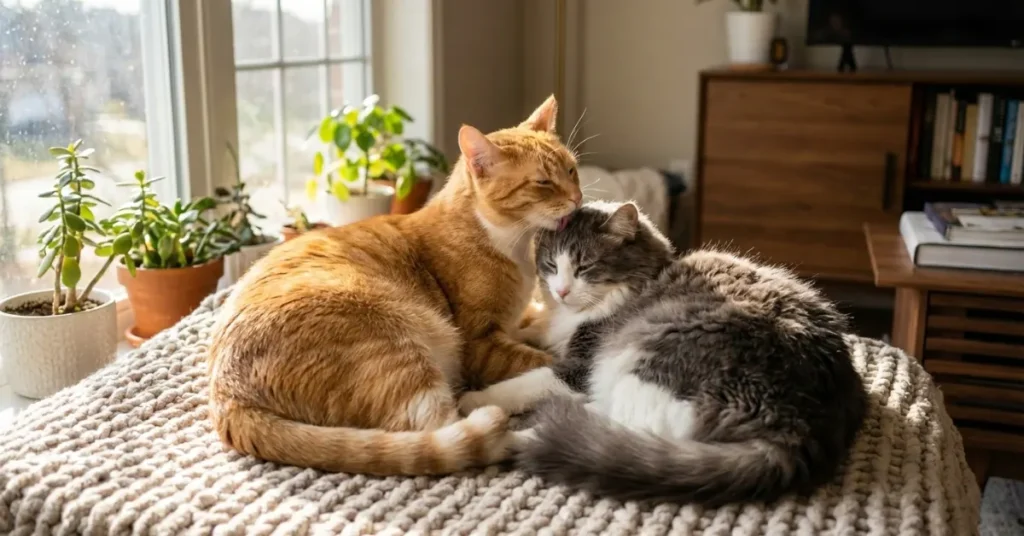

You are sitting on the couch and your two cats are curled up together. One starts licking the other’s head gently. Then out of nowhere, a swat happens and they both run off like nothing happened.
Most cat owners see this every week and never quite figure out what is going on. The truth is that every lick has a real reason behind it, biological, emotional, or social. Once you understand those reasons, your cats start making a lot more sense.
What Is Allogrooming in Cats?
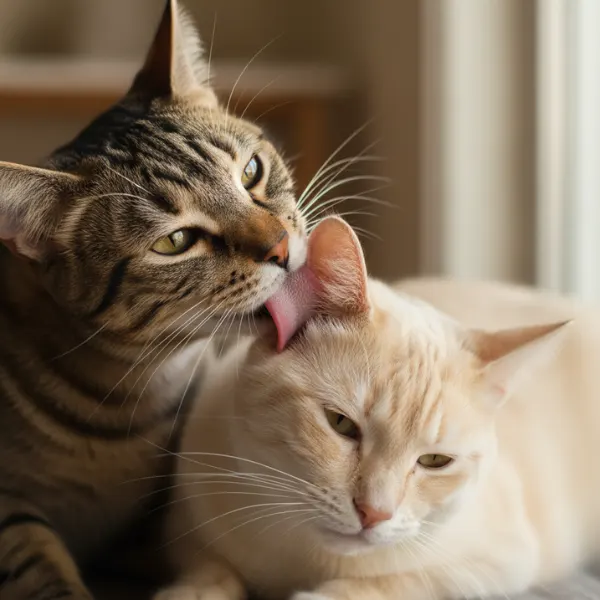
Allogrooming is the scientific term for when one cat licks the fur, ears, face, or neck of another cat. It is a deeply social behavior rooted in biology, not just habit. Research published in Applied Animal Behaviour Science found that cats who allogroom regularly show stronger social bonds and significantly fewer conflict behaviors compared to cats that do not groom each other.
When cats allogroom, the brain releases endorphins, natural feel-good chemicals that create calm and closeness in both cats. This is why cats often look relaxed or even sleepy during and after a grooming session. It is one of the clearest signs that two cats genuinely trust each other.
Why Do Cats Lick Each Other?
Cats do not lick each other randomly. Every grooming session has a real reason behind it. Some are physical, some are emotional, and some go back thousands of years to how cats survived in the wild.
They Are Bonding With Each Other
The most common reason cats lick each other is affection. Jennifer Van de Kieft, an advanced feline training and behavior expert, explains that mutual grooming is “a way of showing affection, and it helps strengthen their social bond.” Cats who allogroom regularly sleep closer together and show less aggression overall compared to cats in the same household who do not groom each other.
They Are Helping Each Other Reach Hard Spots
A cat’s tongue is covered in tiny hollow, hook-shaped spines called papillae that work like a natural comb. The top of the head, behind the ears, and the back of the neck are almost impossible for a cat to self-groom. A companion cat fills that gap instantly, grooming the exact spots their friend cannot reach alone.
They Are Removing Parasites
In outdoor cat colonies, allogrooming serves a direct survival purpose. Cats lick each other to remove fleas, ticks, and other parasites from areas they cannot reach themselves. Indoor cats carry this same instinct even if they are on flea prevention because the drive is hardwired into their biology from thousands of years of evolution.
They Are Sharing Their Scent
When one cat licks another, it transfers its saliva and scent onto that cat. LeeAnna Buis, a certified feline training and behavior specialist, explains that cats are creating a shared scent that is unique to the group because cats use scent before sight to identify friend from foe. In a multi-cat household this scent-sharing reduces territorial tension significantly. Scent works the other way too: when the signalling turns hostile you get spraying, and why cat spray smells the way it does explains what is actually in it.
One Cat Is Comforting the Other
Cats are more emotionally aware than most people give them credit for. When one cat is stressed or anxious, a bonded companion will often begin licking it as a genuine form of emotional support. If your cat comes home from the vet and its companion immediately starts grooming it, that is exactly what is happening. The grooming lowers stress hormones and helps the anxious cat feel safe again.
It Reflects Their Social Structure
The Cornell Feline Health Center notes that cats in social groups use grooming as a key way to reduce tension and reinforce relationships without direct conflict. The cat who starts the grooming session is often the one with a slightly higher social rank. It is a peaceful system that keeps household order without anyone getting hurt.
Why Do Cats Lick Each Other Then Fight?
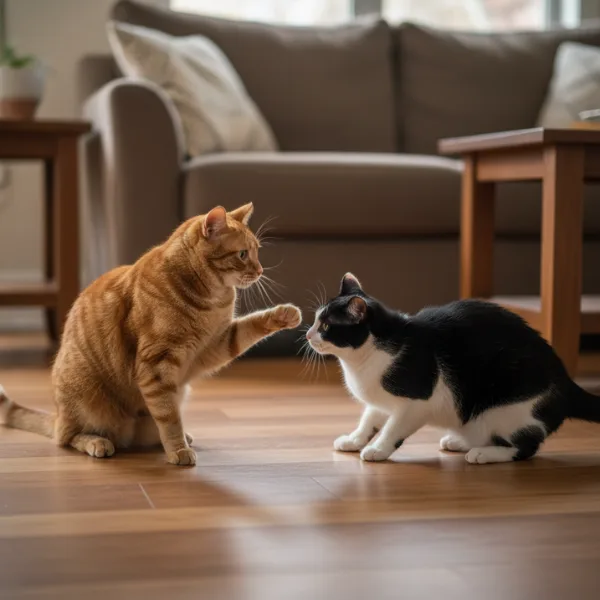
This confuses almost every cat owner. The grooming looks peaceful and then suddenly there is a swat and both cats scatter. There are three main reasons this happens.
Overstimulation
Licking is physically stimulating and when it goes on too long, one cat tips from relaxed into agitated. Watch for the warning signs just before: tail flicking, ears beginning to flatten, or a sudden stillness in the body.
Grooming Shifting Into Play
This is very common in younger cats. A lick becomes a gentle bite, the bite triggers a chase, and suddenly they are wrestling across the floor. If both cats look relaxed and take turns it is play, not conflict.
Redirected Reaction
A noise, smell, or sudden movement can startle one cat mid-session. The nearest cat gets the reaction even though the grooming had nothing to do with it.
Play or Real Fight? How to Tell the Difference
When cats are playing their bodies look loose. They take turns, biting is gentle, there are no wounds, and they stay near each other afterward.
When cats are genuinely fighting the body language changes completely. You will hear growling or hissing. One cat tries to escape and the other blocks it. The biting is hard. After it ends one cat avoids the other or hides for a long time. These are the signs that need your attention.
When Should You Be Concerned?
Most allogrooming is completely healthy. Take it seriously when you notice any of the following.
Fur Loss From Aggressive Grooming
If one cat is losing visible patches of fur from being groomed too hard, that is overgrooming, and it needs attention sooner rather than later.
One Cat Is Hiding or Not Eating
If the cat being groomed starts hiding, skipping meals, or showing signs of ongoing stress, the grooming may have shifted from affection into something more controlling.
Repeated Aggression After Every Session
Occasional swatting is normal. If full fights break out consistently after grooming, the American Association of Feline Practitioners recommends consulting a certified feline behavior consultant.
Blocking Access to Food or Litter
If one cat is blocking the other from food bowls or the litter box, this is a dominance issue that goes beyond grooming and needs to be addressed directly.
How to Help Your Cats Get Along Better
Give each cat its own resources. Separate food bowls, water bowls, and litter boxes remove daily competition without any extra effort from you.
Add vertical space. Cat shelves and trees let lower-ranked cats move away safely without confrontation. This single change reduces household tension more than almost anything else.
Play with them daily. Ten to fifteen minutes of interactive play with a wand toy burns energy and lowers the chance that grooming sessions tip into aggression.
Reward calm moments. When your cats groom peacefully or rest near each other, a small treat reinforces that being calm together is a good thing.
Frequently Asked Questions
Why do cats lick each other’s ears? The ears are one of the hardest spots for a cat to reach alone. A companion licks them as a grooming service and as a clear sign of trust.
Is it normal for cats to lick each other a lot? Yes. Frequent mutual grooming means your cats are bonded and comfortable. It only becomes a concern if one cat shows signs of stress, loses fur, or repeatedly tries to escape.
Why does my cat lick another cat then bite? Grooming shifted into play. If the bite is gentle and both cats stay relaxed it is normal. Hard biting with hissing is a real conflict worth watching.
Do cats only lick cats they like? Generally yes. Allogrooming requires trust and comfort. Cats that dislike each other rarely groom each other so mutual licking is a strong sign of a genuine bond.
Can I groom my cat if it has no companion? Absolutely. Regular brushing and gentle petting fills the same role that allogrooming would and it also strengthens your bond with your cat directly.
Conclusion
When your cats lick each other they are bonding, helping each other stay clean, sharing scent, and keeping their relationship peaceful. It is one of the clearest signs your cats are genuinely happy living together.
The occasional swat or wrestling match after grooming is almost always normal. What matters is the bigger pattern. Both cats eating well, sleeping near each other, and living without fear means you have a healthy and happy multi-cat home.