
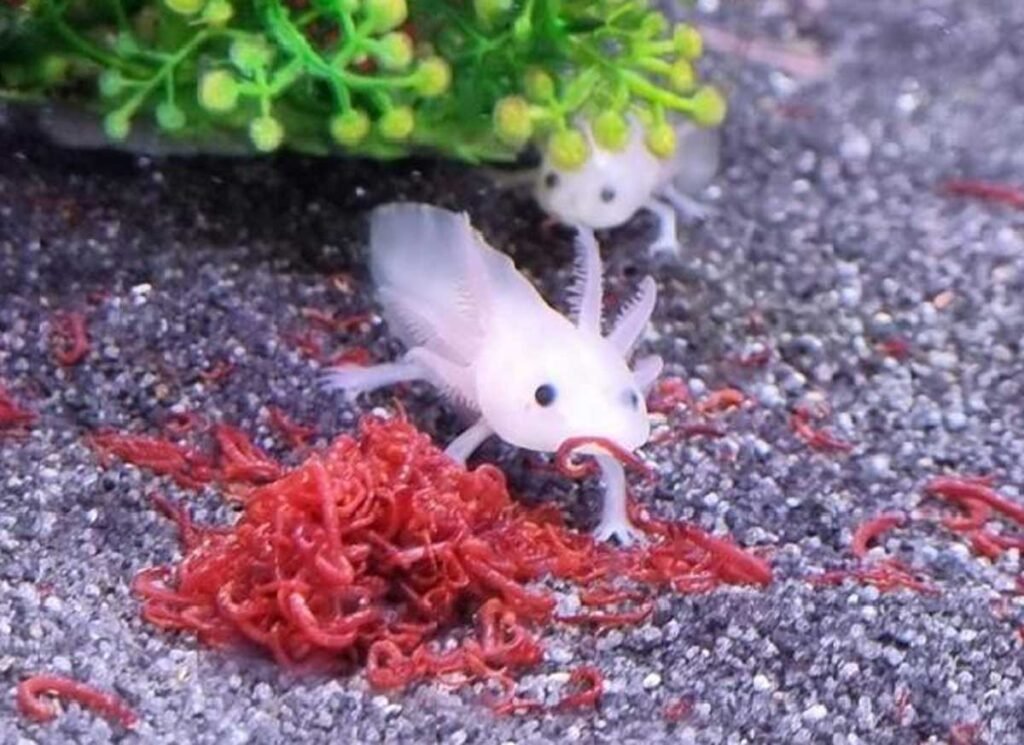

Axolotls are carnivores that eat live or thawed animal protein and nothing else. In a tank that means earthworms as the staple, with bloodworms, blackworms, and sinking pellets filling the gaps. Colour is the other thing keepers sort by, and our axolotl names list is built around it. In the wild it means worms, molluscs, aquatic insects, crustaceans, small fish, and other salamanders.
Two notes before the detail. Minecraft axolotls eat buckets of tropical fish, which settles that question in one line. For the living animal, feeding is the easy part of keeping one; water volume and temperature are what usually go wrong.
What They Eat in the Wild
Wild axolotls take small prey: molluscs, worms, aquatic insects, other arthropods such as crayfish, small fish, and other salamanders. They hunt by suction, snapping the mouth open to pull water and prey in together, which is why anything small enough to fit is a candidate.
That wild population barely exists now. The species is Critically Endangered, restricted to Lake Xochimilco after Mexico City swallowed the rest of its range, with population estimates running from roughly 50 to 1,000 adults. Every axolotl in the pet trade is captive-bred, and none of them have ever hunted a crayfish.
The Staple: Earthworms
Nightcrawlers are the closest thing to a complete axolotl food.
They deliver protein, fat, calcium and moisture in usable proportions, they cost very little, they store in a fridge for weeks, and a healthy adult will take one every few days for its entire life without needing a supplement or a second food source.
Buy them from a bait shop or worm farm rather than digging up the garden, since garden soil carries pesticide and fertiliser residue. Cut large worms into swallowable pieces for juveniles. Adults handle a whole nightcrawler and will make a production of it.
Keepers ask about variety constantly:
“im trying to deversify the palette of my axies to get them healtier, ans i wanna know all the food they can have, either as a treat or a staple food.”
– r/axolotls, October 2025 (49 upvotes)
Variety matters less here than it does for most pets. An axolotl on quality earthworms alone is a well-fed axolotl, and rotation exists for enrichment and for the week your supplier runs dry.
Everything Else Worth Feeding
- Sinking carnivore pellets made for axolotls, or trout and salmon pellets, which is what many breeders raise stock on. Convenient and storable.
- Frozen bloodworms, ideal for juveniles and a reliable appetite trigger for fussy adults. Low in nutrition for their bulk, so not a staple past the juvenile stage.
- Blackworms and whiteworms, live and wriggling, which brings out hunting behaviour.
- Brine shrimp and daphnia, mostly for the smallest larvae.
- Waxworms, fatty enough to be a treat and not a meal.
- Raw prawn or lean fish in small pieces, occasional, unseasoned, and never a substitute for worms.
What to Keep Out of the Tank
The harmful list is short, and the reasons are mechanical more than toxic: feeder fish bring parasites, hard-shelled insects bring indigestible chitin, and gravel gets swallowed alongside food by an animal that feeds by suction.
- Feeder fish. Wikipedia flags the parasite risk plainly, and goldfish and rosy reds are the usual culprits. The illness is not worth the enrichment.
- Anything from a garden. Worms, slugs, and insects collected outdoors bring pesticide and parasites with them.
- Hard-shelled insects. Mealworms and crickets have chitin an axolotl cannot process, and it passes through or impacts.
- Processed or seasoned food. Anything salted, oiled, or cooked for humans.
- Gravel. Not food, but the leading cause of impaction, because axolotls feed by suction and swallow whatever is near the prey. Bare bottom or fine sand only.
How Often to Feed
Frequency tracks age and drops sharply once growth stops. Larvae need feeding two or three times a day, juveniles daily, sub-adults every other day, and adults settle at two or three times a week for the rest of their lives.
| Stage | Frequency | Food |
|---|---|---|
| Larvae, under 2 inches | Two or three times daily | Live baby brine shrimp, daphnia, microworms |
| Juvenile, 2 to 6 inches | Daily | Chopped blackworms, bloodworms, small worm pieces |
| Sub-adult, 6 to 9 inches | Every other day | Worm pieces, pellets |
| Adult, 9 inches and up | Two or three times a week | Whole nightcrawlers, pellets |
Feed what the animal finishes in a few minutes and siphon out the rest before it breaks down. Uneaten protein rotting in a closed tank spikes ammonia within hours, axolotls are unusually sensitive to it, and the resulting stress shows up first as a refusal to eat, which sends the keeper looking for a feeding problem that does not exist.
What Baby Axolotls Eat
Baby axolotls eat live moving food and ignore anything that sits still, which rules out pellets and thawed bloodworms for the first few weeks. Live baby brine shrimp and microworms are the standard starters, fed two or three times a day.
They also need feeding two or three times a day, which is the part that surprises people. Larvae grow fast, cannibalise tank mates when underfed, and separate rearing containers are normal practice for that reason. The transition to chopped blackworms comes at around two inches.
Feeding Is Easy, Water Is Not
Most axolotl deaths blamed on diet are water quality problems. The animals produce a heavy waste load, and the tank has to be sized for it:
“40gal only supports one axolotl with weekly water changes and maintenance. Three need three times that, 120gal. Axolotls have a massive bioload and need the water volume as much as they need the space.”
– r/axolotls, July 2026 (43 upvotes)
Cool water matters as much as volume. Axolotls are a highland lake species and suffer above roughly 20°C, and a warm, overfed tank produces the refusal-to-eat that sends keepers searching for diet advice when the fix is a chiller and a bigger water change.
FAQ: Axolotl Feeding
What is the best food for axolotls?
Earthworms, specifically nightcrawlers from a bait shop or worm farm. They come closest to a complete diet on their own, and an adult axolotl fed nothing else stays in good condition indefinitely.
Can axolotls eat fish food?
Sinking carnivore pellets yes, flake food no. Flakes float, dissolve, and foul the water without delivering protein an axolotl can use. Trout and salmon pellets are what many breeders raise stock on.
What do baby axolotls eat?
Live moving food only, since larvae ignore anything still. Baby brine shrimp and microworms two or three times daily, moving to chopped blackworms at around two inches.
How often do axolotls eat?
Larvae two or three times a day, juveniles daily, sub-adults every other day, and adults two or three times a week. Overfeeding is far more common than underfeeding and shows up as water quality problems first.
Why is my axolotl not eating?
Water temperature above roughly 20°C, ammonia or nitrite in the water, stress from handling or bright light, or recent tank changes. Check parameters and temperature before changing the food, because diet is rarely the actual cause.