
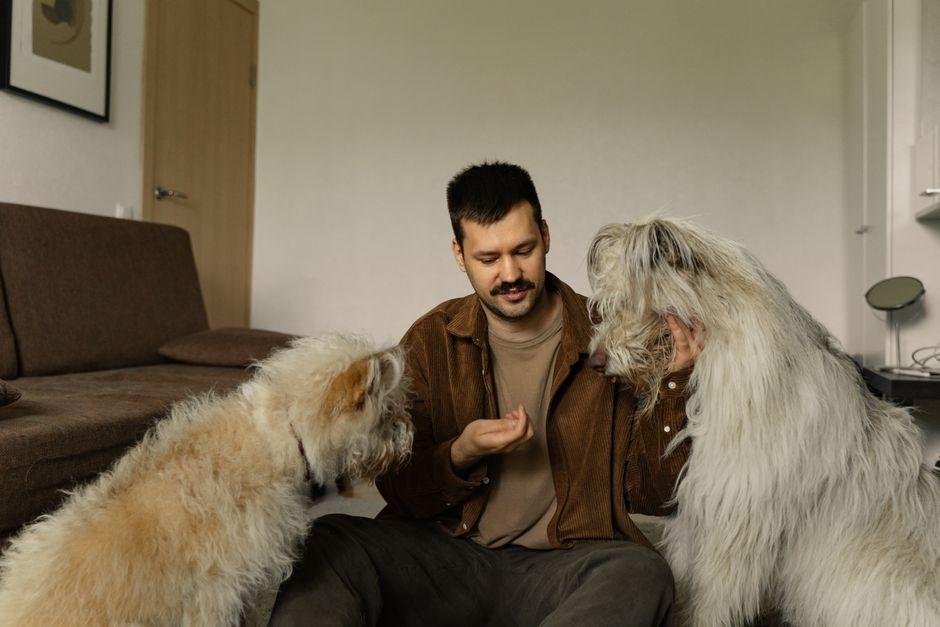

The relationship between a person and a dog runs on guesswork far more often than anyone likes to admit. The dog watches, interprets, and adjusts constantly. The person, busy with work and errands and everything else, catches perhaps a fraction of what the dog is saying.
Across Los Angeles, thousands of households share their space with an animal whose signals go unnoticed for years, and the result is a quiet, low-grade frustration on both sides. The dog seems stubborn. The person seems unpredictable. Neither description is fair, and neither is accurate.
What most owners actually want is not a dog that performs on cue. They want a dog that is easy to live with, calm in the house, steady on a walk, and comfortable around guests. That kind of life does not come from a handful of memorized behaviors. It comes from two individuals who have learned to understand each other well enough to get through an ordinary day without confusion.
Where Understanding Breaks Down
Most people bring a dog home expecting the relationship to sort itself out with time and affection. The trouble is that dog training is often treated as a short list of behaviors to get through, which leaves the animal cooperative for a few minutes a day and adrift for the rest of the day. Structured work with experienced professionals changes that, because the owner learns to read the animal at the same time the animal learns to read the owner.
Many families find that their own habits shift as much as their dog’s do once that guidance is in place. If you are also a dog owner looking for professional dog training Los Angeles has excellent specialists ready to work with you and your dog.
Dogs Speak With Their Bodies
A dog has no way to explain itself in words, so it uses everything else. The set of the ears, the height and speed of the tail, the tightness around the mouth, the direction of a glance, the weight shifted forward or back. These are not random movements. They are a running commentary on how the animal feels about what is happening right now.
Owners tend to notice only the loudest signals, usually barking or lunging, and miss the dozen smaller ones that came first. A dog that turns its head away, licks its lips, or freezes for half a second is already saying something. By the time it barks, it has been ignored several times over. Learning to catch the earlier signals is one of the single most useful things a person can do, because it lets them step in before anything escalates.
The reverse is equally true. Dogs read people with unnerving accuracy. They notice tension in a leash hand, a change in breathing, the pace of footsteps, the tone underneath the words. A person who is anxious about meeting another dog on the sidewalk communicates that anxiety long before the two animals are close.
Why Consistency Matters More Than Correction
One of the more common frustrations owners describe is a dog that seems to understand something one day and forget it the next. Almost always, the explanation is that the rule itself has been inconsistent.
The dog was allowed on the bed twice and scolded for it on the third night. Jumping on visitors was discouraged by one family member and laughed at by another. From the dog’s point of view, there is no rule, only a coin toss.
Correction after the fact does very little. A dog does not connect a raised voice at six in the evening with something it did at four. What it connects is the person’s mood, which teaches it only that the person is sometimes frightening for reasons it cannot predict. That is how trust erodes.
Reading the Signs of Stress and Discomfort
Behavior that people label as bad is very often behavior driven by discomfort. A dog that growls when approached at its food bowl is not plotting against anyone. A dog that destroys furniture during the day is usually telling you something about how it experiences being alone. Aggression, chewing, pacing, excessive barking, and house soiling are symptoms, and treating the symptom without understanding the cause rarely holds for long.
Pain deserves particular attention. A dog that suddenly resists being touched in a certain spot, becomes short-tempered, or stops wanting to climb stairs may well be hurting. Sudden changes in behavior are worth a conversation with a veterinarian before anything else is assumed.
How Patience Changes the Relationship
Progress with a dog is rarely linear. There are good weeks and difficult ones, and setbacks that seem to come from nowhere. Owners who expect a steady upward line tend to get discouraged and give up right before things improve.
Patience is not passive. It means giving the animal time to process, repeating things without irritation, and accepting that understanding builds slowly.
It also means noticing improvement when it happens. A dog that used to bark at every passing car and now barks at half of them has made real progress, even though the problem is not solved.
Building a Home Where Your Dog Feels Secure
Security, for a dog, comes from predictability and from having somewhere to retreat. A quiet corner, a bed away from the traffic of the house, a place where nobody reaches for it or asks anything of it. Children in particular need to learn that a dog resting in its own space is not available for attention.
Guests, noise, deliveries, and rearranged furniture all register with an animal that pays close attention to its environment. Giving a dog a reliable place to go when the house becomes busy prevents a great deal of trouble before it starts.
A Two-Way Conversation
The most contented dogs are not the most obedient ones. They are the ones whose owners have learned to listen. When a person can tell the difference between excitement and anxiety, between boredom and discomfort, they stop reacting to behavior and start responding to the animal underneath it.
That understanding runs in both directions, and it takes time to build. What it produces is a relationship where fewer things need managing, because fewer things go wrong in the first place. The dog is not simply following instructions. It knows what to expect, and so do you.