
Bear names fall into three families: the soft ones for a plush toy, the heavy ones for a big animal or a mascot, and the small group that carry the animal’s own word inside them. Sorting by why a name works beats sorting by alphabet, since you almost always have one of those three situations in front of you. Around 200 options follow, grouped by use, with the worn-out choices marked and the strongest traced back to a language that still says bear.
The strongest of them are borrowed. Twelve given names in other languages literally mean bear, and that seam is the least used in the whole vocabulary, which is why the dozen carry more weight than any three puns you will meet further down. Everything else comes from sweet shops, hedgerows and cartoons: serviceable, none of them rare, and all of them sounding like half the park if you pick too quickly.
What Makes a Bear Name Stick
A bear name sticks when you can shout it across a garden without embarrassment and when it says something the animal does not already show. Two syllables with a hard consonant carry further than three soft ones. A name drawn from the bear’s own vocabulary outlasts anything borrowed from this year’s cartoon.
- Best length for a call name: one or two syllables (Bruno, Kit, Fern)
- Best left on the certificate: three or more (Paddington, Marmalade), which suit a toy or a character
- Consonants that carry: B, K, R and G survive wind and distance better than S or L
- Fastest to date: anything lifted from a film released this year
- Safest bet: a name from the bear’s own vocabulary, covered in the next section
The hardest test is the park test. A name that looks charming on a brass tag has to survive being called four times in a row at increasing volume while its owner pretends not to hear. Anything past two syllables tends to collapse into its first beat by the third attempt, which is why the old working names are almost all one syllable, and why you’ll want to say your shortlist out loud before committing.
Then there is the Bear problem. Bear is now the commonest bear name in English and, by extension, the least useful one. A thread on r/namenerds catches the mood:
“I know so, so many dogs named Bear. Don’t do it” [excerpt, 39 characters in full]
– r/namenerds, 35 upvotes
Keep it as a nickname if you like it, and put something else on the vet’s form. The name a bear answers to at home does not have to be the one that makes it unique.
A second, quieter rule: your bear’s name should not describe the coat twice. Honey and Biscuit both point at the same brown, and a bear called Honey Biscuit reads like a bakery order rather than an animal with a character of its own. One word for the coat, one for everything else, and the two will not fight.
When a meaning matters more than a sound, the method behind dog names with meaning carries over unchanged: trace the name back one step, and if the trace ends at a colour or a sweet, choose it for the sound alone.
If the bear is real rather than plush, the species record weighs as much as the name. sun bear facts covers the smallest of them, which is a separate question from what to call one.
Names That Literally Mean Bear
Twelve given names carry the animal’s own word: Björn is Old Norse for bear, Ursula is Latin for a little she-bear, and Nanook is Inuktitut for a polar bear. Most entered English through saints, surnames and medieval romance. None of them came in through wildlife writing, which is why so few readers recognise them as bear names at all.
| Name | Language | Literal sense | What to know |
|---|---|---|---|
| Björn | Old Norse | bear | The commonest Scandinavian male name of the group; English usually drops the umlaut |
| Ursula | Latin | little she-bear | The ending is a diminutive, so the name means a small bear |
| Orson | Latin via French | bear cub | Carried into English by the medieval romance of Valentine and Orson |
| Bernard | Germanic | bear-brave | The second element reads as hardy or bold |
| Bernadette | Germanic | bear-brave | The feminine form, spread by the Lourdes saint |
| Arthur | Celtic (disputed) | bear-man | The bear reading is widely repeated and still argued over; the name predates the legend |
| Nanook | Inuktitut | polar bear | The animal word and a personal name in parts of the Arctic |
| Dov | Hebrew | bear | Usually paired as Dov Ber |
| Bruin | Dutch | the brown one | The fable name for a bear in the Reynard cycle, still the stock name in English verse |
| Esben, Espen | Old Norse | god-bear | Scandinavian short forms of Asbjørn |
| Barrett | Germanic | bear-rule, glossed bear-strength | The older reading of the second element is rule, not strength |
| Bern | Germanic | bear | The short form behind the Swiss city and a dozen surnames |
The English word itself is a euphemism. Bera — the brown one — replaced a name that speakers avoided saying aloud; that older word survives in Latin ursus, Greek arktos and, through arktos, in Arctic. A language that will not say the animal’s name is a language with few native names for it, which is why the strongest options above are imported. The same avoidance shows in the Slavic medved, literally the honey-eater, and in the northern words that mean the brown one or the shaggy one rather than naming the animal at all. Behind the Name records Björn from the Old Norse bjǫrn and Bruin from the Dutch for brown, which is the same substitution in miniature.
The table is a spine, not a menu. One name from it and one from the style lists that follow gives you a bear with a meaning and a sound, and the two don’t compete. If you want the name to do the work on its own, stop at Björn, Ursula or Orson: each is short, each is real, and none of them turns up twice in the same park.
Cute Bear Names for Cubs and Plush Toys
Cute bear names come from three larders: the sweet shop, the hedgerow and the nursery. Match the name to the coat in front of you, since Treacle suits a dark cub and Candyfloss a pale one. These are the ones that work on a tag and on a toy shelf.
From the sweet shop
Treacle, Honey, Biscuit, Toffee, Fudge, Caramel, Mocha, Cocoa, Maple, Bonbon, Marshmallow, Praline, Butterscotch, Gingerbread, Parkin, Crumble, Candyfloss, Jammy. Treacle and Parkin are the two British oddities on the list, both dark and sticky, both exactly the colour of a cub in autumn. Candyfloss and Marshmallow do the same job for a white or creamy coat.
From the hedgerow
Acorn, Hazel, Fern, Moss, Bramble, Clover, Willow, Rowan, Bracken, Heather, Cobnut, Sloe, Thistle, Dandelion. A hedgerow name works hardest when your bear will be seen outdoors, and it ages better than a cartoon name, since blackberries and bracken never go out of fashion.
From the nursery
Cubby, Pompom, Button, Pebble, Teddy, Plush, Muffin, Pudge, Tuft, Squeak, Nibble, Waffle. Most of these are rounder in the mouth than they look on paper. They suit a toy better than a living animal, which will outgrow the dimple in the name within a year.
Tough Bear Names for Big Animals and Mascots
Tough bear names lean on myth, weather and stone: Atlas for the weight, Thor for the noise, Kodiak for the island the largest brown bears are named after. One syllable carries furthest. That is why the heaviest-sounding options here are also the shortest.
From myth and history
Atlas, Thor, Hercules, Hyperion, Orion, Beowulf, Romulus, Fergus, Bran, Magnus, Sigurd, Ragnar, Brunhild, Boudica. Beowulf works better than it looks: the name is generally read as bee-wolf, a kenning for a bear that raids hives. Bran is Welsh for raven, which makes it a fine contradiction for a bear that will never fly.
From weather and stone
Granite, Basalt, Summit, Ridge, Crag, Tundra, Glacier, Storm, Tempest, Thunder, Rumble, Avalanche. These are the mascot names, and they behave like it: each one is a thing rather than a person, so a crowd can chant it without sounding as though it is addressing a pet.
One-syllable heavies
Bruno, Brock, Bruce, Grizz, Kane, Rex, Fang, Claw, Grunt, Boulder. A single beat at the end of a lead reaches further than any two-beat name. It also won’t wear down to a nickname the way a longer name always does.
Funny Bear Names That Still Work Out Loud
Funny bear names split in two: puns that only work on a tag, and words that stay funny when shouted. Bear Grylls and Bearlock Holmes belong on a certificate. Wobble, Grumble and Trundle belong at the end of a lead, where the joke is the animal’s own walk.
A pun with two joints collapses by the sixth repetition. The ones that last are one joint deep and built on a real word, so Grumble, Trundle and Wobble all still mean something after a hundred calls across a field, and you won’t tire of saying them before the bear tires of hearing them. If the joke needs a second word to land, it belongs on the tag rather than at the end of a lead.
For the tag: Beary Potter, Bearlock Holmes, Bearnard Shaw, Bear Grylls, Paw McCartney, Beary Styles, Bearoness, Cub Reporter, Bear Necessities, Winnie the Brew.
For the field: Wobble, Grumble, Trundle, Bumble, Snooze, Muddle, Noodle, Tumble, Crumble, Truffle. Each one is a small joke about how a heavy animal moves, and none of them needs a famous bear to explain it.
Polar Bear Names: White, Cold and Arctic
Polar bear names come from Arctic vocabulary first: Nanook for the animal itself, Siku for ice, Aput for snow, plus cold-light words such as Aurora and Boreal. A white coat also carries names that would look absurd on a brown animal. Frost and Blizzard work here and nowhere else.
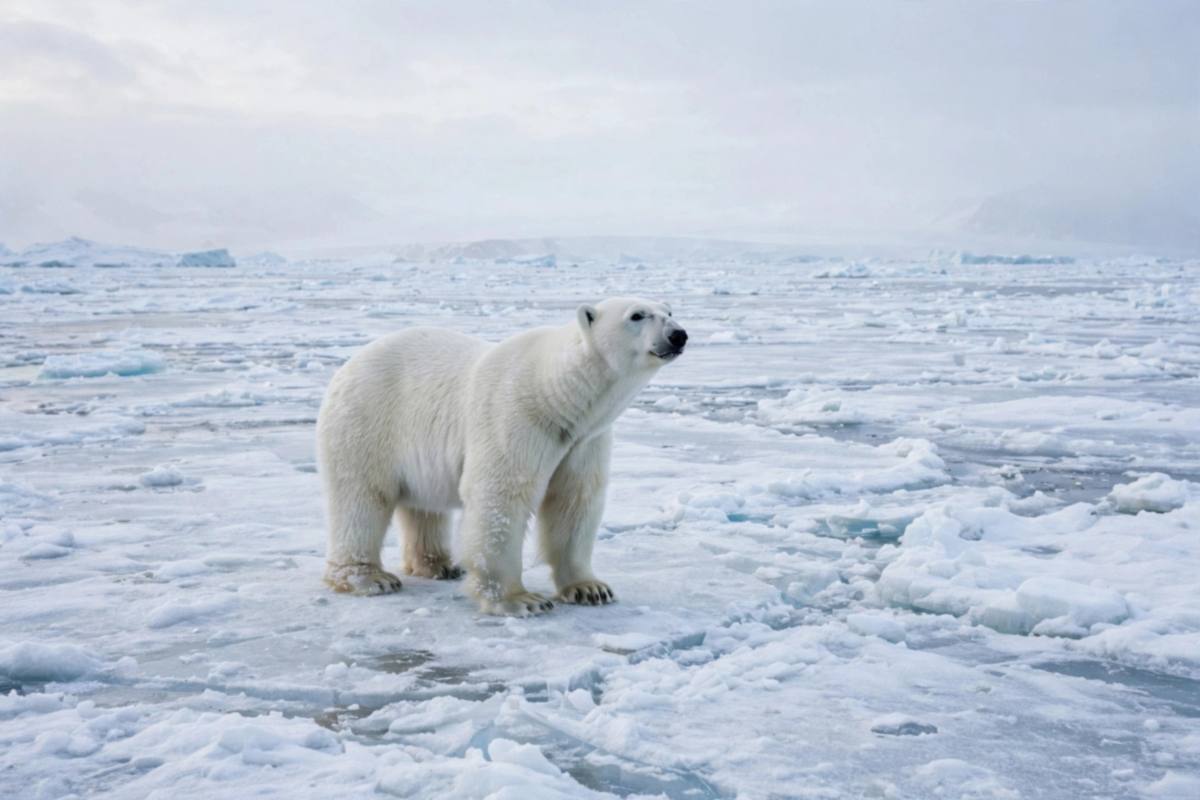
Arctic words: Nanook, Siku, Aput, Qanik, Nuna, Svalbard. The last is a place name rather than a given one, from the Old Norse for cold coast, and it suits a bear that never sits still for a portrait.
Cold light: Aurora, Boreal, Frost, Blizzard, Glacier, Solstice, Hoarfrost, Snowdrift, North, January. These are winter words rather than animal words, and they are the reason you can name a polar bear after weather without sounding like a forecast.
From fiction: Iorek and Iofur, the two armoured bears of Philip Pullman’s Northern Lights. Both are heavy, both are unsentimental, and neither has been worn thin by a cartoon.
Bear Names for a Boy and a Girl
Most of the names above serve either sex, and the split is a matter of habit more than grammar. What separates the two lists is sound. The male picks run on hard consonants and end stopped, while the female picks end on a vowel or a soft -a, which is why so many of them sound as though they belong to a bear in a storybook. The tree names are the safest in between, since English has never given oak or willow much of a gender.
Boy bear names
Barnaby, Bertram, Bramwell, Bruno, Clifford, Duncan, Edmund, Fergus, Gilbert, Harold, Humphrey, Jasper, Kodiak, Leopold, Montgomery, Orson, Percival, Rowan, Theodore, Wilbur. Half of these are Victorian surnames used as given names, which is why they sound elderly in a way that suits a bear with a slow gait.
Girl bear names
Agnes, Beatrix, Clementine, Daphne, Elspeth, Florence, Gretchen, Henrietta, Imogen, Josephine, Matilda, Nell, Ottilie, Primrose, Rosalind, Sybil, Tabitha, Ursula, Winifred, Yvette. Ottilie and Elspeth are the least common of the group and the likeliest to be asked about, which is a small advantage when your bear shares a park with three Bellas.
For a toy rather than a living animal, the same names work with a plainer ending: Teddy, Bramble and Paddington all sit outside the split and suit a bear that will never grow into a name.
Bear Names by Letter
A letter-by-letter start helps when a classroom, a story or a child has already decided the initial. One strong option per letter follows. The ones that double as ordinary words are marked, so you can build a shortlist from whatever letter the bear has to have.
- A: Atlas (myth, weight)
- B: Björn (the only one that means bear outright)
- C: Clover (a field word that suits a light coat)
- D: Dov (Hebrew for bear)
- E: Esben (god-bear)
- F: Fern (hedgerow, soft)
- G: Grizz (one syllable, no explanation needed)
- H: Hazel (colour and tree at once)
- I: Iorek (fiction, armoured)
- J: Juniper (a hedgerow name with a gin note)
- K: Kodiak (place name, heavy)
- L: Luna (overused for cats, still clean here)
- M: Maple (sweet, autumnal)
- N: Nanook (polar bear)
- O: Orson (bear cub)
- P: Paddington (better on a shelf than on a lead)
- Q: Quill (a quiet word with a sharp end)
- R: Rowan (tree, red berries)
- S: Siku (ice)
- T: Treacle (dark and British)
- U: Ursula (little she-bear)
- V: Vale (a valley word, calm)
- W: Willow (soft, silver, popular)
- X: Xeno (Greek for stranger, which a bear always is)
- Y: Yogi (famous, and now a little dated)
- Z: Zephyr (a west wind, light for a big animal)
Bear Names: Common Questions
What is another name for a bear?
Bruin is the usual alternative in English, and ursine is the adjective. The animal’s older Indo-European name survives in Latin ursus and Greek arktos. Arctic comes from the same root.
What Viking name means bear?
Björn, from the Old Norse bjǫrn. The Vikings also used bear-kennings for people. A saga name can therefore describe a temperament without ever using the word itself.
What is a good bear name for a girl?
Ursula and Bernadette both carry the bear-root, and Nanook works for either sex. Willow, Hazel and Fern suit a lighter coat. None of them sounds like a cartoon character.
Is Bear a good name for a bear?
It is the commonest one in English and now the least distinctive. Keep it as a nickname if you like it. Choose something with a meaning or a sound of its own for the paperwork.