
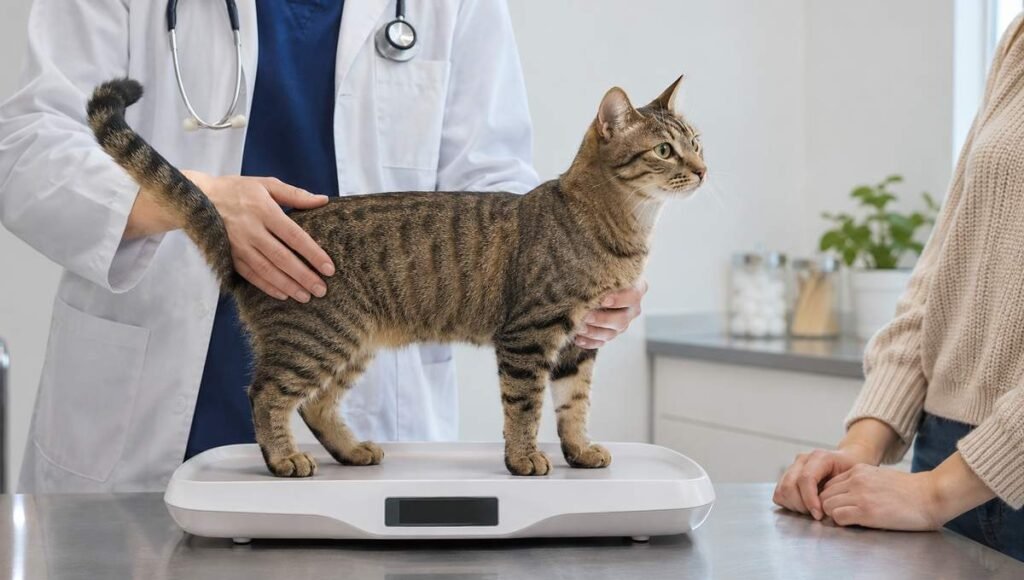

Most adult domestic cats weigh 8 to 12 pounds (about 3.6 to 5.4 kg), and PetMD’s veterinary writer Liz Bales puts the typical cat at around 10 pounds. That average only gets you so far. A vet judges each cat against its own frame on a 9-point body condition score, where 4 or 5 is ideal.
For a single cat, the answer to how much should a cat weigh comes down to how far it sits above its own ideal weight. Cornell Feline Health Center treats 20 per cent or more above normal weight as obesity. VCA Animal Hospitals calls 10 to 20 per cent overweight, and on a cat whose ideal is 10 pounds those lines fall at 11 and 12 pounds.
How Much Should a Cat Weigh by Breed?
A healthy adult cat can weigh anywhere from about 5 pounds to more than 20, depending on breed and sex. PetMD’s breed chart runs from 5 to 8 pounds for a female Siamese up to 12 to 20-plus pounds for a male Maine Coon, with domestic shorthairs at 8 to 12.
| Breed | Males | Females |
|---|---|---|
| Maine Coon | 12–20+ lb (5.4–9.1+ kg) | 10–14 lb (4.5–6.4 kg) |
| Bengal | 9–15 lb (4.1–6.8 kg) | 6–12 lb (2.7–5.4 kg) |
| Persian | 9–14 lb (4.1–6.4 kg) | 7–11 lb (3.2–5.0 kg) |
| Siamese | 8–12 lb (3.6–5.4 kg) | 5–8 lb (2.3–3.6 kg) |
| Abyssinian | 7–10 lb (3.2–4.5 kg) | 6–8 lb (2.7–3.6 kg) |
| Domestic shorthair | 8–12 lb (3.6–5.4 kg), average 10 lb | 8–12 lb (3.6–5.4 kg), average 10 lb |
The pound ranges come from PetMD’s breed chart, and the kilogram figures are converted and rounded to one decimal place. Males tend to run larger than females, PetMD notes, especially when a tom reaches full maturity before he is neutered. Yet both sexes of an ordinary moggy average the same 8 to 12 pounds.
Kitten weight by age
Kittens follow a steeper curve, and the adult ranges above don’t apply until about a year old. Alley Cat Allies, the US cat charity, gives these markers in its kitten progression guide:
- Newborn: 3 to 5 ounces (roughly 85 to 140 grams), small enough to sit in the palm of a hand.
- One week: around 8 ounces, about double the birth weight.
- Eight weeks: about 2 pounds (0.9 kg), the weight at which the charity says a kitten can be spayed or neutered.
After that the pace eases. PetMD says growth slows between 6 and 12 months and most cats reach maturity at about a year old, so a scale reading on a ten-month-old is a snapshot of a cat still filling out.
Where Overweight Starts: Four Vet Sources Compared
The four sources below agree on the broad shape of the 9-point scale. They differ by half a point here and there on where its edges sit, which is worth knowing before you compare one clinic’s verdict with another’s.
| Source | Ideal | Overweight | Obese |
|---|---|---|---|
| PetMD (Liz Bales, VMD) | Score 4 to 5 | Not banded separately | Score 9 is morbidly obese |
| Cornell | Score 4.5 to 5 | Above 6.5 or 7 | 8 or above; 20% or more over normal weight |
| VCA Animal Hospitals | 5 on a 1–9 scale (3 on a 1–5 scale) | 10% to 20% over ideal weight | More than 20% over ideal weight |
| APOP 2022 survey | Score 4 to 5 | Score 6 to 7 | Score 8 to 9 |
Two lines carry the weight here. The obesity figure on Cornell’s feline obesity page and the one VCA uses both start at 20 per cent above ideal. That makes it the safest single threshold to remember.
Cornell is also stricter about the ideal band. It asks for 4.5 to 5 where PetMD and the APOP survey accept a 4. It doesn’t call a cat overweight until the score passes 6.5 or 7, which is half a point to a point later than the APOP bands. The differences are small on paper, though a cat scored 6 could be called overweight by one survey and still be short of Cornell’s line.
The stakes behind those lines have been measured. VCA cites research finding a 2.8-fold increase in mortality in obese cats aged 8 to 12 compared with lean cats. Cornell lists osteoarthritis and diabetes mellitus among the disorders that extra weight can worsen, and the early signs of the second are set out in our guide to cat diabetes symptoms.
Is a 7, 12 or 15 Pound Cat a Healthy Weight?
A 12 pound cat is overweight if its ideal is 10 pounds and healthy if its frame suits 12. A 15 pound domestic shorthair is 50 per cent over a 10 pound ideal, while a 15 pound male Maine Coon sits within PetMD’s range. A 7 pound cat is normal for several small breeds.
A 12 pound cat
The arithmetic is simple once a vet has named the ideal weight. Take VCA’s bands and a cat whose ideal is 10 pounds: 11 to 12 pounds is overweight, and anything above 12 pounds is obese. In metric, the same cat with a 4.5 kg ideal crosses into overweight at about 5 kg and into obesity above about 5.4 kg.
The lines move with the frame. A cat whose ideal is 12 pounds, for instance a male Persian in the upper half of PetMD’s 9 to 14 pound range, would only reach them at about 13.2 and 14.4 pounds.
A 15 pound cat
PetMD’s own answer is that 15 pounds may be overweight for most cats, since a cat with an average frame weighs around 8 to 12. On a 10 pound ideal, 15 pounds is 50 per cent over. That is more than twice the 20 per cent obesity line. The exceptions are the big breeds: a male Maine Coon at 15 pounds sits near the middle of PetMD’s 12 to 20-plus range, and a male Bengal tops out at exactly that figure.
A 7 pound cat
Seven pounds is ordinary for a female Siamese, an Abyssinian of either sex or a petite Persian queen. It is also only a pound under the domestic shorthair range.
Direction matters more than the figure. A cat that has always weighed 7 pounds and scores 4 or 5 is fine. A cat that weighed 9 pounds last year and 7 now has lost more than a fifth of its weight, though, and PetMD says any unplanned loss warrants a vet visit as soon as possible. That advice applies with more force to a senior cat, since PetMD singles out kidney disease and hyperthyroidism as illnesses that cause weight loss in older cats.
Scoring Your Cat’s Body Condition at Home
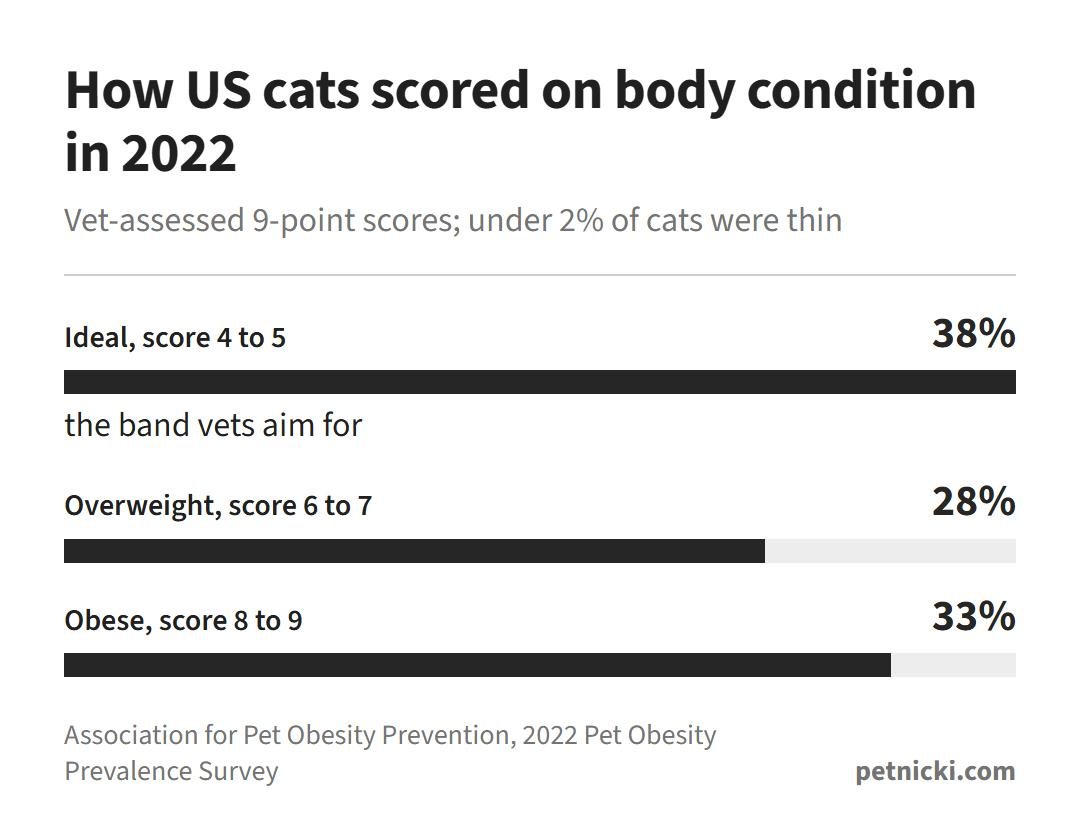
Owners turn out to be generous judges of their own cats. In the Association for Pet Obesity Prevention’s 2022 Pet Obesity Prevalence Survey, vets scored 61 per cent of cats as overweight or obese. Only 38 per cent scored in the ideal 4 to 5 band, while 28 per cent scored 6 or 7 and 33 per cent scored 8 or 9.
The same survey found that 28 per cent of cat owners called their cat’s body condition normal when the vet had put it between 6 and 9.
Cornell describes three checks. Run both hands, palms down, along each side of the ribcage. Look at the cat in profile, then stand over it and look down. PetMD adds what a healthy result looks like: ribs you can feel without searching through a layer of fat, a slight hourglass from above as the belly tucks in behind the ribs, and only a very small fat pad underneath when seen from the side.
VCA’s version uses your own hand as the ruler. Feel the ribs just behind the front legs. If they feel like the back of your hand, the condition is good; if they feel more like the fleshy part of your palm, the cat is carrying too much over the ribcage.
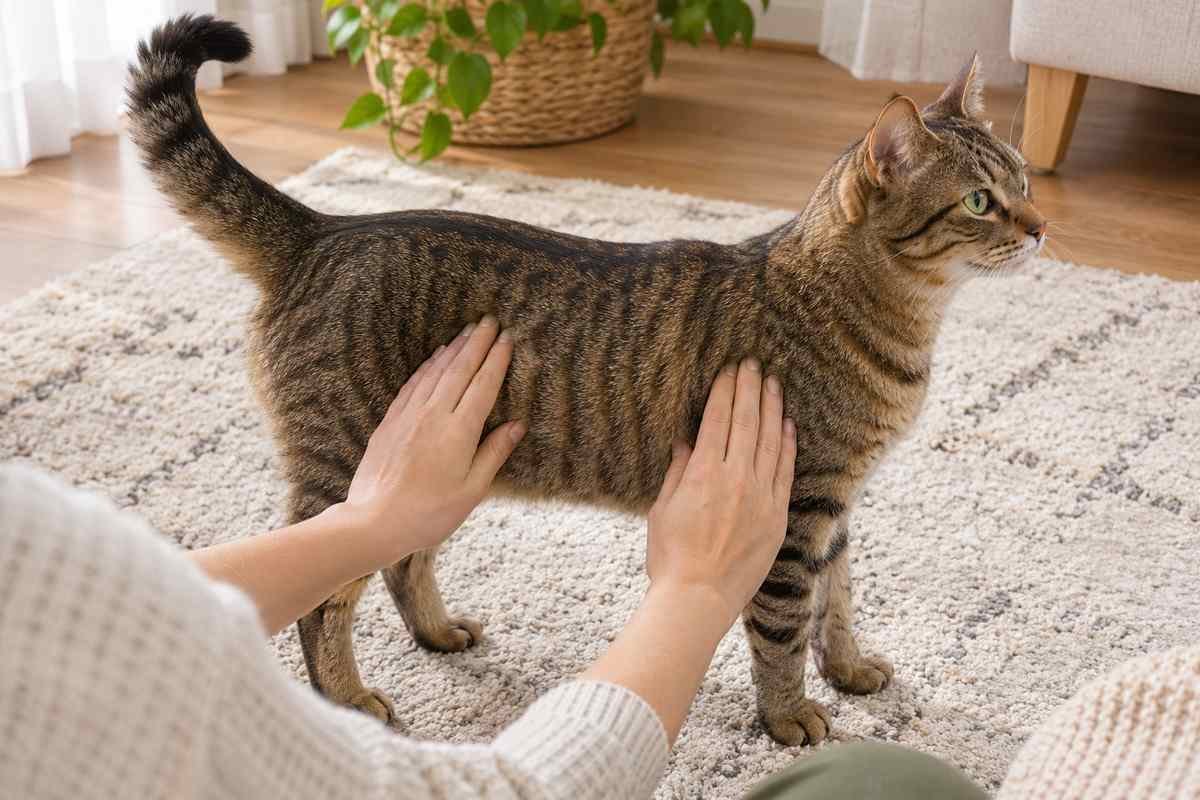
The side view counts as much as the overhead one, as one owner found when she posted photos of her cat for a second opinion:
“She’d have 12 meals a day if she had her way, from the top down she looks fine but 2nd pic looks a bit chunky?”
– r/cats, June 2026 (603 upvotes)
Weighing Your Cat Without a Vet Scale
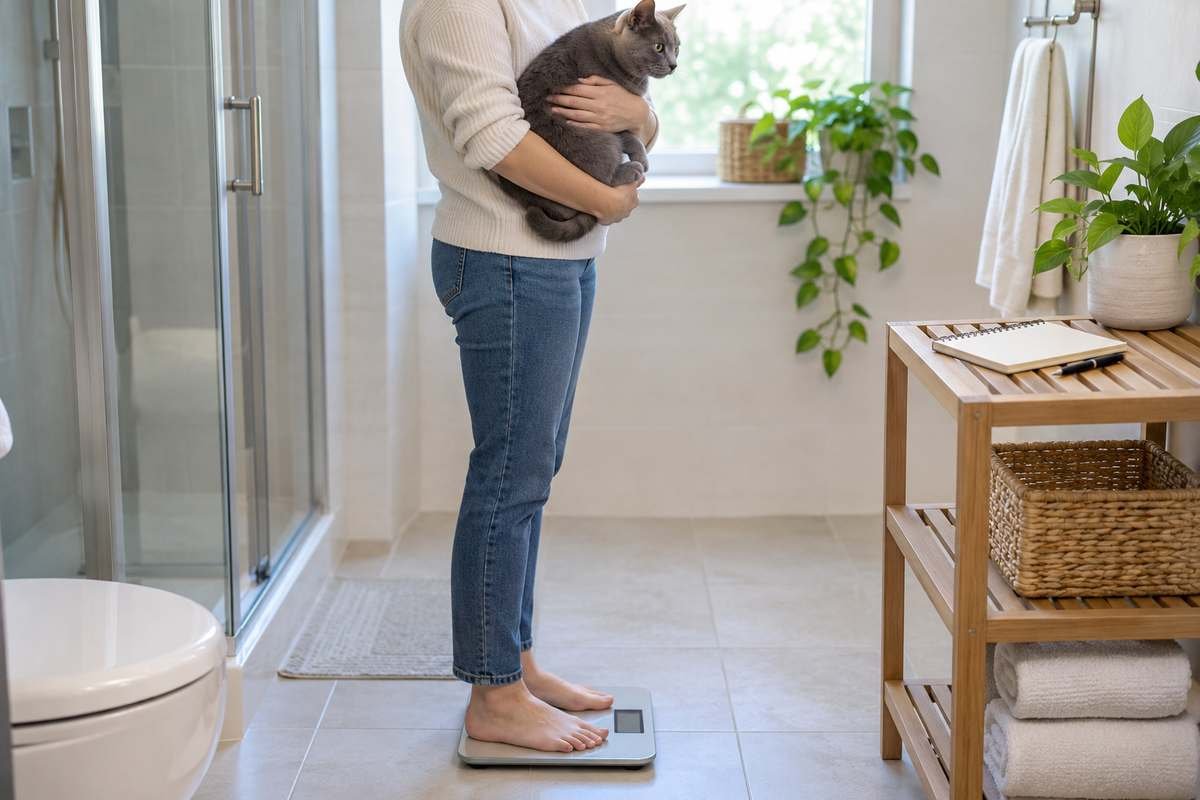
A bathroom scale will do. PetMD’s method is to weigh yourself, step back on holding the cat and subtract the first figure from the second. A baby scale or pet scale with a towel on it catches smaller changes, and Cornell suggests a baby scale to anyone with a chubby cat. PetMD advises weighing every two to four weeks and photographing the cat from above and from the side each time, since slow change is easier to judge in a row of pictures than from memory.
How Fast an Overweight Cat Should Lose Weight
Slowly, and under a vet. Cornell’s Carolyn McDaniel suggests aiming for one or two per cent of body weight a week. She warns that a cat put on a sudden starvation diet risks hepatic lipidosis, a serious liver condition.
For a 15 pound cat, one or two per cent works out at roughly 2.4 to 4.8 ounces a week, or about 70 to 135 grams. VCA recommends monthly weigh-ins to confirm that the loss is neither too fast nor too slow. It also notes that obese cats which stop eating face the same liver risk, so a heavy cat refusing food is a reason to ring the vet the same day. Our page on how long a cat can go without eating sets out the timelines vets and charities give.
Cutting the scoop of the current food isn’t the answer, according to VCA, because simply reducing the volume can leave a cat short of micronutrients over time. VCA’s route is a calorie-restricted therapeutic diet chosen with your vet and fed in set portions at set meal times. Treats are held to no more than 10 per cent of daily calories — on a 300 kcal target, 270 from the diet and 30 from treats.
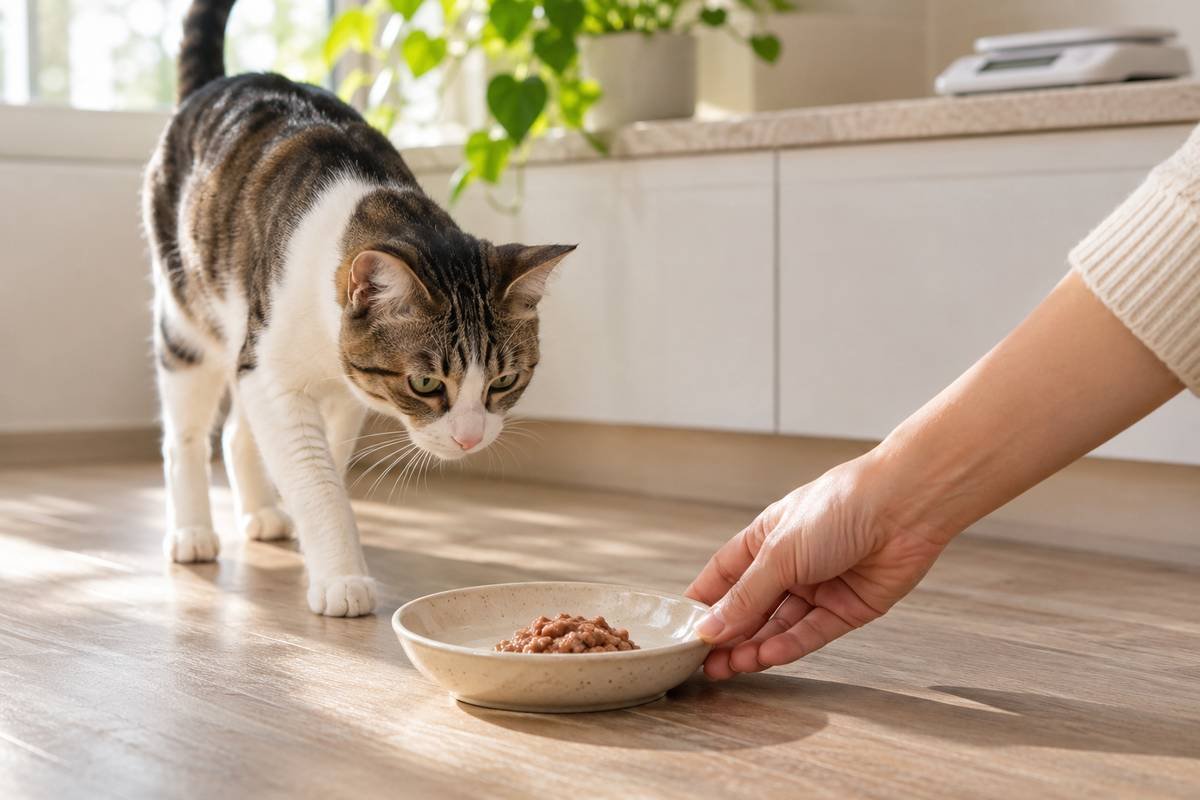
Cornell’s McDaniel names free feeding from an always-full bowl of dry food as a major cause of feline obesity, and she wants distinct meal times with the owner in control of them.
Neutering changes the sums too. Most cats need around 30 per cent fewer calories after being spayed or neutered, according to PetMD, because the hormones that help regulate appetite fall away, and a portion that suited the cat before surgery may now be too generous.
When an owner on Reddit asked about a cat that seemed bigger after a month in a friend’s care, one commenter replied:
“I would say he is overweight but at a stage where it is easily changed with small changes overtime. I would recommend contacted your vet for further advice”
– r/cats, August 2026 (24 upvotes)
Cat Weight FAQ
What is the ideal weight for an indoor cat?
An indoor cat has the same ideal range as any other cat of its breed and frame, which for a typical domestic cat is 8 to 12 pounds in PetMD’s figures. Neither PetMD, Cornell nor VCA sets a separate indoor figure. PetMD does name low activity as a cause of weight gain, especially for cats kept indoors.
How much should a cat weigh in kg?
A typical adult domestic cat weighs about 3.6 to 5.4 kg, the metric version of PetMD’s 8 to 12 pounds, with about 4.5 kg as the average. Large breeds run higher. A male Maine Coon at 5.4 kg to more than 9 kg is within PetMD’s range.
Should you worry if a cat loses weight without a diet?
Unplanned weight loss in a cat warrants a vet visit as soon as possible, PetMD says, particularly in senior cats. Causes on PetMD’s list include hyperthyroidism, kidney disease, diabetes, dental disease and intestinal parasites. If you aren’t sure whether your cat counts as a senior yet, our cat years to human years chart converts its age.
A cat getting lighter without any change in its food is the one weigh-in result that should never be filed as good news.