

Cat leukemia symptoms often don’t appear for a long time: Cornell’s Feline Health Center says many cats with feline leukemia virus (FeLV) show no signs at all in the early stages, and the later signs, such as weight loss, pale gums and repeated infections, overlap with many other illnesses. Only a blood test settles it.
That matters if you’re searching because your cat seems off. Below, three veterinary pages are set side by side, followed by what the quiet early stage means, how testing works, why a first positive result is not always the last word and what the survival figures measure. It’s general information, not a diagnosis, so ring your vet if you’re worried.
Cat Leukemia Symptoms Vets List
Cornell’s page, updated in 2024, lists twelve signs. PetMD, in a page by Melissa Boldan, DVM, published in February 2023, lists nine. International Cat Care, updated in September 2025, lists six and calls the signs “extremely diverse”.
| Sign | Cornell | PetMD | International Cat Care |
|---|---|---|---|
| Appetite | Loss of appetite | Decreased appetite | Eating less than normal |
| Weight loss | Progressive weight loss | Weight loss | Weight loss |
| Temperature | Persistent fever | Fever | High temperature |
| Pale gums | Pale gums and other mucous membranes | Pale gums (anaemia) | Pale gums |
| Coat | Poor coat condition | Unthrifty coat | Not listed |
| Lymph nodes | Enlarged | Enlarged | Not listed |
| Gums and mouth | Gingivitis and stomatitis | Gingivitis and stomatitis | Not listed |
| Gut | Persistent diarrhoea | Chronic diarrhoea | Persistent or recurrent intestinal problems |
| Repeat infections | Skin, bladder, upper respiratory | Skin, eye, respiratory or urinary tract | Persistent or recurrent breathing and skin problems |
| Lethargy | Not listed | Not listed | Lethargy, tiredness |
| Seizures, behaviour changes, eye conditions, abortion of kittens | Listed | Not listed | Not listed |
Four signs (appetite, weight loss, fever and pale gums) appear on all three pages in almost the same words. Cornell is the only one to list neurological signs, eye conditions and reproductive failures, and International Cat Care is the only one to name lethargy.
None of these signs belongs to FeLV alone. Weight loss and a poor appetite also turn up in the site’s page on cat diabetes symptoms, and a cat with repeated bladder infections may fit the picture on cat UTI symptoms instead, which is why a vet’s test matters more than a guess.
Why a Healthy-Looking Cat Can Still Have FeLV
Cornell says it’s common for a cat to show no signs of disease in the early stages. Over weeks, months or even years, an infected cat’s health may deteriorate steadily, or it may go through repeating cycles of illness and relative health. What happens depends on how the immune system responds after exposure.
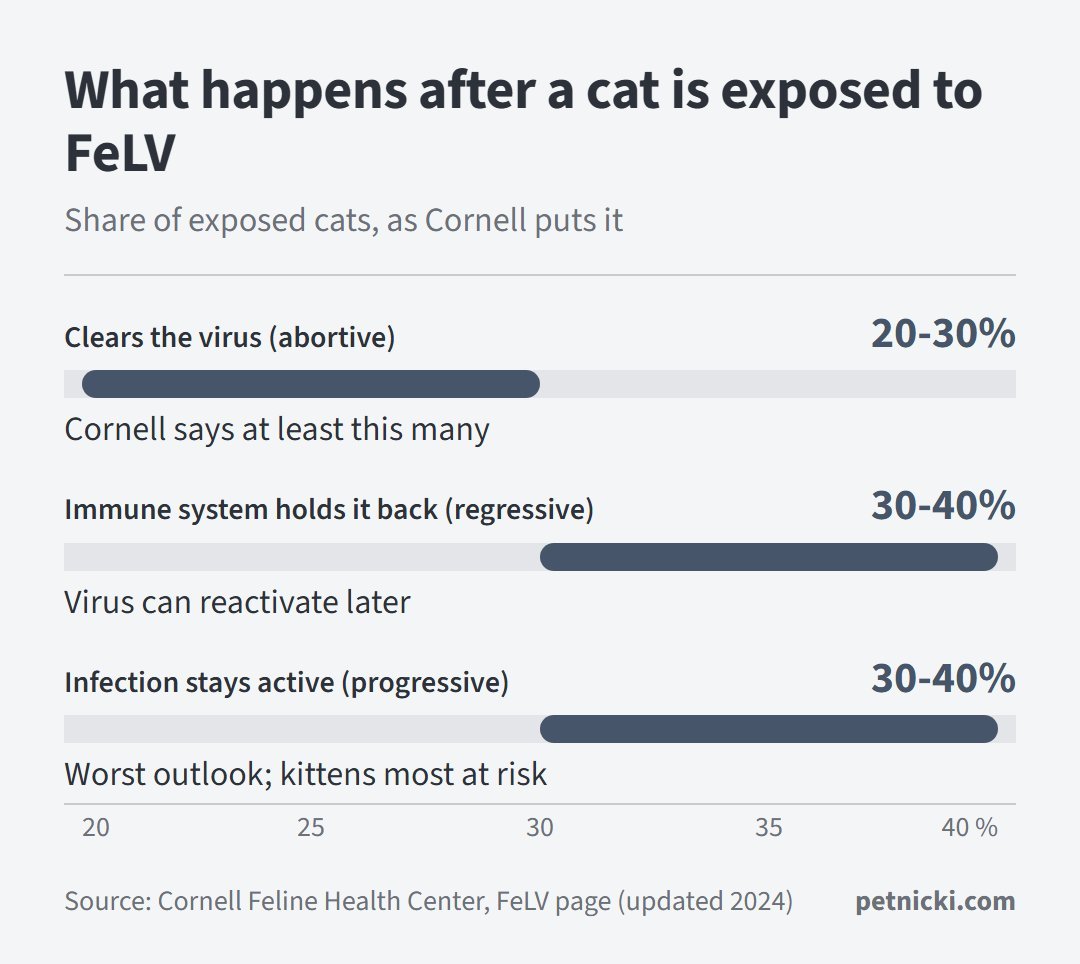
Cornell describes three outcomes. In an abortive infection the cat clears the virus, and at least 20 to 30 per cent of exposed cats do; they never test positive on routine tests. About 30 to 40 per cent have a regressive infection, where the virus is built into the cat’s genome but is held back by the immune system. Such a cat can’t infect other cats and is very unlikely to show signs, though the virus can reactivate if the cat becomes immunosuppressed. Another 30 to 40 per cent develop a progressive infection, which carries the worst prognosis. PetMD gives the same 20 to 30 per cent for cats that clear the virus, and International Cat Care says young cats are more likely to become progressively infected while older cats grow more resistant.
One commenter in r/cats described what a quiet infection can look like:
“My bb had FELV from the time I adopted him (when he was about 2) and he was mostly fine until he passed away around 5 when it became lymphoma. He was mostly happy and healthy until the end, when he deteriorated frighteningly fast.”
– r/cats, May 2026 (20 upvotes)
That is one cat, told by someone who isn’t a vet. It does fit Cornell’s description of long stretches without signs — and Cornell also calls FeLV the most common cause of cancer in cats.
Testing: Why a First Positive Isn’t the Last Word
Cornell says more than one test is generally needed, because a single test at one point in time can’t show whether a cat has a progressive infection. An ELISA blood test, which can be run in a vet’s surgery, is usually done first. It detects a viral protein in the blood, and Cornell warns that false positives are possible, so a positive screening test should always be followed by confirmatory testing. A PCR test, which detects whether the virus is built into the cat’s genome, is the follow-up Cornell recommends.
Timing matters too. Cornell says all of these tests can give a false positive very soon after infection, so if recent exposure is the worry, the test should be repeated in 3 to 6 weeks, and most positive results should be retested 6 to 12 weeks later to see whether the infection is progressive or regressive. PetMD suggests repeating a positive ELISA 8 to 12 weeks later, especially in young cats and kittens, and International Cat Care says false positives and negatives happen occasionally and repeat testing after several weeks is sometimes needed.
A commenter in a r/cats thread about a four-month-old kitten with a positive result put it this way:
“Before you panic, this was most likely a snap test and can absolutely be a false positive from exposure.”
– r/cats, September 2026 (47 upvotes)
Nobody can say that about a particular cat from a comment. What the veterinary pages support is narrower: a positive screening result is a reason to retest, not a verdict.
How Long Do Cats With FeLV Live?
The three pages give three different figures, and they don’t measure the same thing. Cornell puts the median survival after diagnosis at 2.5 years, much longer for a regressive infection.
PetMD says the average life span after a positive test is less than three years, though some cats live normal lives for years. International Cat Care says an estimated 80 to 90 per cent of infected cats die within 3 to 4 years of diagnosis.
A median is the midpoint, an average can be pulled by a few long-lived cats, and a percentage within a time window counts deaths. The pages don’t tie these figures to a named study in the text, so read them as a rough range rather than a forecast for your cat. Cornell’s closing point is that cats with FeLV can live normal lives for prolonged periods.
Who Gets FeLV and How It Spreads
Cornell says FeLV affects 2 to 3 per cent of cats in the United States and Canada, and up to 30 per cent of cats that are ill or at high risk. PetMD puts it at about 2 per cent in the United States. Kittens are at greater risk than adults because their immune systems are immature.
The virus is shed mainly in saliva, and also in faeces, urine and milk. Cornell lists bite wounds, mutual grooming and shared feeding dishes and litter boxes, plus transmission from a mother to her kittens before birth or while nursing. It survives only a few hours outside a cat’s body, so catching it from the environment without close contact is unlikely. PetMD says it isn’t contagious to people or to other pets such as dogs or rabbits.
What Treatment and Prevention Look Like
There is no cure, according to all three pages. Cornell says some therapies can lower the amount of virus in the blood but may have significant side effects, so vets usually treat the specific problems that arise.
That means antibiotics for bacterial infections or blood transfusions for severe anaemia. PetMD recommends keeping an FeLV-positive cat indoors and says vets tend to start antibiotics earlier because the immune system is weaker. Cornell advises close monitoring of weight, appetite, activity, litter habits, the mouth and eyes, and behaviour, with any change worth a call to your vet.
Prevention is mostly about exposure. Cornell says the only sure way is keeping cats away from infected cats, and that all cats should be tested before joining a home. A vaccine exists and Cornell now treats it as a core vaccine for kittens, though it doesn’t protect every cat. PetMD says the American Association of Feline Practitioners recommends all kittens be vaccinated in their first year, and that low-risk indoor-only adults may stop after the initial series. The site’s pet vaccination schedule has the wider picture.
Contact your vet if your cat shows any of the signs above, or if it has been in contact with a FeLV-positive cat. A test is quick, and it is the only thing that tells you what you are dealing with.