
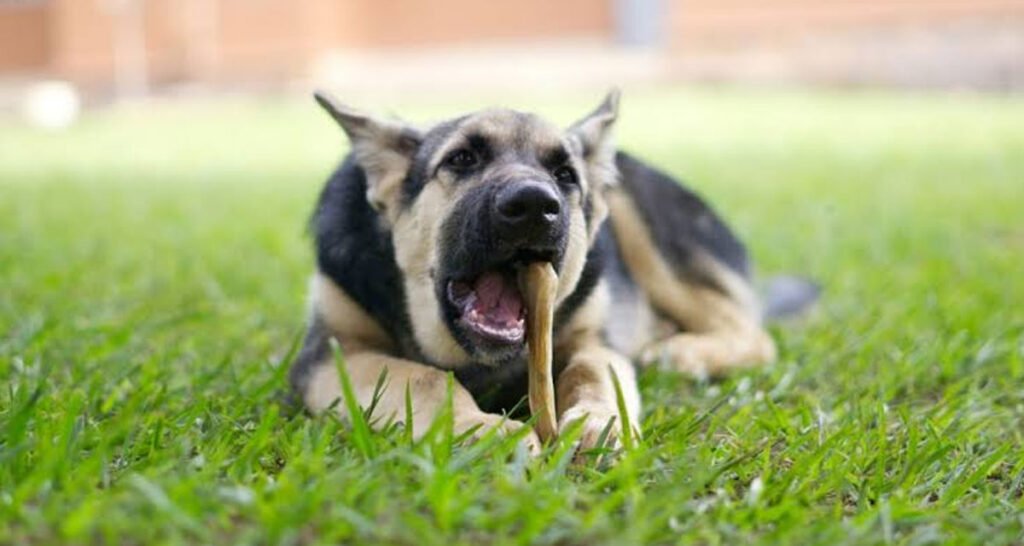

Imagine a household with a powerful chewer, such as a German Shepherd or Rottweiler mix that can finish a standard bully stick in less than fifteen minutes. Just as the dog settles in, the chew is gone, leaving its owner wondering why every treat disappears so quickly.
The problem may not be the dog’s behaviour or the product’s quality. It may simply be the size. Some dogs need a thicker, more substantial chew to remain engaged and satisfied for longer. But what makes a monster bully stick better suited to these determined chewers? Understanding the answer can help owners choose a chew that better matches their dog’s size, strength, and chewing habits.
The Real Reason: Chewing Is a Genuine Physical Need, Not a Habit
It helps to start with what’s actually happening biologically when a dog chews, beyond simply keeping them occupied. According to a study published in the peer-reviewed journal Frontiers in Behavioral Neuroscience, chewing is a natural, highly motivated behavior linked to feeding, exploration, jaw development, and learning, and without appropriate outlets for this drive, dogs may turn to chewing on inappropriate household items instead.
That distinction is the foundation everything else in this article builds on. Chewing isn’t a behavior to train away, it’s a genuine physiological drive that has to go somewhere, in the same way hunger or curiosity has to go somewhere. When a chew disappears in minutes, the underlying drive doesn’t disappear with it, it just gets redirected toward whatever’s nearby, a table leg, a shoe, a baseboard, often at exactly the moments an owner is least prepared to intervene.
Why Some Dogs Blow Through Standard Chews So Fast
With that physical drive in mind, the next question is why the intensity of that drive varies so much from one dog to the next. A handful of factors genuinely explain the gap:
- Breed and jaw strength, since working and guardian breeds bring considerably more raw bite force to every session than an average household dog
- Body size and weight, which correlates directly with how much material a dog can realistically work through before finishing
- Individual chewing style, since some dogs gnaw steadily along a stick’s length while others focus intense pressure on a smaller section
- Age and experience, as adult dogs with fully developed jaw muscles typically chew with noticeably more force than puppies
A chew size for an average dog is, almost by definition, going to underperform against a dog sitting well above average on several of these factors at once, which is exactly the gap a thicker chew is built to close.
Which Dogs Tend to Hit This Wall Most Often
A handful of specific breeds and body types show up again and again as the dogs genuinely outgrowing standard chew thickness:
- German Shepherds and Belgian Malinois, whose working-dog jaw strength and sustained chewing drive routinely outpace average sizing
- Rottweilers and Doberman Pinschers, both bred historically for bite force well above the average household dog
- Pit Bulls and other bully breeds, known specifically for concentrated, high-pressure chewing over shorter bursts
- Large mixed breeds over 60 pounds, where genetics from multiple powerful lines often compound into an especially strong chew
Recognizing a dog’s own breed background against this list often explains, on its own, why a particular chew keeps disappearing faster than it reasonably should.
What Actually Makes a Chew Last Longer
Length alone doesn’t solve the problem above. A longer stick with the same thin cross-section still finishes just as quickly for a power chewer, it just takes slightly longer to get there. What genuinely extends a session is thickness, since a denser cross-section forces the dog to work through considerably more material with every bite. A handful of specific factors determine this:
- Cross-sectional thickness, since a genuinely thick stick simply contains more material to work through than a thin one of the same length
- Actual weight, which matters more than visual appearance, since two sticks that look similar in a photo can weigh dramatically different amounts
- Source material density, since certain sourcing and preparation methods produce a genuinely denser, more resistant final product
- Consistent sizing, so an owner can actually predict how long a given chew will realistically last, rather than guessing every time
Taken together, these factors explain why two chews that look nearly identical on a store shelf can produce wildly different chewing sessions once they’re actually in front of a dog.
Where Monster Thickness Chews Fit Into the Solution
This is exactly the gap that monster-tier bully sticks are built to close. Rather than simply making a chew longer, this weight tier addresses the actual problem directly, genuine thickness and density, specifically engineered for dogs whose jaw strength consistently outpaces standard sizing.
Choosing Monster Bully Sticks built specifically at this heavier weight tier gives an owner a genuinely realistic option for a dog that’s been blowing through everything else. Bully Sticks Direct sorts every stick by actual measured weight rather than visual appearance alone, meaning a Monster-tier stick is confirmed to be two to three times heavier than a standard stick of the same length, translating directly into a considerably longer, more satisfying chewing session for exactly the kind of dog that’s been finishing everything else in minutes.
How to Tell If Your Own Dog Actually Needs This
Not every dog needs the thickest option available, but a handful of genuine signs suggest a dog is outgrowing standard sizing specifically:
- Consistently finishing a standard-thickness chew in under twenty or thirty minutes
- Belonging to a large or powerful breed known for strong, sustained jaw pressure
- Showing visible frustration or restlessness shortly after a chew disappears
- Weighing 60 pounds or more with an active, engaged chewing style
If several of these genuinely describe a specific dog, stepping up to a considerably thicker chew tier is usually the most direct, practical fix, rather than simply buying more of the same size more frequently.
Using a Longer-Lasting Chew Safely
A longer-lasting chew can be a valuable way to keep a dog occupied, but it should never be treated as an unlimited resource. Always supervise chewing sessions, provide access to fresh water, and monitor how the dog handles the stick. As the chew becomes smaller, softer, or more likely to fit fully inside the dog’s mouth, it should be removed to reduce the risk of choking or swallowing problems.
A monster-sized chew may last considerably longer, but it does not eliminate the need for sensible supervision. Building these simple checks into the dog’s routine allows owners to enjoy the benefits of extended chewing time while keeping safety a priority.
Conclusion
Some dogs genuinely need monster bully sticks to stay satisfied because their jaw strength, breed background, and chewing intensity simply outpace what a standard-sized chew was ever built to withstand, and reaching for a bigger bag of the same thin stick rarely solves a problem that’s fundamentally about thickness and density rather than quantity.
Given how directly a properly matched chew supports a dog’s natural need to chew, choosing a genuinely appropriate weight tier for a specific dog’s actual chewing strength isn’t just about making a treat last longer, it’s about giving a powerful chewer the kind of satisfying, appropriately challenging outlet their instincts have been asking for all along.