
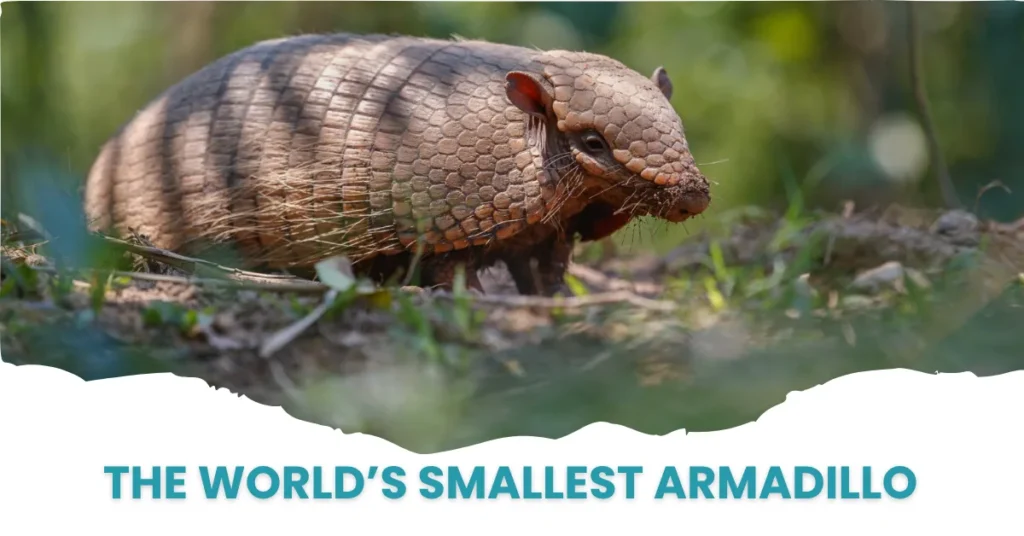

Most people have never seen a pink fairy armadillo. Not in a zoo. Not in a wildlife documentary. Not even in photos taken in the wild. There is a good reason for that.
This animal spends its entire life beneath the surface of the earth. It comes up rarely, moves fast, and disappears again before anyone gets a proper look. The most experienced local observer in its home range in Argentina had seen just 12 of them across 45 years of living in that area.
So if you are curious about what this animal actually is, how it survives, and why it almost never makes it outside the wild, this guide covers everything science currently knows.
What Exactly Is the Pink Fairy Armadillo
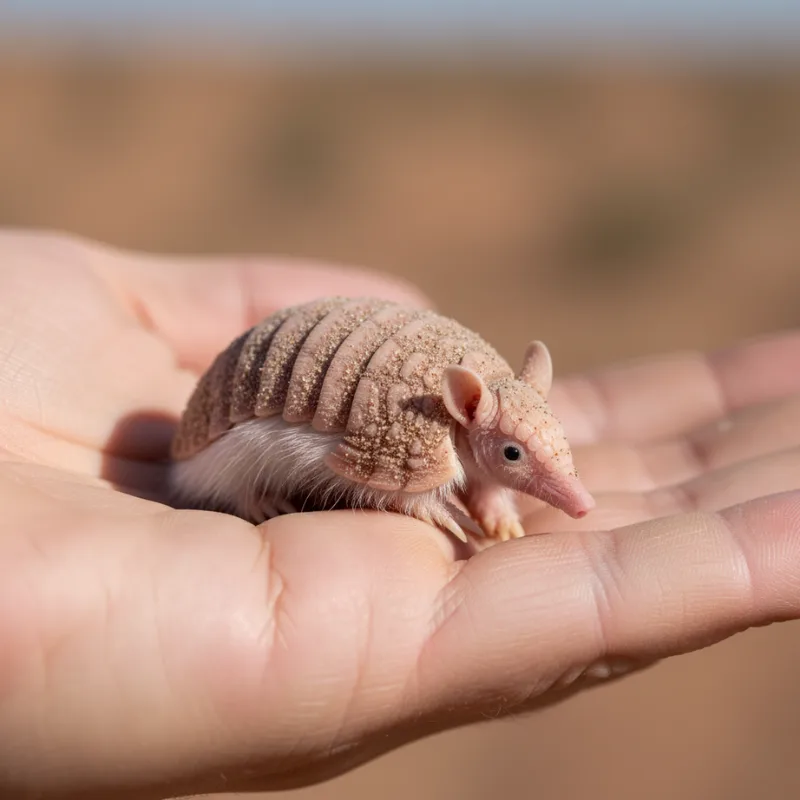
The pink fairy armadillo, known in science as Chlamyphorus truncatus, is the smallest armadillo species alive today. A fully grown adult reaches about 13 centimeters in body length and weighs roughly 120 grams. It fits comfortably in a human palm.
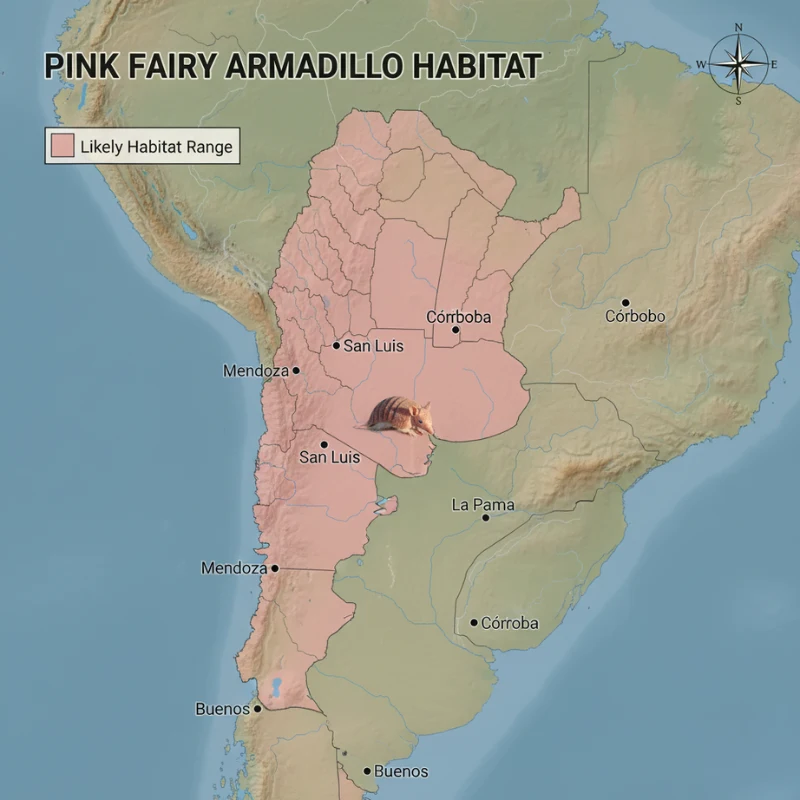
It lives only in central Argentina, in provinces like Mendoza, San Luis, La Pampa, Buenos Aires, and San Juan. Outside this region, it does not exist in the wild anywhere on Earth. Its name comes from the soft pale pink tone of its shell. The fur underneath is long and off-white. People who see it for the first time often struggle to believe it is real.
Quick Reference Table
| Feature | Detail |
|---|---|
| Scientific Name | Chlamyphorus truncatus |
| Body Length | Around 13 cm |
| Weight | Around 120 grams |
| Found In | Central Argentina only |
| Habitat Type | Sandy grasslands and dry scrubland |
| Main Food | Ants and soil insects |
| Active Hours | Night and early morning |
| IUCN Status | Data Deficient |
| Captivity Survival | Rarely more than a few days |
| Main Predators | Feral cats and domestic dogs |
Where It Lives and Why That Location Matters
Its habitat is not a preference. It is a strict requirement that defines its entire survival.
Why Sandy Soil Is Non-Negotiable
The pink fairy armadillo needs one specific environment: loose, dry, sandy soil. Not clay. Not packed earth. Sandy ground it can move through quickly and dig into without resistance. This is why it stays in the semi-arid grasslands and scrublands of central Argentina, where the soil is light enough to burrow through and dry enough that tunnels do not flood.
Why Rainfall Acts as a Natural Border
To the east, rainfall increases and soil becomes heavier. The animal cannot survive where the ground stays wet because its burrows collapse or flood. This natural border limits how far its range can spread. It lives at elevations from sea level up to 1,500 meters, as long as sandy soil conditions are met.
What It Looks Like Up Close
Every physical feature of this animal connects directly to its underground lifestyle.
The Shell and How It Connects to the Body
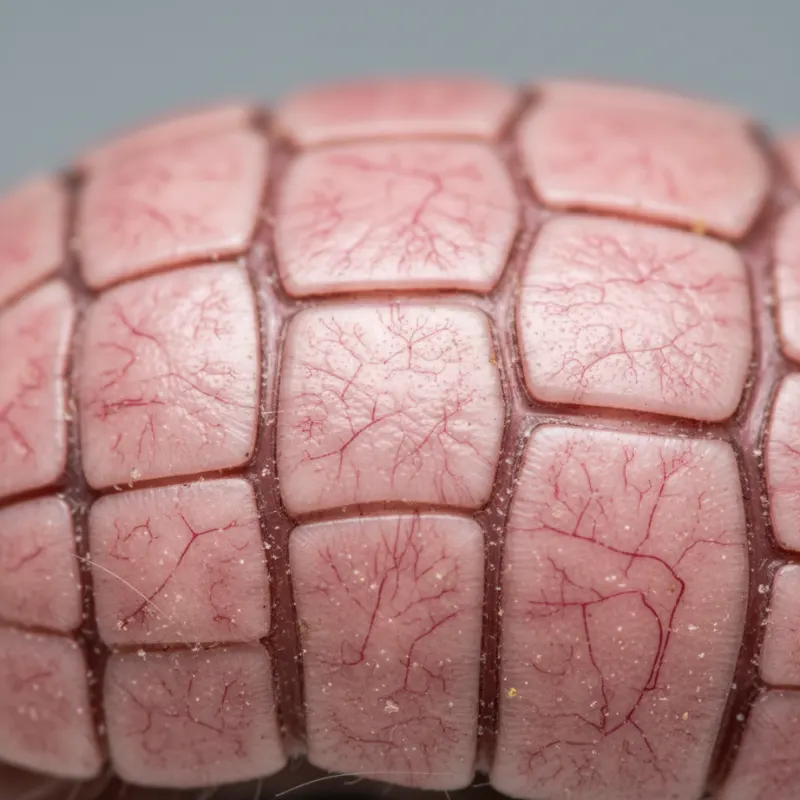
The body is shaped for moving through soil with minimal friction. Scientists call this fusiform, meaning streamlined and tapered at both ends. The shell sits on top of the back, connected to the body only along a thin strip down the middle of the spine. Because that attachment is flexible, the animal can twist underground without the shell restricting movement. The shell has 24 bands, and at the rear a flat diamond-shaped plate helps compact soil behind it while digging.
Claws, Eyes, Ears, and Fur
The front claws are large, noticeably out of proportion with the rest of the body. These drive the digging. The back legs provide the pushing force. There are no visible external ears. The eyes are small and poorly developed. Both features are standard in animals that live underground, where touch and smell matter more than sight or hearing. The fur beneath the shell is yellowish-white and long, providing insulation for an animal whose metabolic rate runs 40 to 60 percent lower than expected for its body size.
How It Digs and What the Burrow Does
Digging is not just a skill for this animal. It is the foundation of everything it does.
The Mechanics of Burrowing
The front claws break into soil first. The animal drives itself forward with back legs while the tail plate presses sand backward, keeping the tunnel from collapsing behind it. The streamlined body shape means it meets minimal resistance as it moves forward.
What the Burrow Is Actually Used For
The burrow is where it sleeps, hides from predators, forages for insects, and stays at a stable temperature. When threatened above ground, it can vanish into loose sand within seconds. This speed is effective enough that even experienced researchers rarely get a sustained look at one.
For a broader look at unusual burrowing species, the Petnicki guide to animals starting with A covers many more animals with similarly specialized survival strategies.
What It Eats
Its diet is simple, specific, and almost entirely sourced underground.
Primary Food Sources
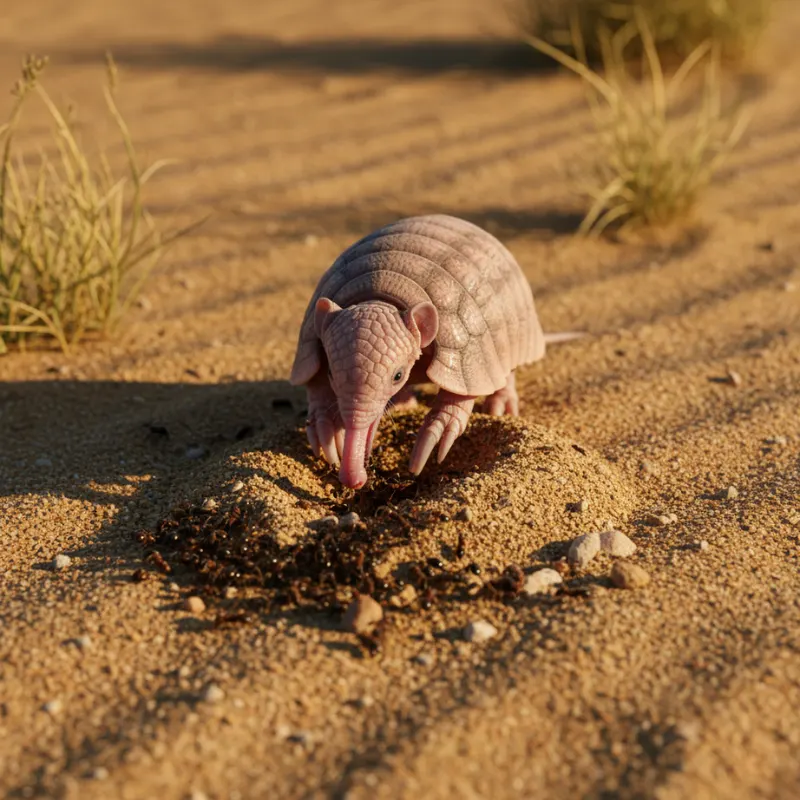
Ants are the main food. The pink fairy armadillo digs through ant colonies and feeds on both ants and their larvae. It also eats other soil insects and worms. When insect populations drop, it consumes plant roots and vegetation, making it technically omnivorous depending on conditions.
How It Gets Water Without Drinking
It has never been observed drinking water in captivity. Researchers believe it extracts moisture directly from food, a known desert adaptation called metabolic water use. All foraging happens at night, guided by smell and the sensitivity of its claws underground.
Its Behavior and Activity Patterns
Very little behavior has been directly observed. What researchers know comes mostly from rare sightings and a small number of captive records.
Nocturnal, Solitary, and Hard to Track
The pink fairy armadillo is active at night and around dawn and dusk. During daylight it stays underground. Every individual ever recorded has been alone, which strongly suggests it is a solitary species. In cold or harsh conditions, it likely enters torpor, a state of reduced metabolism and activity, consistent with its unusually low basal metabolic rate.
The Screaming Behavior in Captivity
One captive specimen showed a striking response: whenever objects in its enclosure were rearranged, it ran around making a screaming sound. Whether this is a stress signal, a warning call, or something else entirely, researchers are not certain. What it clearly shows is that environmental change causes severe distress in this species.
Why the Shell Is Pink
The pink color is not decorative. It comes from blood vessels running very close to the outer surface of the carapace. This allows the shell to act as a heat-exchange surface. When the animal needs to release heat, blood flow increases toward the surface. When it needs to conserve warmth, circulation near the surface reduces. This is a practical adaptation for an animal moving between stable burrow temperatures and variable surface conditions.
Why It Dies in Captivity So Quickly
This is the most important question for anyone thinking about conservation or the pet trade.
The Four Core Reasons
The pink fairy armadillo almost always dies within days of capture. It needs loose sandy soil at all times. Without it, the behaviors that regulate its stress and temperature break down immediately. Its diet of live soil insects cannot be replicated in captivity. It is highly sensitive to any environmental change, and the compounded stress of capture, transport, new surfaces, and human presence is consistently fatal. No zoo in the world keeps this species. The IUCN Red List lists illegal pet collection as a recognized and growing threat, separate from habitat loss.
Conservation: Where Things Stand
The situation is more serious than the current classification suggests.
IUCN History and Declining Sightings
The IUCN currently classifies the pink fairy armadillo as Data Deficient. This does not mean it is safe. It means population data is too thin to assign a formal threat level. The classification history tells the real story: not listed before 1996, listed as Endangered in 1996, Near Threatened in 2006, and Data Deficient from 2008 onward. Sightings have declined steadily since before 1995. The area with the most frequent observations records only two to three per year.
Active Threats Right Now
- Large-scale farming clears and compacts the sandy grassland it depends on
- Pesticide use reduces ant and insect populations that form its food supply
- Livestock grazing packs soil too firmly to burrow in
- Climate change shifts rainfall patterns, affecting soil conditions and burrow stability
- Feral cats and domestic dogs continue to expand into its range
- Illegal pet collection removes individuals that almost never survive capture
Argentina has protective legislation for this species. Enforcement in remote grasslands is genuinely difficult.
Frequently Asked Questions
Is the pink fairy armadillo actually real? Yes. It is a documented mammal species first formally described in 1825. It lives underground and avoids the surface, which makes it extremely rare to observe.
Why can it not survive as a pet? It needs sandy soil to burrow into, live soil insects to eat, and a completely stable environment. None of these can be provided in captivity. Nearly every individual removed from the wild dies within days.
What does Data Deficient mean for this species? It means researchers do not have enough population data to determine whether the species is stable or declining. It is not a reassuring status. Available evidence, particularly the drop in sighting rates, points to real pressure on the population.
What are the biggest threats to the pink fairy armadillo? Agricultural habitat loss, pesticide use, soil compaction from livestock, climate-driven rainfall changes, feral cat and dog predation, and illegal collection for the pet trade.
Could climate change wipe it out? Researchers consider it a serious possibility. This species needs very specific soil and moisture conditions. Shifts in rainfall directly affect whether its burrows remain viable.
Has anyone ever photographed one in the wild? Very rarely. The few photographs that exist came from chance encounters. The animal disappears underground too quickly for planned photography to be realistic.
Conclusion
The pink fairy armadillo is not famous. It does not appear in wildlife documentaries. It does not survive in zoos. Almost nobody who studies it has seen more than a handful in their entire career.
It is a very small mammal with very specific needs that took millions of years to develop. It needs sandy soil, ants, and the ability to burrow undisturbed. When any of those conditions breaks down, it does not adapt. It dies.


