
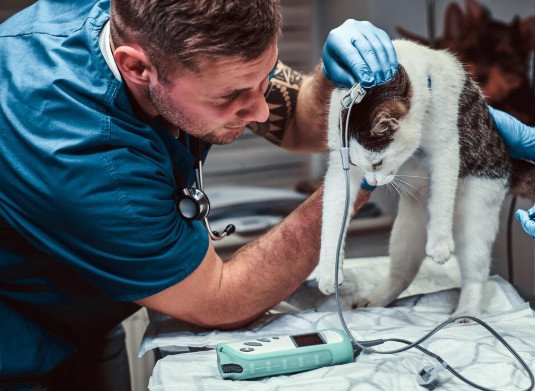

Your veterinarian has taken X-rays of your dog and says a specialist will review them. The clinic takes the images, but a radiologist can interpret them from another location without examining your dog in person.
This remote review is called teleradiology. Knowing how it works helps you understand the wait, the report and the questions worth asking.
Key Takeaways
- Your dog must be there for the scan. Imaging happens in person, even when a specialist reviews the images remotely.
- The clinic handles submission. The specialist reviews the images alongside the clinical history and returns a written report to your clinic.
- Your vet explains the results. Your treating veterinarian tells you what the report means for your dog and what, if anything, comes next.
- Emergencies come first. If your dog is struggling to breathe, seek immediate care rather than waiting for a report.
The Scan Comes First
Your veterinarian considers imaging alongside your dog’s physical exam, history and any lab work. That history is one reason regular vet visits matter, since a vet who knows your dog’s normal patterns can more easily spot what has changed.
The scan your vet recommends depends on the question they need to answer. X-rays, ultrasound, CT and MRI provide different kinds of information, so one does not automatically replace another.
| Imaging type | What it does | Where it can help |
| X-rays | Pass through the body to show solid structures and areas of contrasting tissue density | Bones and other dense structures, though X-rays do not reveal every internal detail |
| Ultrasound | Uses sound waves to build images from echoes that bounce off tissues | Organs and soft tissue; it can also guide tissue sampling when a diagnosis needs confirming |
| CT | Uses X-rays to produce cross-sectional images, often described as slices, without overlapping structures | Areas where overlap on a plain X-ray could hide detail |
| MRI | Produces detailed images of soft tissue | Investigating suspected brain or spinal problems |
Preparation varies by scan and by dog. CT often involves sedation or anesthesia, and MRI usually requires general anesthesia, so ask the clinic for instructions on food, water and medications rather than following a general rule.
Getting a scan and having a specialist interpret it are separate services. CT, for instance, may require a visit to a specialty facility, and while the radiologist can review the images remotely, the scan itself must happen in person.
How a Remote Specialist Reviews the Images
For a remote review, your veterinary team sends the images electronically along with your dog’s medical history. The process usually follows four steps.
- The clinic captures the study. Your veterinarian or a technician positions your dog and takes the images, with sedation or anesthesia if needed.
- The clinic sends the files and history. DICOM is a medical image file format that holds the image data, and the clinic also shares your dog’s age, symptoms, exam findings and the question it wants answered.
- The radiologist interprets the study. Radiologists review the images together with the medical history, because that context helps them judge what the findings mean.
- A written report returns to the clinic. Your veterinarian reviews it alongside the exam findings and other test results, then talks you through it.
A clinic may use a veterinary teleradiology service such as RadsForVets, which states that every case is read by a board-certified veterinary radiologist. Clinics submit images by DICOM auto-send or direct upload, with STAT X-ray reports targeted within 1 hour, STAT CT, MRI and ultrasound within 4 hours and Standard reports within 24 hours.
Because services like this work with practices rather than owners, your clinic handles the submission. Those turnaround figures cover the interpretation step only, not the length of your appointment or the timing of your callback.
What the specialist can assess depends on what was captured. Ultrasound interpretation depends on the images recorded during the examination, and remote review cannot fill in views that were never taken.
The clinic also chooses a reporting priority, such as urgent (STAT) or Standard, which affects how quickly the report comes back. Your veterinarian still needs to review it and discuss the findings with you.
Using the Report to Plan Your Dog’s Next Step
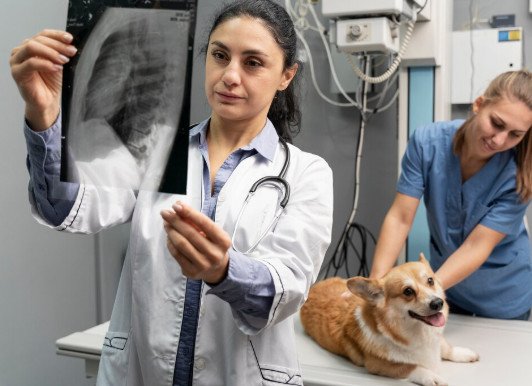
Radiology reports commonly separate findings, an impression and recommendations. Those labels divide what the specialist observed from what it may mean and what to do next, though layouts vary between providers.
Findings. What the radiologist observed, such as sizes, shapes, tissue densities and anything unusual, often in technical terms.
Impression. The radiologist’s interpretation of those observations, including which explanations are more or less likely.
Recommendations. Suggested next steps, which may include no further imaging, another scan or a tissue sample.
An image does not always establish a diagnosis. Ultrasound, for example, can guide tissue sampling for further analysis, so a scan may help your veterinarian plan the next test rather than give a final answer.
When your veterinarian discusses the report with you:
- confirm what the study showed and what it did not establish;
- ask whether further imaging or a tissue sample is recommended, and why;
- agree on a follow-up plan, including who will call and when;
- request an itemized estimate for any proposed next step before agreeing to it.
You can also ask who interpreted your dog’s images and whether a specialist read them.
Conclusion
Remote radiology lets a specialist read your dog’s scans without your dog ever leaving the clinic. Your vet captures the images, the radiologist interprets them and your vet turns the report into a plan you can act on.
Ask questions at every step, and keep the conversation focused on what the report means for your dog. If your dog is struggling to breathe, seek immediate veterinary care rather than waiting for a report or callback.
FAQ
Does my dog need to travel to the radiologist?
No. Your dog is scanned at the clinic or a specialty facility, and the radiologist reviews the images remotely.
Can I send my dog’s X-rays to a teleradiology service myself?
Usually not. These services typically work with veterinary practices, so your clinic submits the case.
How long does a remote radiology report take?
It depends on the provider and the priority your clinic chooses. Urgent reports can come back within hours, while standard reports may take up to a day.
Will the report give my dog a diagnosis?
Not always. A scan may narrow the possibilities and point to a next test, such as a tissue sample, rather than give a final answer.