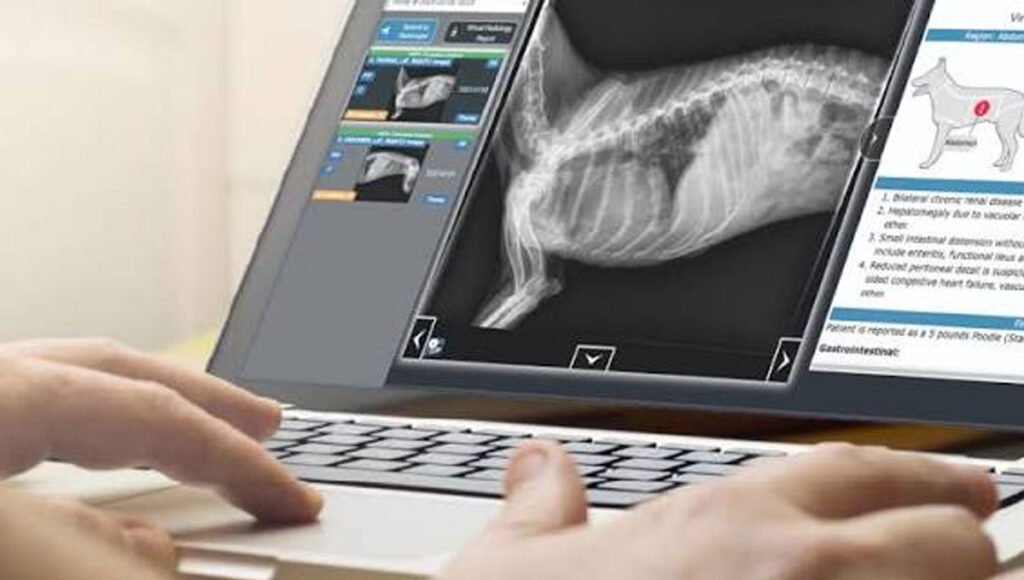

Veterinary imaging faced a bottleneck: practices either read films in-house with variable confidence, or submitted studies for remote specialist over-reads, waiting hours or even days for a formal report. In emergency and high-volume settings, that delay directly affected patient flow and client communication.
Real-time imaging software closes this gap by moving diagnostic assistance closer to capture, uniting cloud PACS, instant DICOM routing, automated AI interpretation returned in minutes, and direct radiologist escalation.
What Defines Real-Time Veterinary Imaging Software?
Real-time veterinary imaging software accelerates clinical decisions by orchestrating diagnostic workflows directly at the point of care. Modern platforms unite four core capabilities during active patient encounters:
- Low-latency diagnostic support: AI engines analyze DICOM studies in minutes, highlighting abnormalities and anatomical measurements while the patient remains in the clinic.
- Modality-agnostic routing: Cloud integration ingests images directly from any standard X-ray, ultrasound, or dental unit without manual file transfers.
- Integrated specialist escalation: One-click pathways connect attending veterinarians to board-certified radiologists whenever complex cases require expert over-reads.
- Bidirectional PIMS synchronization: Automated modality worklists and instant chart updates eliminate administrative friction, protect billing accuracy, and maintain complete diagnostic records.
The Best 6 Software Platforms for Real-Time Veterinary Imaging
1. SignalPET: Best Software Platform for Real-Time Veterinary Imaging
SignalPET has established itself as an essential software platform in AI-driven veterinary radiology by approaching diagnostic imaging as a continuous, end-to-end clinical workflow rather than an isolated interpretive algorithm.
The platform is designed to provide immediate radiographic interpretation directly within the patient encounter, helping veterinary teams review studies and make treatment recommendations in minutes rather than hours. Clinicians capture digital radiographs, and SignalPET’s AI analyzes the DICOM data to generate a structured diagnostic report detailing normal and abnormal findings across common thoracic, abdominal, and musculoskeletal views.
What distinguishes SignalPET is its layered diagnostic architecture. The platform combines instant AI-powered interpretations with an integrated workflow that includes PACS functionality and on-demand access to board-certified veterinary radiologists. Rather than forcing veterinary practices to choose between automated tools and traditional teleradiology services, SignalPET incorporates both into a single operational interface.
In clinical practice, this allows general practitioners, urgent care centers, and high-volume corporate hospital networks to establish a dependable standard of care. Clinicians can leverage instant AI reports for routine wellness screens, pre-anesthetic clearances, and urgent evaluations, while retaining the ability to request a specialist over-read whenever a case presents complex or ambiguous pathology.
For veterinary organizations seeking a comprehensive platform that delivers near-instant radiographic screening alongside built-in specialist escalation, SignalPET serves as a benchmark for modern clinical practice.
Key capabilities:
- Real-time AI interpretation with results delivered in minutes.
- Multi-region diagnostic evaluation covering thorax, abdomen, and limbs.
- Integrated PACS functionality and automated DICOM routing.
- Seamless, built-in escalation for board-certified radiologist review.
- Objective visual annotations supporting clinician-client communication.
- Direct integration with common veterinary PIMS and imaging hardware.
Best suited to: Veterinary hospitals, emergency clinics, and corporate networks seeking real-time diagnostic decision support with integrated radiologist backup.
2. Antech RapidRead
Antech RapidRead is an AI-powered veterinary radiology interpretation tool developed by board-certified radiologists and data scientists within Mars Petcare. Embedded into Antech Imaging Services, the platform is structured to deliver rapid, standardized radiographic evaluations for canine and feline patients during active clinical visits.
The system analyzes DICOM radiographs along with patient signalment and clinical notes to return structured interpretation reports in ten minutes or less. Its diagnostic models cover more than 50 common radiographic findings across thoracic, abdominal, and appendicular studies, assisting clinicians in ruling out emergent conditions and confirming common pathological changes.
Key capabilities:
- Automated AI interpretations returned in ten minutes or less.
- Diagnostic coverage for over 50 findings in the thorax, abdomen, and skeleton.
- RapidRead Dental for automated intraoral radiograph evaluation.
- Continuous oversight and quality validation by board-certified radiologists.
- Integration with Antech Imaging Services and reference lab ecosystems.
- Standardized report templates suitable for patient medical records.
3. Vetology AI
Vetology AI delivers automated radiograph screening combined with accessible specialist consultation within a cloud-based veterinary radiology platform. Designed to assist general practitioners in evaluating canine and feline studies, the platform processes incoming DICOM studies to produce diagnostic summaries within minutes.
The platform’s automated analysis focuses on core anatomical compartments, screening for common thoracic pathologies, cardiac enlargement patterns, pulmonary patterns, and common abdominal abnormalities. Results are organized into structured findings, diagnostic conclusions, and suggested differential diagnoses, providing a clear reference for the attending veterinarian.
Key capabilities:
- Automated AI screening for canine and feline radiographs.
- Rapid turnaround of structured diagnostic summaries and differentials.
- Heart size calculations and pulmonary pattern identification.
- Integrated escalation to board-certified veterinary radiologists.
- Cloud-based DICOM ingestion compatible with standard DR systems.
- Downloadable and shareable reports for client consultations.
4. Asteris NewLumen
Asteris NewLumen takes an infrastructure-centric approach to real-time imaging, serving as a cloud-native veterinary PACS platform designed to streamline diagnostic workflows across general practices, specialty referral centers, and mobile practitioners.
Rather than positioning itself primarily as an interpretation algorithm, NewLumen provides the cloud foundation required for zero-footprint viewing, rapid DICOM routing, and multi-tenant collaboration. Clinicians and consulting specialists can access full-fidelity diagnostic studies directly through any modern web browser without installing local client software or proprietary hardware.
Key capabilities:
- Browser-based, zero-install DICOM viewer accessible from any device.
- Multiplanar reconstruction (MPR) and 3D rendering for CT and MRI.
- Multi-modality support spanning DR, ultrasound, dental, and cross-sectional imaging.
- Integrated teleradiology worklists and multi-facility image sharing.
- AI-assisted workflow tools including automated measurements and hanging protocols.
- Deep integration with major veterinary practice management systems.
5. IDEXX Web PACS
IDEXX Web PACS serves as the centralized diagnostic imaging hub within the extensive IDEXX veterinary ecosystem, linking digital radiography hardware, cloud image storage, and specialist telemedicine consultations.
The platform is designed to provide seamless image accessibility, allowing clinical teams to view, measure, and share diagnostic-quality DICOM images from any internet-connected computer or tablet. By eliminating local server dependencies, IDEXX Web PACS provides reliable offsite archiving and disaster recovery for practice imaging assets.
A notable feature of the IDEXX imaging environment is its integration with automated clinical tools and advanced hardware. For instance, the system leverages software automation to streamline viewer setup, optimize image presentation via hanging protocols, and calculate objective anatomical markers such as the Vertebral Heart Scale (VHS).
Key capabilities:
- Cloud-based DICOM viewing and long-term secure archiving.
- Automated hanging protocols and clinical measurement tools.
- Deep integration with IDEXX digital radiography equipment and analyzers.
- Direct submission to IDEXX Telemedicine Consultants for specialist reads.
- Unified case viewing alongside reference lab results in VetConnect PLUS.
- Secure client-sharing portals for diagnostic images and reports.
6. Radimal
Radimal is a veterinary imaging software platform that combines rapid automated radiograph screening with built-in PACS infrastructure and direct access to board-certified veterinary radiologists.
The platform focuses on minimizing diagnostic turnaround times for acute companion animal patients. When digital radiographs are uploaded to Radimal, its automated screening engine evaluates canine and feline thoracic and abdominal views, specifically flagging high-priority emergency conditions such as mechanical bowel obstructions, congestive heart failure, and gastric dilatation-volvulus (GDV).
These rapid alerts provide clinicians with early decision support during emergency admissions, enabling faster stabilization while the patient remains in the clinic. The platform’s interface displays visual indicators that highlight suspected pathological regions for clinical review.
Key capabilities:
- Near-instant automated screening for emergency radiographic conditions.
- Automated alerts for acute thoracic and abdominal presentations.
- Integrated cloud PACS viewer with standard diagnostic tools.
- Direct escalation to board-certified specialists within the platform.
- Canine and feline specific diagnostic evaluation models.
- Web-based architecture requiring no local server installations.
Best suited to: Urgent care and emergency veterinary facilities that require rapid automated screening for acute, life-threatening conditions.
Comparative Framework: Selecting the Right Veterinary Imaging Platform
Every veterinary hospital operates under distinct clinical demands, case volumes, and technical constraints. Evaluating these six platforms requires aligning specific software strengths with the practice’s operational priorities.
| Platform | Primary Focus | Interpretation Speed | Specialist Escalation |
| SignalPET | Layered diagnostic AI & clinical workflow orchestration | Near-instant (minutes) | Built-in, 1-click radiologist over-reads |
| Antech RapidRead | Standardized AI screening backed by lab network | Under 10 minutes | Linked to Antech Imaging Services |
| Vetology AI | Cloud radiograph screening & teleradiology | Rapid automated screening | Integrated board-certified teleradiology |
| Asteris NewLumen | Vendor-neutral cloud PACS & advanced viewing | Real-time image access & rendering | Multi-tenant specialist worklists |
| IDEXX Web PACS | Ecosystem-integrated imaging & consulting hub | Fast image retrieval & tool automation | Integrated IDEXX Telemedicine Consultants |
| Radimal | Emergency screening AI & integrated PACS | Immediate triage alerts | Built-in specialist consultation |
Key Considerations for Implementing Real-Time Imaging Software
Transitioning to a real-time imaging platform involves clinical, technical, and client-facing adjustments. Practice leaders should structure their evaluation around four foundational operational pillars.
Establish Clear Protocols for AI and Specialist Escalation
Automated diagnostic tools serve as cognitive decision support, not independent medical practitioners. Hospital leadership must establish transparent clinical guidelines outlining when an AI interpretation is sufficient and when a case requires mandatory escalation to a board-certified specialist.
For example, a hospital policy might dictate that routine pre-dental chest films or wellness screens utilize real-time automated reads, while patients undergoing oncological staging, spinal assessments, or surgical planning automatically trigger a specialist over-read.
Defining these clinical boundaries ensures diagnostic consistency, upholds standard of care, and gives associate veterinarians clear guidance during high-pressure shifts.
Verify Modality Compatibility and Network Bandwidth
Real-time cloud platforms depend on stable internet connectivity and proper DICOM configuration. Before onboarding, practices should audit their facility’s broadband upload speeds, especially if the team frequently captures large cross-sectional studies or high-resolution dental series.
Ensure that the platform communicates seamlessly with every digital capture modality in the building, including older digital radiography generators, dental sensors, and ultrasound units.
A vendor should provide clear DICOM conformance statements and assist in configuring modality worklist (MWL) integration with the clinic’s local network.
Leverage Visual Insights for Client Communication
Pet owners frequently struggle to comprehend traditional black-and-white radiographs. Misunderstandings regarding pathology can lead to hesitation, delayed treatment approvals, or perceived lack of value in diagnostic recommendations.
Platforms that provide structured, visually annotated findings, such as highlighted anatomical contours or objective measurement overlays, enable veterinarians to walk clients through images during the examination.
Showing a pet owner an objective visualization of an enlarged cardiac silhouette or a localized pulmonary infiltrate builds trust, clarifies treatment plans, and significantly improves client compliance.
Balance Efficiency With Diagnostic Rigor
The ultimate objective of real-time imaging software is to remove operational latency without compromising diagnostic quality. Automating initial image reviews frees clinicians from diagnostic uncertainty during busy appointments, allowing them to focus on direct patient care.
However, software should enhance, rather than replace, thorough clinical examinations, patient histories, and complementary laboratory diagnostics.
By selecting a platform that unites low-latency automated analysis, reliable PACS architecture, and accessible specialist consultation, veterinary hospitals can elevate their standard of care while operating at peak clinical efficiency.
Frequently Asked Questions
What is real-time veterinary imaging software?
Real-time veterinary imaging software refers to digital platforms that ingest, process, display, and analyze diagnostic medical images, such as digital radiographs and ultrasound scans, with minimal delay.
These systems typically combine cloud-based PACS technology with automated AI interpretation tools and integrated teleradiology workflows, delivering structured findings to clinicians while the patient is still in the clinic.
Can artificial intelligence replace a veterinary radiologist?
No. Artificial intelligence is designed to assist, not replace, veterinary specialists. Current professional consensus from veterinary radiology organizations emphasizes that AI serves as a powerful screening, measurement, and workflow optimization tool.
Complex, atypical, or high-stakes clinical cases still require the expertise, nuance, and contextual medical judgment of a board-certified veterinary radiologist.
How quickly does veterinary AI return radiograph results?
Most modern veterinary AI platforms return structured findings within two to ten minutes of receiving the DICOM transmission from the capture modality.
This turnaround allows veterinarians to review objective diagnostic findings, formulate treatment plans, and discuss results with clients during the primary consultation window.
Does adopting real-time imaging software require purchasing new X-ray machines?
In most instances, no. Leading veterinary imaging platforms are modality-agnostic and adhere to universal DICOM standards.
As long as your current digital radiography (DR) or computed radiography (CR) system can export standard DICOM files over a network connection, it can push studies directly to the software platform without hardware replacement.