

Introduction
The letter M covers some of the most fascinating wildlife on Earth. From the mountain gorilla clinging to survival in Central Africa to the mantis shrimp that sees 16 types of color, M animals span every continent, every ocean, and nearly every size imaginable. This guide covers 50 species with their habitats, diets, and the one fact that makes each worth knowing.
What Are Animals That Start With M?
Animals that start with M are species whose common names begin with the letter M. This group spans mammals like the moose and meerkat, marine animals like the manta ray and manatee, birds like the macaw and magpie, and insects like the mosquito and moth. Together, they represent some of the most diverse wildlife on Earth, found on every continent and in every ocean.
Common Animals That Start With M
Monkey
Monkeys are social primates with over 260 recognized species split into two groups: Old World monkeys in Africa and Asia, and New World monkeys in the Americas. They use tools, solve problems, and pass knowledge between generations. The pygmy marmoset is the smallest at 5 inches. The mandrill is the largest at 77 pounds.
Habitat: Tropical forests, grasslands, mountains Diet: Fruits, leaves, insects, small animals
Moose
The moose is the largest member of the deer family. Adult males weigh over 1,400 pounds and stand nearly 7 feet tall. Their antlers grow up to 1 inch per day in summer and can span 6 feet wide. Moose are strong swimmers and wade into lakes to feed on aquatic plants and escape biting insects.
Habitat: Boreal forests and wetlands across North America, Europe, and Asia Diet: Shrubs, bark, aquatic plants
Mongoose
The mongoose is a small carnivore famous for fighting venomous cobras. It is not fully immune to snake venom but has specialized acetylcholine receptors that make it highly resistant. Mongooses live in social groups and communicate through a wide range of calls.
Habitat: Grasslands, forests, and semi-arid regions across Africa and Asia Diet: Snakes, insects, rodents, eggs, fruit
Macaw
Macaws are the largest parrots in the world. Their coloring includes deep blues, bright reds, and vivid greens. They mate for life and crack open hard nuts with powerful curved beaks. Wild populations have dropped sharply because of habitat loss and the illegal pet trade.
Habitat: Tropical rainforests of Central and South America Diet: Seeds, nuts, fruits, berries
Magpie
The Eurasian magpie is one of the few non-mammal species that can recognize itself in a mirror, a sign of self-awareness shared with great apes and dolphins. Magpies also recognize individual human faces and remember them for years.
Habitat: Woodlands, farmland, parks, and urban areas Diet: Insects, small animals, eggs, berries, carrion
Mole
Moles spend about 80% of their lives underground. Their paddle-shaped front feet dig tunnels at surprising speed. Their velvety fur lies flat in any direction, so they can reverse through tunnels without friction. Despite being nearly blind, moles have an exceptional sense of touch and smell.
Habitat: Gardens, meadows, and woodland soil across Europe, Asia, and North America Diet: Earthworms, grubs, insects
Rare and Endangered M Animals
Mountain Gorilla
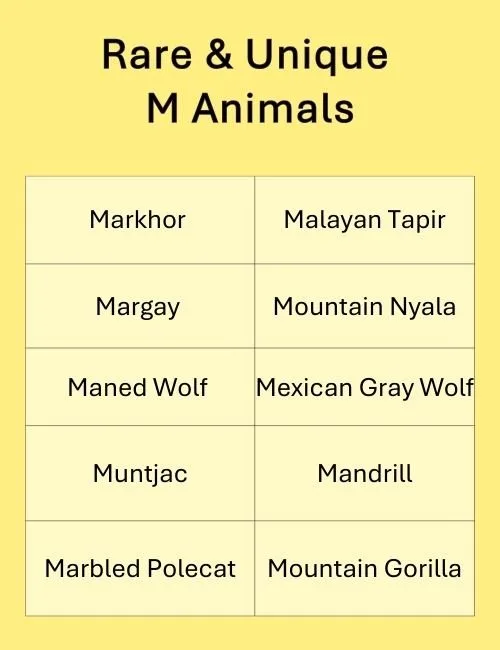
Fewer than 1,100 mountain gorillas remain in the wild today, according to the World Wildlife Fund. They live in the high-altitude cloud forests of Uganda, Rwanda, and the Democratic Republic of Congo. Family groups are led by a dominant silverback male. They use tools and form strong emotional bonds within their groups.
Habitat: Afromontane forests at 8,000 to 13,000 feet elevation Diet: Leaves, stems, roots, fruit
Markhor
The markhor is the national animal of Pakistan. It is famous for its dramatic corkscrew-shaped horns, which can reach 5 feet in adult males. Fewer than 2,500 exist in the wild today. They navigate steep cliffs in the Hindu Kush and Karakoram mountain ranges with ease.
Habitat: Mountainous regions of Central and South Asia Diet: Grasses, leaves, shrubs
Maned Wolf
The maned wolf is not a wolf and not a fox. It belongs to its own genus entirely. Its long legs help it see above the tall grasses of the South American savanna. It raises its black mane when threatened and eats mostly fruit, making it one of the few large predators with a plant-heavy diet.
Habitat: Cerrado grasslands of Brazil, Bolivia, and Argentina Diet: Wolf apple fruit, small mammals, birds, insects
Mexican Gray Wolf
The Mexican gray wolf was declared extinct in the wild in 1980. Captive breeding programs saved the species. Reintroduction efforts in the American Southwest and Mexico have slowly rebuilt its numbers. It remains one of the rarest mammals in North America.
Habitat: Mountain forests and grasslands of the southwestern USA and northern Mexico Diet: Deer, elk, rabbits, small mammals
Marine and Aquatic Animals That Start With M
Manatee
Manatees are gentle, slow-moving marine mammals often called sea cows. They graze on seagrasses and eat up to 10% of their body weight in plants daily. Boat strikes are one of the biggest threats to their survival. All three manatee species are listed as vulnerable or endangered.
Habitat: Shallow coastal waters and rivers in the Caribbean, Amazon basin, and West Africa Diet: Seagrasses, aquatic plants
Manta Ray
The manta ray is the largest ray in the world, with a wingspan reaching up to 23 feet. It filter-feeds by swimming open-mouthed through the water to collect plankton. Manta rays have the largest brain-to-body ratio of any fish and visit reef cleaning stations where smaller fish remove parasites from their skin.
Habitat: Tropical and subtropical oceans worldwide Diet: Plankton, small fish, fish eggs
Mantis Shrimp
The mantis shrimp strikes with one of the fastest and most powerful punches in the animal kingdom, fast enough to shatter aquarium glass. Its eyes can detect 16 types of color, polarized light, and ultraviolet spectrum. No other known animal sees the world the way a mantis shrimp does.
Habitat: Tropical coral reefs and shallow marine environments Diet: Fish, crabs, mollusks, worms
Moray Eel
The moray eel hides in reef crevices and has a second set of inner jaws that shoot forward to grip and pull prey deeper into its throat. Moray eels constantly open and close their mouths to breathe, which makes them look aggressive even when resting calmly.
Habitat: Coral reefs and rocky coastlines across tropical oceans Diet: Fish, octopus, crustaceans
Insects and Small Creatures Starting With M
Mosquito
The mosquito is the deadliest animal group on Earth by human deaths caused. Only females bite, using blood protein to produce eggs. Mosquitoes transmit malaria, dengue fever, Zika, and yellow fever, responsible for over one million human deaths per year globally.
Habitat: Every continent except Antarctica, near standing water Diet: Plant nectar (both sexes); blood (females only, for reproduction)
Moth
There are roughly 160,000 known moth species, far outnumbering butterflies. Moths are nocturnal and serve as important pollinators for night-blooming plants. Their wings are covered in microscopic scales that create color and texture.
Habitat: Every habitat on Earth except polar regions Diet: Nectar (adults), plant matter (larvae)
Millipede
Millipedes do not have 1,000 legs. Most species have between 40 and 400. They eat decaying plant matter and play a key role in returning nutrients back to the soil. When threatened, they curl into a tight spiral and release a chemical repellent that irritates predators.
Habitat: Moist soil and leaf litter in forests and gardens worldwide Diet: Decaying leaves, wood, fungi
Complete M Animals Reference Table
| Animal | Type | Found In |
|---|---|---|
| Monkey | Mammal | Africa, Asia, Americas |
| Moose | Mammal | North America, Europe, Asia |
| Mongoose | Mammal | Africa, Asia |
| Macaw | Bird | Central and South America |
| Magpie | Bird | Europe, Asia, North America |
| Mole | Mammal | Europe, Asia, North America |
| Mountain Gorilla | Mammal | Central Africa |
| Markhor | Mammal | Central and South Asia |
| Maned Wolf | Mammal | South America |
| Mexican Gray Wolf | Mammal | Southwest USA, Mexico |
| Mountain Nyala | Mammal | Ethiopia only |
| Manatee | Marine Mammal | Caribbean, Amazon, West Africa |
| Manta Ray | Marine Animal | Tropical Oceans |
| Mantis Shrimp | Marine Animal | Tropical Reefs |
| Moray Eel | Marine Animal | Tropical Reefs |
| Moon Jellyfish | Marine Animal | Coastal Oceans Worldwide |
| Mudskipper | Fish | Indo-Pacific, West Africa |
| Mosquito | Insect | Worldwide |
| Moth | Insect | Worldwide |
| Millipede | Arthropod | Worldwide |
| Musk Ox | Mammal | Arctic |
| Mountain Lion | Mammal | Americas |
| Meerkat | Mammal | Southern Africa |
| Marmot | Mammal | Europe, Asia, North America |
| Magellanic Penguin | Bird | South America |
Endangered M Animals: Conservation Status
Many M animals face serious threats from habitat loss, climate change, and illegal hunting. According to the IUCN Red List, here is where key species currently stand:
| Animal | IUCN Status |
|---|---|
| Mountain Gorilla | Endangered |
| Mexican Gray Wolf | Endangered |
| Mountain Nyala | Endangered |
| Malayan Tiger | Critically Endangered |
| Manta Ray | Vulnerable |
| Manatee (West Indian) | Vulnerable |
| Markhor | Near Threatened |
| Mekong Giant Catfish | Critically Endangered |
Protecting these animals requires habitat preservation, anti-poaching laws, and global awareness. Each species on this list plays a specific role in its ecosystem. When one disappears, the effects ripple through the entire food chain.
FAQs About Animals That Start With M
Which M animal is the largest? On land, the moose is the largest, weighing over 1,400 pounds. In the ocean, the manta ray holds that title with a wingspan of up to 23 feet.
What is the rarest animal starting with M? The Mexican gray wolf and mountain gorilla are among the rarest, with critically small wild populations remaining today.
Which M animal is most dangerous to humans? The mosquito causes more human deaths than any other animal on Earth through the diseases it carries and transmits.
What M animal has the most unusual ability? The mantis shrimp can see 16 types of color and strikes fast enough to break glass. No other animal has vision or striking power close to it.
Are there M animals found in only one country? Yes. The mountain nyala lives only in Ethiopia. The Malayan tiger exists only in Malaysia and parts of Thailand.
Final Thoughts
Animals that start with M cover an extraordinary range of life on Earth. From the self-aware magpie to the ocean-gliding manta ray, from the nearly extinct mountain gorilla to the common mosquito, each species has a unique role in its ecosystem.
Many of these animals face real threats today. Learning about them is the first step toward understanding why they matter. Explore more wildlife guides and pet care tips to keep building your knowledge of the natural world.